Saturday, January 31, 2009

"I just try and refresh folks memory by way of illustration."

One of my favorite movies about filmmaking is The Five Obstructions (von Trier and Leth, 2003). It is a non-fiction film in which director Lars von Trier challenges his friend, fellow Danish filmmaker Jørgen Leth, to remake his 1967 short film "The Perfect Human" five times, each time under different constraints. For example, once Leth must remake the film with no shot longer than 12 frames (half a second), another time he must make the film as an animated cartoon. Each time Leth remakes the film, he approaches the same material from a slightly different angle thereby revealing a different aspect of the infinitely complex truth of the human condition.

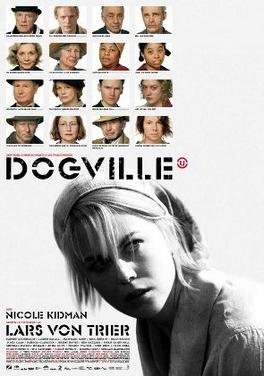
Today I was watching von Trier's own film from the same time period Dogville (von Trier, 2003), and it struck me that von Trier's entire English language career (his Danish language films are another story) has been a Five Obstructions-style series of remakes. Von Trier keeps remaking the same movie a female Christ-figure -- a pure-hearted woman who suffers unjust torments in order to save someone she selflessly loves. In Breaking the Waves, von Trier challenged himself to shoot the film in a hyper-realistic hand-held camera style; in Dancer in the Dark he remade the story as a musical; and in Dogville he remade the film on a single sound stage without any sets in the manner of Thornton Wilder's Our Town or a Bertolt Brecht play.

The strange thing is that Dogville ends quite differently than the previous films it is remaking. In the earlier films, the suffering woman is eventually killed but brings a kind of redemption through her death. These are clearly New Testament sort of stories. At first Dogville seems to be following the same narrative, but in its last ten minutes the story suddenly turns Old Testament: a God-like gangster shows up and convinces the film's Christ-figure to choose judgment over forgiveness. I'm not sure what to make of this. Is von Trier repudiating the earlier films? Or is he merely showing us another aspect of the infinitely complex truth?

At one point, the philosopher-novelist character says he is writing a story based on the events of the film. When he adds that he hasn't come up with a good name for the town yet, the heroine asks him why he doesn't just call it Dogville. He replies: "It wouldn't work. It's got to be universal." Well, if the movie we're watching is called Dogville, does that mean it isn't (and isn't intended to be) universal? So perhaps the point of the film is not to reject forgiveness and mercy entirely but to remind us that grace is not the whole story: there is judgment and justice, too. Rather than read Dogville as a critique of the Gospel narratives, perhaps we should read it as a retelling of the Sodom and Gomorah narrative: God sends an angel to the town but the people rape her and so God destroys the town. This isn't the prettiest story in the Bible, but it is still in there and must be reckoned with.

Starting from this reading it is tempting to see the film as von Trier's reaction to the terrorist attacks of September 11, 2001. (This was von Trier's first film made after 9/11.) Perhaps, like Jeremiah Wright and Jerry Fallwell, von Trier is interpreting the terrorist attacks as God's judgment on the United States. Especially in light of the closing credits which plays David Bowie's "Young Americans" over images of American crime and poverty, combined with the film's Prologue about the philosopher's attempt to teach the town a lesson about their inability to receive good gifts, von Trier seems to be saying that God has given the U.S. grace upon grace but we have not provided God's gifts with a hospitable place in which to live and bear fruit. And if we persist in our inhospitality we will face God's wrath.

Fortunately this is only one aspect of the infinitely complex truth. Instead of following the townspeople of Dogville, we might instead follow the selfless heroines of Breaking the Waves and Dancer in the Dark. We might choose to take the world's suffering on ourselves and to transform it into an opportunity for love.

Thursday, January 29, 2009

"Hand of God, that bible stopped a bullet."

This week I watched a couple of heist genre movies: Mission Impossible III (Abrams, 2006), and Heist (Mamet, 2001). It occured to me that heist movies suggest various positions on divine Providence.

In many recent heist movies, there is an elaborate, twist-filled plot which makes it seem that the robbers are facing various set-backs until in the final scene the criminals seeming complications are revealed to have been part of their plan all along. Perhaps the best classic example of this plot is The Sting (Hill, 1973). Recent examples include the Ocean's Eleven (Soderbergh, 2001) and Inside Man (Lee, 2006).

What is interesting about the two movies I saw this week is the way they deviate from the conventional plot. In The Sting et al, seemingly unforseen events occur throught the film, but the heroes turn out to have been in control of these events all along. These movies could be read as a symbol of Providence -- God is in control even if we can't initially see how. But in Mission Impossible III (actually in all three of the Mission Impossible movies), it turns out in the end that the villain -- not the hero -- was actually in control of the seemingly random events all along. This a pessimistic vision of a kind of dark Providence. More interestingly, in Heist there are real set-backs, though the heroes manage to be successful in spite of them. Here we have a world of real contingency where there seems to be no providence at all: genuinely random things happen of which no one is in control.

That writer-director David Mamet knows his film is dealing with (the lack of) Providence is seen in these lines, thrown away in a quiet moment in the middle of the film: "We knew this firefighter, this trooper, who always caried a bible next to his heart. We used to mock him, but that bible stopped a bullet. ... Hand of God, that bible stopped a bullet, would of ruined that fucker's heart. And had he had another bible in front of his face, that man would be alive today." In Mamet's world, shit just happens, and even miracles are random and meaningless.

Tuesday, January 27, 2009

"These are the fittest, well-fed, best-kept horses I've ever seen."

Recently actor Liam Neeson was a guest on The Daily Show With Jon Stewart. He was supposed to be there to discuss his new movie, but the interview ended up focusing on a local New York City political debate about the horses used to pull carriages around Central Park. Stewart maintains that animals "would rather run" freely than pull carriages and deserve "a better life" in a "pastoral existence". But Neeson argues that domestic animals like cows and horses have "been trained for thousands of years" to do this work and actually enjoy it. Neeson's suggestion is that domestic animals can actually be fulfilled by their work (when given humane working conditions) in the same way that humans can be fulfilled by their jobs.

I couldn't get the embed function to work, but you can watch the video here. (The relevant discussion starts at 1:40 and ends at 5:04.)

Neeson's view reminds me of C.S. Lewis's argument in The Problem of Pain that it is the human vocation to domesticate all animals. In contrast to what he calls “atheistical thought” which sees wild animals as natural and domestication as artificial, Lewis argues (based on God's command in Genesis 1:28 to "subdue" the earth and "have dominion" over the animals") that the tame animal is “in the deepest sense, the only ‘natural’ animal – the only one we see occupying the place it was made to occupy".

For a reconstruction of Lewis's view see my essay "Animal Pain and the Community of All Creatures" (esp. p. 10ff) available on my website.

Monday, January 5, 2009

"If you want more meaningful art, build a more meaningful world."

I found myself with some time to kill in a bookstore recently. Mostly I read philosophy and theology books, but brick-and-mortar bookstores rarely carry a very good selection of such books. I have to go to Amazon to find most of the stuff I'm looking for. So I often turn to the periodical section to kill my browsing time.

This time I ended up reading the Nov/Dec 2008 issue of Adbusters magazine. I've been a fan of the Adbusters anti-capitalist artwork (such as the image above), but I've never read the actual magazine. There were several really interesting articles in this issue.

The first one that caught my eye was about pop art (foreshadowed by Ducham's dadaism) as a critique of American capitalism's implicit nihilism. Author Sarah Nardi quotes Warhol as saying he "wanted to paint nothing" and Murakami as saying he tries to "express hopelessness." You can read the article here.

But a more thought-provoking article was "Virtual Morality" by Andrew Tuplin. Tuplin explores the phenomenon of violent video games such as Gand Theft Auto and amoral virtual worlds such as Second Life. These and other computer programs allow users to act out violent and sexually deviant fantasies.

Tuplin points out that the Enlightenment conception of morality (which most Americans have) is more or less libertarian: the purpose of morality is only supposed to allow us to pursue our own freely chosen goals while preventing us from hurting others in the process. In short, something is morally wrong only if it harms someone. And "harm" is defined as doing something against someone's will. Note that on this view it is conceptually impossible to "harm" oneself (as long as you are not acting out of some sort of confusion or insanity such as addiction). So for those with this conception of morality, there could be nothing wrong with acting out fatasies of rape, torture, pedophilia, etc. if these fantasies are simulated and do not harm any actual person.

Then Tuplin argues that religious ethics can provide an alternative to this view. According to Tuplin, religious ethics teaches that something is wrong if it offends God and that God is offended by our thoughts and desires as well as our actions. On this view, it is morally wrong even to want to rape or torture whether you act on those actions or not. So for those who have this conception of morality, there is no significant difference between virtual and actual behavior.

Now, I see what Tuplin is going for. The subtitle of his essay asks the question "Are we free to do anything we want in a virtual world, or are some things inherently wrong?" So he is attempting to reject the ethical view called "consequentialism" according to which something is wrong only if it harms someone. Instead he want to affirm a form of "deontology" according to which actions are inherently right or wrong regardless of their consequences. But he doesn't seem to understand that one need not be religious to affirm deontological ethics.
And he doesn't seem to understand that one need not hold to a divine command ethics in order to be religious. Historically, the majority of Christian theologians have rejected the sort of ethics Tuplin calls "religious". Indeed, I would argue that, it is logically incoherent to think that morality is based on what offends God.

But Tuplin is on to something when he says "The humanist or secular view of morality is concerned only with what we do. True religious morality is concerned not only with what we do, but with who we are, with what we desire to do." If we disregard his characterization of the two views as religious vs. secular, Tuplin has indeed given us a good alternative to Enlightenment ethics. The point is that for pre-Enlightenment views morality is as concerned with character as with behavior. (Note that this was the view of the Greek philosophers and is not essentially tied to religion.)

The important difference between this view and the Enlightenment view is that morality is not simply about preventing harm to others, but involves preventing harm to oneself. "Harm" on this view is doing something against an ideal, not simply doing something against one's will. This is a health model of morality. If you act in a way that is not healthy (i.e., it is not living up to the ideal of human nature), then you harming yourself and are acting immorally even if you don't harm anyone else.

This view gives us a way to criticize violent and sexually deviant fantasies: it is an abuse of one's own character to have immoral desires even if one never acts on those desires.

Thursday, December 25, 2008

"What's Christmas but a time for finding yourself a year older and not a day richer?"

I'm with my in-laws for Christmas, and last night I got raked over the yule log for suggesting that children should be taught not to care about getting presents for Christmas. I was arguing that Christians especially should be brought up to reject consumeristic celebration of the secular holiday (call it Festivus, if you wish, though I'm not referring to the Seinfeld holiday) on which American children worship the false god named Santa Claus. Though not in so many words, I was more or less accused of being a Scrooge.

Tonight we're watching Scrooge (Neame, 1970), the best musical version of A Christmas Carol, and it struck me that it's the American consumer culture that is Scrooge, not me. Modern Christmas is the triumph of the Scrooges over the Dickensian sentiment.
I don't know how I missed it before, but A Christmas Carol is obviously an anti-corporate screed. It is a critique of Scrooge, a capitalist who refuses to give his employees fair working conditions: no living wage, no eight hour working day, no five day work week, no vacation days, no day off for Christmas, etc. Scrooge hates Christmas, not because he hates people in general (as the musical version would have it), but because Christmas is bad for business. He is being asked to give Bob Cratchit a day off with pay and to give money to various charities. He thinks the whole holiday is a scam by lazy poor people to get money out of hard working rich people. But in the 20th Century, Scrooge got his revenge. He managed to turn Christmas into a money-making business. Even if he has to give people a day off from work, he still makes a profit because he has made their celebration of the holiday all about getting and spending.

I don't have it in for celebration of what Dickens calls the spirit of Christmas. In fact, Dickens's point seems to be that the spirit of Christmas is to be generous to those less fortunate than yourself. (The ghost of dead businessman Jacob Marley tells Scrooge that "'Tis mankind should be our business, though we [capitalists] rarely attend to it.") And I don't even have it in for making merry -- decorating trees, dancing, driking, exchanging gifts. I've written on this blog about my theory of Christian art as redemption of secular culture, and that's what most of our Christmas traditions are about: baptizing pagan rites for Christian purposes. But there are some things that can't be redeemed. Violence is one of them. Consumerism is another. When you try to sell Christmas, the pagan (in this case, American capitalist) element wins, and the Christian attempt at redemption is overwhelmed.

So I say a hearty "Humbug!" on Scroogified gift-centered capitalist Christmas. And wish you instead a truly Dickensian semi-socialist merry Christ-Mass.

Sunday, December 14, 2008

"Only in theory do we begin to suspect the power of aesthetics to shape our lives."

I was in the doctor's office waiting room this week, and I happened to pick up an old issue of The New Yorker from back in June. I was pleasantly surprised to find an essay by Tobias Wolff about a time when he saw Bergman's Winter Light at a church screening in Oxford. I really liked Wolff's optimistic reading of the film:
Bergman takes care to show that Tomas and the fisherman are not alone in their suffering, and that others, equally afflicted—the fisherman’s wife, the pastor’s steadfast lover, his hunchbacked assistant—are able to bear their pain into a still deeper faith and capacity for love.
This is how I want to read Winter Light. It is an unexpected affirmation of faith, not a rejection of faith as it is normally read.

But the point of the essay is not really about Winter Light. It is about the importance of art and beauty. After seeing the film, Wolff says he "felt harrowed, crust broken, buried things churning to the surface." At that point in his life Wolff was an atheist, but he was open to hearing what the minister might say about the film. Until the minister put up a slide of William Holman Hunt's painting "The Light of the World" which Wolff found "garish, melodramatic, cloying in its technique and sentimentality". Wolff ended up continuing in his life as a disbeliever until, years later, he discovered the poetry of George Herbert, Gerard Manley Hopkins, and T.S. Eliot.

Wolff concludes:
We like to think of our beliefs, and disbeliefs, as founded on reason and close, thoughtful observation. Only in theory do we begin to suspect the power of aesthetics to shape our lives.
But he notes that not everyone experiences beauty in the same way. A friend of his who was with him at the Winter Light screening was converted by the Holman Hunt painting that put Wolff off. His encounter with the painting put him on a path that eventually led him to being a missionary in Africa. Peggy Rosenthal over at the Image Journal interprets this as a lesson about the power even bad art can have to point us toward truth:
We must admit that in our popular culture plenty of bad art stirs people to genuinely good religious faith, a faith that issues in loving actions and a Christ-like spirit.
I'm not sure that's quite right. This is a lesson about the importance of context. Wolff writes that "the contrast between Bergman’s severe, honest art and this painting, on the same screen, chilled me" (my emphasis). I actually don't hate the Holman Hunt painting. I think it does have a (perhaps simplistic) kind of beauty. But I can see how in juxtaposition to Bergman's film it would come off banal. So why didn't Wolff's friend notice this jarring juxtaposition? The context of film appreciation is not entirely external. It is internal and subjective, too. We bring our own context to the work.

If all we look at is the objective context of the chapel in Oxford on a night in the winter of 1970, then all we see is the contrast between Winter Light and Holman Hunt. But if we could see into the heart of Wolff's friend, we could see why he was able to experience the beauty of the painting while for Wolff that small beauty was outshone by the brilliance of Bergman's film. Every object has some beauty in it, and every beauty has some truth. And the power of beauty's truth is so strong that it can work even through less than brilliant artworks. I guess I'm ultimately saying the same thing as Rosenthal: even lesser art can shape our lives for the better.

Thursday, December 11, 2008

"This is the website of John McAteer."

I haven't had much time for blogging lately. I've been busy applying for jobs. To that end I have created a website with my professional and personal info as well as samples of my philosophical, religious, and film writings.

Feel free to check it out at http://www.filmphilosopher.com/.