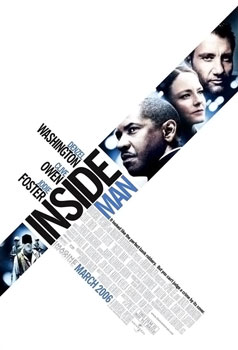
 Today I mention my most recent Bollywood viewing, Dil Se (Ratnam, 1998) -- a Hindi title translated "With My Whole Heart". I watched it this week after Netflixing Spike Lee's Inside Man (Lee, 2006). I enjoyed Inside Man as a Hollywood thriller, though as Roger Ebert points out in his review, the plot is completely unbelievable. But the plot is twisty enough to be entertaining for a couple of hours. What really makes the movie worth watching, though, are the fun characters. The actors are clearly having a great time with the improvisational dialogue, and their enjoyment is infectious.
But, for me, the single most memorable thing in the film is the song under the opening credits: "Chaiyya Chayyia" from Dil Se. It makes no sense thematically to open Inside Man with a Bollywood song, but on the DVD commentary, Spike Lee said he just "likes" it. You can see the song in its original context here:
 As you can see for yourself, the music in Dil Se (by the incomparable A.R. Rahman) is excellent. As for the rest of the movie ... well, not so much. Dil Se is one of those new generation Bollywood movies that wants to be taken seriously as art. It is aesthetically and thematically ambitious. Like Inside Man, it is an exploration of complicated and morally ambiguous characters. And that would be all well and good, if the movie didn't seem to be ashamed of its traditions. I have no problem with social commentary as long as it doesn't get in the way of pure fun that a Bollywood movie is supposed to be. In other words, Dil Se could have learned a lesson from Inside Man. Spike Lee managed to insert his trademark racial commentary into the film without distracting from its pulpy genre charms.
Too many young Bollywood directors don't seem to actually like Bollywood movies. They are always complaining that audiences/studios require them to make every movie a melodramatic musical. These films usually still have musical numbers, but (as in Dil Se) the songs seem perfunctory and disconnected from the main action. They could be cut (as the directors wish they would be) without losing anything. Instead of embracing the Bollywood genre elements audiences love, these young directors try to make "serious" movies that end up being just bad versions of American independent movies. They lose their unique Indian flavor. We have plenty of pretentious wannabe Sundance filmmakers. What India has to offer the world is cheesy Bollywood fun.
There are some great scenes in Dil Se. For example, the opening scene at the train station is a nice vignette. It ends with the line I used as a title for this post: "Duniya ki sabse choti prem kahani hogi." Hindi for: "must be the world's shortest love story." It works beautifully. But when the love story starts to aspire to epic proportions -- in this case, Romeo and Juliet meets the suicide bomber drama Paradise Now -- its reach exceeds its grasp. In the end, Dil Se is an interesting failure with wonderful music. Inside Man would have suffered the same fate if it hadn't kept its pretentious under control.