Showing posts with label Maggie. Show all posts

Friday, May 8, 2009

"To progress by moving backwards"

I was walking down the street the other day and saw someone pushing a Bugaboo Cameleon stroller. Bugaboo is one of the hippest brands of stroller, largely (I think) because it is the most expensive brand. Personally I prefer both Stokke and Quinny strollers. (Both are only slightly less outrageously priced than the Bagaboo. We were lucky enough to get a gently used Quinny for Maggie at half the list price.) But if I had to buy a Bugaboo, I'd go for the "Cameleon" model. In one of its configurations it transforms into an old-school British-style pram. (The Cameleon is pictured to the left, and an antique pram is pictured to the right.)

This is great example of retrofuturistic design. I discussed retrofuturism in my earlier post on the movie Steamboy. By the way, the current Wikipedia article on retrofuturism has got it wrong. That article limits the use of the term "retrofuturism" to nostalgic representations of what past eras thought the future would look like. For example, if Old Navy started selling silver jump suits, that would be retrofuturistic. And that is definitely one common use of the term. But, as Wikipedia itself notes, the term was originally coined by conceptual artist Lloyd Dunn who used it to mean "the act or tendency of an artist to progress by moving backwards." Dunn was an early practicioner of what has come to be called mashup in which parts of several existing artworks are combined to form a new artwork. Here is an excellent article about the history of the term, written by people who worked with Dunn. The article explains that:


Retrofuturism is an idiom in which expressions are constructed, as in any natural language, out of pre-existing conventional elements. The machine arts (photography, xerox, audiotape, video, etc.), like the work of the contemporary language poets, coin new "words" like no other media in history. Because they are mechanistically reproductive, they also conventionalize and codify information. Conventionalized material, like the cliché (a form of verbal shorthand which collapses entire narratives, often into a few syllables) becomes the raw material for for the construction of new metalogic expressions. Artworks are also complex, like real words, which have an internal syntax all their own. Retrofuturist artworks do them one better by being like sentences, recursive collections of (themselves) recursive words; all parts of which exhibit syntactic structure (and play with it) to express new thoughts (and old ones in novel juxtapositions).

So in its broadest use "retrofuturism" is just another name for "mashup". In its more common use, retrofuturism means the use of design conventions and clichés from past artistic periods to present something that looks modern, even futuristic. This is the way the Museum of Contemporary Art used the term when it applied it to a show of car designs by J Mays (the artist who designed the new VW Beetle, Ford Mustang, and Ford Thunderbird). (You can read more about the show and see some pictures here. And you can get a good sense of what Mays is doing if you compare the 1955 Thunderbird seen here with the 2002 Thunderbird seen here.) And this is what the Bugaboo pram is doing.

Seeing this retrofuturistic pram also made me realize that this is what the emerging church is doing, too. (See my earlier post on the emerging church and/as avant garde.) Having realized that the church's links to philosophical modernism has left it theologically bankrupt, emerging theologians are attempting to return to premodern ancient and medieval theology for resources in constructing a postmodern theology. (Hence such formulations as "ancient-future faith".) In other words, they are looking to the past to find a way to move forward. In still other words, the emerging church is retrofuturistic religion.

Tuesday, July 29, 2008

Maggie and Daddy

Yesterday I lamented that I can't get out to the movie theater with my newborn baby.

Here's why it's all worth it...

Monday, July 28, 2008

Thank God for DVD

So it looks like the first casualties of life-with-a-newborn are Wall-E and The Dark Knight. We were able to make it out to the theater a couple of times in the early weeks after Maggie was born, because she used to sleep all the way through them. But now she's awake a lot more and unable to make it through the whole movie.

It looks like we'll have to wait to see these two movies on DVD. I've heard a lot of great things about both of them, but I am especially sad about The Dark Knight since I wrote my first professional academic paper on the themes of fear and revenge in Batman Begins. I'm excited to see how director Christopher Nolan elaborates on these themes in the sequel. But it may be a few months before I find out.

For now there's Netflix.

Tuesday, June 10, 2008

Christian Art as Redemption of Culture

With Baby Maggie here now, I've been home a lot more lately than I have in a while. And I've been looking at my art collection more than I have before.

"Collection" is a bit of an exaggeration. I only own two pieces of original art (as well as a signed print of The Promised Land by Nelson de la Nuez). One is by Amanda Tan, a Los Angeles based artist and personal friend of ours. (You can see a couple of examples of Amanda's art here (you need to scroll down a bit), and here. The Tan piece we have is the most like the piece you can view here.

Our other original artwork is by Robin Zimmerman, a student of mine from Biola. Robin's piece is the one that has been capturing my attention lately. It's in my bedroom where, before I had a baby, I only really spent time when I was asleep. Now I hang out in there a lot trying to get the baby to sleep, so I've been able to contemplate it anew.

The Zimmerman piece (see image to the left) is an icon of St. Francis painted in chocolate (milk, dark, and white). The gold background is made from candy bar wrappers (Twix, I think she said). And the flesh tones were highlighted with caramel. (A year and a half since its creation in late 2006, the chocolate elements of the artwork have held up nicely, but the caramel has begun to run due to gravity.)

The chocolate icon was Robin's final project for an Aesthetics class I taught. In that class we talked a lot about the Incarnation of Christ as an affirmation of the original goodness of creation and an act of redemption of the world. This is a somewhat radical point at an Evangelical school like Biola where students are constantly given subtle Gnostic-like messages about the inherent evil of the world. (I think most Evangelicals unwittingly hold to a kind of Docetist theory of the Incarnation.) But more radically, I was suggesting an Eastern-Orthodox influenced soteriology according to which the Incarnation (and Resurrection) are at least equally significant (and possibly more significant) for our redemption than the Crucifixion. According to the Evangelical "penal substitution" view of salvation, the whole point of the Incarnation was to get Jesus killed as a sacrifice for our sins. But on the alternative Orthodox "theosis" view, Jesus's life (not just just death) is itself an act of salvation. As St. Athanasius put it, "God became human so humans could become gods."

Throughout the class, I argued that Jesus's life was like a piece of performance art meant to embody the Word of God (AKA "the Way, the Truth, and the Life") on earth. (This is certainly the way the author of the Gospel of John sees Jesus's life. Consider his use of the word "sign" to refer to miracles and other acts of Christ.) I also argued that the Christian liturgy is a piece of performance art in which the Church participates in Christ's redeeming work, constituting the continuing life of his Body on earth. Finally I argued that the vocation of Christian artists is to use their painting, music, dance, writing, etc. to also engage in this redeeming work of embodying the Kingdom of God on earth.

Now the language of "redeeming" suggests an interesting mode of art-making for Christians. To "redeem" something is to "buy it back". We "redeem" pawned items, financial bonds, or coupons. So "redemption" is an economic term for trading it a marker for something of genuine value. Metaphorically, then, Christ is buying us back from the devil's pawnshop -- from our slavery to sin, error, and death.

What, then, would it look like for an artist to "redeem" something? How might an artist take something from God's good creation which has been enslaved to a dying culture, cut off from the life-giving presence of God, and translate it into the Kingdom of God where it can live again? (Writing this sentence I am reminded of Heidegger's theory of art as "unconcealing" nature's true reality so that it can finally be itself instead of disappearing into modern mechanistic culture where it is used up in service of human beings' shallow goals.)

One way this sort of redemption might look is Robin Zimmerman's Chocolate St. Francis. What Robin has done is to take an "icon" of American slavery -- candy, whose empty calories exist only to enslave us to gluttony, and whose role in the economy is only to reinforce our consumerist addiction to buying what Fight Club's Tyler Durden calls "shit we don't need" -- and transform it into an icon of Christian freedom -- St. Francis, who is known not only for his ability to see God in nature, but (more relevantly) for introducing the vow of poverty into Christian monasticism. Robin has taken something that had belonged to the devil and redeemed it for the Kingdom of God.

Another of my favorite examples of this tactic is the work of St. Johnny Cash with Rick Rubin's American Recordings record label from 1994 until Cash's death in 2003. Cash's five albums recorded during this time consisted mostly of covers of rock songs. But somehow when Johnny Cash sang the same lyrics, their meaning completely changed. An obvious example is his cover of Depeche Mode's "Personal Jesus". Originally it was the song of a lover to his beloved. But in some indefinable way Cash makes it sound like Jesus Christ's song to a lost sinner.

But the most artistically successful of the American Recordings covers is "Hurt", originally by Nine Inch Nails. If you haven't seen it, check out the music video by director Mark Romanek here. Consider the chorus of the song:

What have I become?
My sweetest friend
Everyone I know
Goes away in the end
You could have it all
My empire of dirt
I will let you down
I will make you hurt

Hearing Trent Reznor sing these lyrics in the original version of the song, they are the cries of a depressed young man whose heroin addiction has driven away all his friends so that he declares everything he has achieved to be worthless. But when Johnny Cash sings these exact same lines, they seem to echo the message of Ecclesiastes: an old man at the end of his career declaring "all is vanity". (Romanek draws this theme out by setting the video at the run-down Johnny Cash museum "The House of Cash".) When Cash laments the loss of his friends, it is their deaths that he has in mind. (Again Romanek is insightful: on the line "my sweetest friend" we see an image of Cash's wife June Carter who died shortly after the video was shot.) And most importantly, the "you" to whom he is giving all his achievements is God.

In this way, Cash has redeemed a song about nihilistic despair, turning it into a song about the vanity of fame and the need to give one's life to God. And that's what Christian art is all about.

Monday, June 9, 2008

Maggie's First Movie


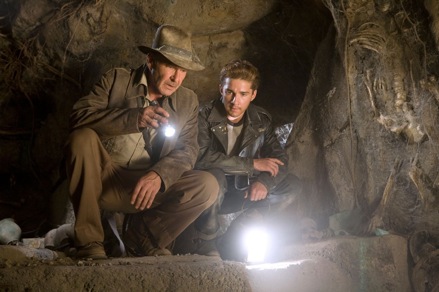
We just got back from taking six-day-old Maggie to her first movie: Indiana Jones and the Kingdom of the Crystal Skull (Spielberg, 2008).

Maggie slept through the whole thing, but I thought it was awesome. The movie itself was harmless fun without much artistic or philosophical interest -- nowhere near as cool as Speed Racer (see my post on that film here.) But it was really amazing to be at the movie theater with my daughter on our first outing away from home since she was born.

It was especially appropriate that out first cinematic experience was a movie about an iconic Hollywood hero meeting his son. I look forward to many more father-daughter movie matinees.

Thursday, June 5, 2008

Maggie Sue is here!

Margaret Susanna McAteer was born at 10:55am on June 3, 2008. She weighed 7 lbs and was 19 inches long. Both she and her mother are in perfect health.

Pictures are coming soon! For now, enjoy these pictures of her namesakes St. Margaret of Scotland and Susanna Wesley.