Showing posts with label abortion. Show all posts

Wednesday, October 29, 2008

"Abortion confronts the Christian with the most perplexing questions of all."

This election season many Roman Catholic and Evangelical voters have found themselves attracted to Democratic candidate Barack Obama. At the same time, many of these religious voters feel conflicted because of Obama's pro-choice stand on abortion. That Evangelicals could support a Democrat at all is surprising, of course, because Evangelicalism has, for the past 30 or so years, wed itself tightly to the Republican party. But, for some Evangelicals and Roman Catholics, it is simply too much to ask to forsake the pro-life commitment that the Replublican party has used to gain the loyalty of the "Religious Right" for so long.

In light of this controversy, religious supporters of Obama have given some interesting arguments for Obama. For example, my wife posted about this issue on her blog and received some nice responses. Some pro-life advocates have explicitly argued in favor of Obama, too. But one of the most interesting arguments has come from Obama's running mate Joe Biden who has recently pointed out that Roman Catholic dogma on abortion has shifted throughout the centuries.

Catholic historian Frank Flinn has a nice article on the Church's changing attitudes toward abortion. He explains that it wasn't until 1869 that the pope declared abortion to be absolutely forbidden during all stages of pregancy. Before that, the fetus was not considered a person until the moment of "quickening" (i.e., the moment the mother first feels the baby move in her womb) which usually happens in the middle of the second trimester. Flinn even quotes Anselm as saying: "No human intellect accepts the view that an infant has the rational soul from the moment of conception"!

I suppose the argument here is that if even the supposedly infallible Roman Catholic Church has changed its mind over the centuries about when a fetus becomes a human person, then this is a question too hard for the American government and should be left up to individual people. It's the same point Obama was making when he told Evangelical leader Rick Warren that this question was above his "pay grade". One could reply (as did Biden's own Bishop) that when the Church changes its teaching, the later teaching is always better than the earlier teaching. But this reply would seem to undermine the whole point of conservatism which teaches that "traditional" (i.e., older) teachings are always better. This was the point I was making in my earlier post about same sex marriage. Conservatives can't argue that we should accept the "traditional" view of marriage, because on the traditional view wives are property of their husbands and the possibility of polygamy was assumed: men can own as many wives as they can afford. Here again the conservative argument from tradition doesn't support Evangelical and Catholic positions.

Now, I knew this stuff about the Catholic Church's evolving position, but when I read it again it got me wondering about Evangelicals. Has there been any shift in Evangelical understandings of abortion? A few minutes with Google reveals that there has been.

In 1968 Christianity Today sponsored a symposium on issues of birth control and abortion. And what happened? Evangelical leaders of the day got together and decided ... to be pro-choice. Follow this link for the published summary of the symposium along with some responses. Below are some of the most interesting passages, along with my comments in italics:
  • "Abortion confronts the Christian with the most perplexing questions of all: Is induced abortion permissible and if so, under what conditions? If it is permissible in some instances is the act of intervention still sinful? Can abortion then be justified by the principle of tragic moral choice in which a lesser evil is chosen to avoid a greater one? As to whether or not the performance of an induced abortion is always sinful we are not agreed, but about the necessity and permissibility for it under certain circumstances we are in accord." -- i.e., abortion is always tragic, but sometimes it is the best choice in a bad situation. Note also the assumption that we should approach the question of abortion with humility -- i.e., we should remember that the answer is above our pay grade.
  • "The Christian physician will advise induced abortion only to safeguard greater values sanctioned by Scripture. These values should include individual health, family welfare, and social responsibility." -- i.e., it is permissible to have an abortion if you think you won't be able to care for the child.
  • "The Christian maintains that in avoiding legalism on the one hand and license on the other, the prescriptions of legal codes should not be permitted to usurp the authority of the Christian conscience informed by Scripture." -- i.e., the choice of whether to have an abortion should be left to the individual, not mandated by the government.
  • "Physicians are called upon to maintain and restore the health of the whole [human being]." -- i.e., abortion may be necessary for the mental (not just the physical) health of the mother.
  • "We live in a world pervaded by evil. Human relationships become distorted; unwanted children are born into the world; genetic defects are not uncommon and harmful social conditions abound. Therefore, it is the duty of Christians to be compassionate to individuals and to seek responsibility to mitigate the effects of evil when possible, in accordance with the above principles. When principles conflict, the preservation of fetal life or the integrity of the human body may have to be abandoned in order to maintain full and secure family life." -- i.e., there are many kinds of cases in which abortion may be necessary: cases of "distorted" relationships such as rape or incest, cases of "genetic defects", cases of "harmful social conditions" such as poverty, cases in which the mother's bodily "integrity" is threatened such as when her life or health is in jeapardy, and even in cases of "unwanted" pregnancy. Note that many of these cases are spelled out in more explicit detail elsewhere in the report.
So this is a fairly standard pro-choice document. It is also a clearly pro-life document -- what? you can be pro-life and pro-choice at the same time? -- but while affirming the value and sanctity of all human life from the moment of conception, the document's drafters understand that in this fallen world hard choices must sometimes be made. And those choices can't be made for us by government officials who don't know the specifics of our case and try to create blanket rules that apply to everyone. Its a document I think Obama could agree with.

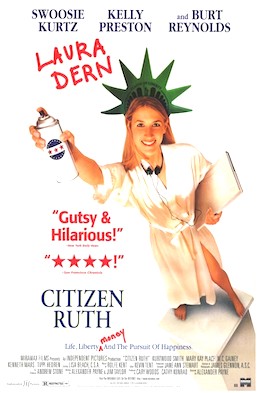
The document actually reminds me a lot of one of my favorite movies on the topic of abortion: Citizen Ruth (Payne, 1996). The movie satirizes both sides of the culture war, indicting both pro-life and pro-choice activists for their mutual failure to treat the women involved as actual human beings rather than pawns in a political battle. (There's a key scene toward the end where the two sides are so involved in screaming at each other about what is in Ruth's best interests that they don't notice her walking away from the whole mess.) In 1968 Evangelicals were the compassionate people writer-director Alexander Payne would one day challenge us to be with his film. But by the time he actually made his film in 1996, Evangelicals were just the butt of his jokes.
Sunday, October 5, 2008

"Abortion is murder!"

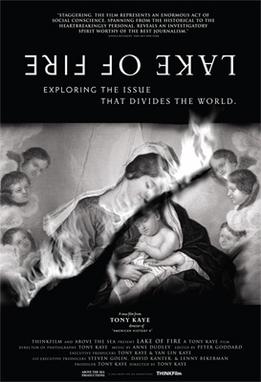
When I return to teaching, I plan to assign my students to watch the abortion documentary Lake of Fire (Kaye, 2006). Along with the Jewish homosexuality documentary Trembling Before G-d, it's one of the most stimulating movies I've seen about a contemporary ethical issue. And, like movies such as Waking Life and My Dinner With Andre, the film is made up almost entirely of philosophical discussion, priming the audience's intellectual pump for class discussion.

One caveat I have about the film, though, is that I don't think students will be able to digest the material without expert commentary. Much of the footage is presented without editorial comment -- there is no narrator and very few on-screen titles -- and hence lacks any sort of context and ends up being misleading.

Because of this lack of commentary, most reviews of the film claim that it is fair to both sides of the debate -- something unusual in the abortion contoversy. But I didn't find the film to be fair and openminded at all. Filmmaker Tony Kaye is not unbiased -- he's obviously pro-choice. I actually have a hard time understanding why anyone would miss this point. Why would reviewers think Kaye is anything but pro-choice? Surely professional film critics don't need the director to come right out and say he is pro-choice before they can detect his viewpoint. (Maybe they've seen too many Michael Moore movies!)

A more charitable interpretation of the critical blindspot is that since the film includes graphic footage of late-term fetuses, perhaps reviewers were led to think Kaye is sympathetic to the view that abortion is murder. After all, these fetuses look exactly like post-birth babies, and hence exactly the same sort of footage is used in many anti-abortion propaganda movies. (This, by the way, is one of the misleading scenes. The fetuses are clearly in their second-trimester of development. But without being told that almost 90% of abortions take place in the first-trimester when the fetus looks more like a sea monkey than a baby, viewers might think that all aborted fetuses look like this.)

Another reason people may mistakenly believe the film is ambivalent is that, in part because of the graphic footage but also because it presents such an array of voices from every side of the debate, the film is so unsettling that it creates a kind of ambivalence in the viewer. It's not that Kaye doesn't know what he thinks about abortion or that he keeps his own viewpoint hidden in the film -- it's that after watching the film, you no longer know exactly what you think about abortion. And that's the most significant aspect of the film. It's also one of the most pro-choice aspects of the film. The film wants to convince us that this is a hard issue that is not as black and white as it is usually presented in political debates. Therefore, the film suggests, we should leave the choice about abortions up to individuals.

Another caveat: I'm not sure the film is primarily a debate about abortion at all. It is a documentary about the people involved in the abortion debate. And it's mostly about fundamentalist Christians who believe that abortion doctors should be assassinated. In some ways, the film is presenting a philosophical challenge to pro-life advocates, asking them "if you agree that abortion is murder, then what makes you different than these extremists?" (Again, I don' t think the film is even trying to be unbiased.) It's a fascinating question: if abortion really is parallel to the holocaust, then why shouldn't pro-lifers declare open war on abortionists like the Allies declared on the Nazis?

Brett McCracken, an Evangelical reviewer, misses this challenge. He complains in his Christianity Today review that the film "purposefully avoids featuring any thoughtful, articulate, or moderate Christians". From the rest of the review, I have to assume that by "moderate", McCracken means a Christian who condemns abortion as murder but also condemns the murders of abortion doctors. While this may be true, the film nevertheless presents the positions of moderate Christians, while putting them in the mouths of extremists. And what this move does is make the extremists look like they have some good points and that they are not (entirely) crazy. So I actually take this to be a rhetorical virtue of the film.

Moreover I reject McCracken's definition of "moderate Christian". I think any view according to which abortion is obviously murder is a pretty conservative one. A truly moderate Christian is one who admits that this is a hard issue about which the Bible has little to say, and who is willing to allow diversity of opinions about abortion. A liberal Christian is one who simply accepts the pro-choice viewpoint as obviously true.

McCracken seems to think that what separates his own (supposedly "moderate" view) from other "fundamenatlist" or "expremist" views, is that he is not interested in forcibly converting nonbelievers. He complains that the film makes all pro-life advocates look like "mindless pawns in a larger and more malicious march toward theocracy". In other words, the film assimilates anyone who votes against abortion rights to the "reconstructionist" viewpoint that the laws of the United States should be revised to match the laws of the Old Testament so that, for example, anyone who uses the Lord's name in vain should be put to death. (Someone in the film actually gives this example!)

Again, McCracken's observation is true: the film does attempt to blur the line between extremist theocrats and more moderate run-of-the-mill pro-life Republicans. But again this is a virtue of the film. I think a strong case could be made (though the argument is left implicit in the film) that anyone whose position on aborion legislation comes from their Christianity and not from publically shared reasons is, indeed, a theocrat. (This point is even more clear when it comes to the issue of gay marriage.) The fact that McCracken is so defensive suggests that, on some level, he knows this critique to be on target.

It's this ability to challenge us to rethink the implications of our deeply held beliefs about abortion that I think is the film's biggest philosophical strength. Without the Socratic ability to recognize that we lack wisdom, we have no hope of escaping the unproductive torment of the "lake of fire" the abortion controversy has devolved into.