Showing posts with label evil. Show all posts

Tuesday, January 27, 2009

"These are the fittest, well-fed, best-kept horses I've ever seen."

Recently actor Liam Neeson was a guest on The Daily Show With Jon Stewart. He was supposed to be there to discuss his new movie, but the interview ended up focusing on a local New York City political debate about the horses used to pull carriages around Central Park. Stewart maintains that animals "would rather run" freely than pull carriages and deserve "a better life" in a "pastoral existence". But Neeson argues that domestic animals like cows and horses have "been trained for thousands of years" to do this work and actually enjoy it. Neeson's suggestion is that domestic animals can actually be fulfilled by their work (when given humane working conditions) in the same way that humans can be fulfilled by their jobs.

I couldn't get the embed function to work, but you can watch the video here. (The relevant discussion starts at 1:40 and ends at 5:04.)

Neeson's view reminds me of C.S. Lewis's argument in The Problem of Pain that it is the human vocation to domesticate all animals. In contrast to what he calls “atheistical thought” which sees wild animals as natural and domestication as artificial, Lewis argues (based on God's command in Genesis 1:28 to "subdue" the earth and "have dominion" over the animals") that the tame animal is “in the deepest sense, the only ‘natural’ animal – the only one we see occupying the place it was made to occupy".

For a reconstruction of Lewis's view see my essay "Animal Pain and the Community of All Creatures" (esp. p. 10ff) available on my website.

Sunday, November 2, 2008

"You can't mend the heart in a heartless world by observing that the world is in fact heartless."

Here are some nice reflections on the problem of evil by Andrew Brown, columnist for the British newspaper The Guardian:
"In the end, I suppose, my objections to God are, as they must be, theological: the workings of divine providence are just a little too inaccessible to human reasoning. The problem of suffering remains insoluble. There is no possible theodicy. But I can't, either, take the Dawkinsian view that the problem of suffering is an illusion generated by the illusion of God. You can't mend the heart in a heartless world by observing that the world is in fact heartless. That's not the point. I suppose I end up saying that I accept the Christian account of the problem; I just can't accept Christianity's account of the solution, and so I remain, by the grace of God perhaps, an atheist."
You can read the whole essay here. (Thanks to Episcopal Cafe's "The Lead" for pointing me to it.)

I really like his criticism of Richard Dawkins. And I am sympathetic to his view that there is no solution to the problem of evil -- sometimes I'm tempted to agree. But I wonder what exactly Brown takes to be "Christianity's account of the solution".

I'm a Christian theologian (more or less), and I'm still trying to figure out what sort of theodicy Christianity actually teaches. There have been many different theodicies offered by Christians throughout history. And even the Bible suggests different responses to evil. I don't find it at all obvious which theodicy (if any) coheres best with the majority of other fundamental Christian theological committments.

If there's one thing I am fairly sure of (given my reading of the relevant Biblical texts such as Job, the Psalms, Revelation, etc.) is that the best response to evil is going to have something to do with worship of God generally and in particular the liturgy of the Eucharist. (Then again, I tend to think that everything has something to do with the Eucharist!)

The centrality of worship (prayer, liturgy, communion, etc.) for our response to evil is something the best cinematic theologians have realized. I have already discussed Bresson's Diary of a Country Priest (see my earlier post) on this topic. Here let me just mention the work of Ingmar Bergman, perhaps the filmmaker most obsessed with the problem of evil. There are hints of Eucharistic themes in The Seventh Seal (Bergman, 1957) and The Virgin Spring (Bergman, 1960). But the theme becomes most prominent in Winter Light (Bergman, 1962) whose story takes place in and between two celebrations of the Eucharist.

One could argue that Bergman intended these films as a critique of the idea that worship can provide an adequate response to evil. (For a really good analysis of The Seventh Seal along these lines, see Steven Greydanus's essay at Decent Films.) But even if it is true that Bergman intended to reject a Eucharistic theodicy, he was unable to keep the truth from shining through his work. In any event, I think Bergman's intentions were more complex than simply rejecting Christianity. He also struggled with the ability of art to respond adequately to evil -- most significantly in Persona (Bergman, 1966), but I don't think he ever quite gave up hope that art could help us go on living.

Unfortunately I don't have time now to give a detailed analysis of Winter Light (I hope to do so in a future post -- this post was supposed to be a simple link to the essay by Andrew Brown!), but I encourage you to watch it for yourself and try to figure out what is going on in the final scene. Has the priest lost his faith? Why does he go through with the liturgy? Is this an optimistic or pessimistic ending? How does the ending relate to the endings of The Seventh Seal and The Virgin Spring? And, most importantly, what can we learn from this film (regardless of what Bergman was trying to teach us) about responding to evil?

Let me know what you think.

Thursday, August 28, 2008

"Is not all religion a contract between man and God?"

One of the recurring themes of this blog is the problem of evil. My first real post was titled "Theodicy at the Movies". But my interests are all of pop culture, not just movies. Today I want to discuss a graphic novel. Comic book auteur Will Eisner coined the term "graphic novel" as a fancy word for a literary comic book. And what's a comic book but a non animated cartoon?

The title piece in Eisner's seminal graphic novel (actually a collection of graphic short stories, but graphic literature in any case) A Contract With God (Eisner, 1978) is an interesting exploration of the problem of evil -- interesting because, like much great literature, it is open to multiple interpretations. Indeed, I would say that the story's ambiguity is its point. Like the problem of evil itself (at least in Eisner's view), the story is a mystery with no solution.

This is a very Jewish bit of theology. One of my favorite things about Contract is the way Eisner sometimes draws question marks in a font that resembles the Hebrew alphabet. Another example of this font is the word "God" on the cover, shown above left. To the right is one point where we see the Hebrew-esque question mark.

It is important that Eisner doesn't always draw question marks this way. He reserves this font for theological questions. Moreover, the only place he uses this Hewbrew font (other than the title) is in these theological question marks. It is as if Eisner sees the essence Hebraic thought as an unsolvable mystery, perhaps drawing on the tradition according to which the word Israel means "he who wrestles with God". And for the Jews, a nation persecuted for thousands of years, this wrestling revolves around the mystery of evil.

Sunday, July 20, 2008

"I have a PhD in horribleness."

Today is the last day you can watch Dr. Horrible's Sing-Along Blog (Whedon, 2008) for free. After today, you'll have to buy it on itunes for $3.99. But for a limited time you can stream it here.

Role-reversal is a common motif in Joss Whedon's work. For example, blond cheerleaders get terrorized by monsters in most horror movies, but Buffy Sommers is a superhero the monsters are afraid of in Whedon's Buffy the Vampire Slayer. Here we get the tragic story of Dr. Horrible in which the evil genius is presented as the sympathetic underdog and his superhero nemesis Captain Hammer is a dim-witted yet pompous boor.

What is fascinating about the movie is Whedon's vision of evil. Dr. Horrible is a geek who talks a lot about undermining the "status quo" in which nice guys finish last. Here evil is seen as the use of violence to make the world into your own image of a better place. Notice that there are two ways this could go. If your image of a better place involves everyone bowing to your slightest wish, you could establish yourself as supreme dictator. This sort of egoistic evil is exemplified in the movie by Bad Horse, the head of The Evil League of Evil. But Dr. Horrible exemplifies a more paradoxical altrustic evil. He wants to take over the world, not so much for personal gain but to create justice. For example, at one point he complains that innocent children might get hurt. In short, Dr. Horrible is a vigilante -- like Batman and other characters usually considered heroes.

But it turns out that Captain Hammer is worse in a certain way. He's not even interested in making the world better. He is himself well off, and so he thinks the world is fine the way it is. He thus exemplifies what you might call egoistic good. The only truly good character -- the altruistic good character for those keeping up with my categories -- is Penny, the love interest. So we hate Captain Hammer and want Dr. Horrible to succeed in defeating him and to "get the girl". And we sympathize with the Doctor's aims while also regretting his methods. This is high tragedy -- note that Penny's true goodness is threatened by the battle between egoistic goodness and altruistic evil.

Dr. Horrible's Sing-Along Blog turns out to be complex and subtle stuff for a musical superhero spoof.

Tuesday, May 27, 2008

“What does it matter? All is grace.”

The opening image of Diary of a Country Priest (Bresson, 1951) is of the eponymous diary. The book opens and we see a black ink blot that resembles a Jackson Pollock painting. This sheet is moved to reveal the words of the diary. The abstract “painting” turns out to be a blot sheet inserted between wet pages to keep the ink from bleeding onto other pages. But the accumulated image created by the words of the diary is an image of chaos and disorder. We see and hear the Priest writing the film’s first lines: “I don’t think I’m doing anything wrong in writing down daily, with absolute frankness, the simplest and most insightful secrets of a life actually lacking any trace of mystery.” The Priest sees his life as insignificant, just another accumulation of events that, when seen over time, only amount to a disordered ink blot. This theme of disorder returns when the priest’s friend Torcy says the job of a priest is to create order: “Keep order all day long, knowing full well disorder will win out tomorrow, because in this sorry world, the night undoes the work of the day.”

The theme of struggling for Justice and order recurs throughout the film. One of the Priest’s first duties is the funeral of a townswoman. Her husband says it is “only just” that he be allowed to bury his wife for free even though everyone is required to pay the same funeral fee. The Doctor says “I’m not one to go around babbling about justice. I don’t expect it for myself. From whom should I ask it? I don’t believe in God.” After the Doctor commits suicide, the Priest wonders about the state of his soul, and Torcy replies “God is the only judge. Dr. Delbende was a just man, and God is the judge of the just.” Chantal comes to him in anger about her father’s adulterous affair with her Governess and says “You know quite well all I ask is justice.” The Countess thinks God’s allowing her son to die was “unjust”.

But the Priest sees himself as a bad priest, unable to create the meaningful order he is called to. In the next scene after Torcy tells the Priest to create order, the Priest says “the simplest tasks are by no means the easiest”. The Priest is constantly criticizing himself for not praying enough, but Torcy tells him “you have the spirit of prayer”. What could this mean?

The Priest’s defining characteristic seems to be the stomach illness that will develop into terminal cancer by the end of the film. The illness prevents him from eating anything but bread and wine, leaving him weak and making the townspeople think he is a drunk. The doctor tells him his stomach problem is the result of his alcoholic mother drinking too much while she was pregnant. Clearly the illness is a metaphor for original sin, passed down from parent to child. And the only solution to the suffering caused by sin is the bread and wine of the Eucharist. But this is something the world will not understand: they will only see the Church as a bunch of hypocritical sinners, rather than a group of sin-sick pilgrims in search of the only medicine that can help them.

Indeed, the film seems to see the priest’s suffering as a sign of his closeness to God. After he receives the anonymous letter telling him to resign from the parish, the Priest stays up all night trying unsuccessfully to pray. He finally concludes “God has left me. Of this I am sure.” And the next scene reports “an incredible improvement in my health”. But the very next scene is the Doctor’s suicide. In response the Priest says “I have never suffered so much and likely never will again, even when I die.” The Priest’s emotional distress is presumably because he himself had considered suicide and the Doctor had told him “You and Torcy and I are of the same race, an odd race. … The race that holds on.” If the Doctor could not hold on, how could he? At the Doctor’s funeral, Torcy told him that the Doctor had “lost his faith, and couldn’t get over not believing”. It is this connection between himself and the Doctor that leads the Priest to suffer. But it is at this point the Priest says he realized he “had not lost my faith”. Apparently, the evidence of his faith and God’s presence is his suffering.

Later he has an epiphany when Torcy again discusses with him what it means to be a priest (or to have a “vocation”): “If you can’t pray, just repeat the words! Listen, I don’t think I’ve been wrong about you. Try to answer this. I’ve thought a lot about vocation. We’ve all received the calling, only not in the same way. And to simplify things, I try to put each of us in his place – in the Gospels. In short, I think – or I imagine – if our soul could drag this wretched body of ours back up that slope of 2,000 years, it would lead it straight to the very place where – ” He breaks off because the Priest is crying. The Priest tells us “The truth is that I always return to the olive grove [i.e., to the Garden of Gethsemane where Christ suffered his most emotional anguish while waiting to be crucified.] It was a very familiar and natural movement for my soul. I’d never realized it until that moment. Suddenly Our Lord had shown me grace and reveled through my old master’s lips that nothing would tear me from my chosen place in eternity. I was a prisoner of the Holy Agony”.

Note that the film’s first shot of the Priest is of his wiping his face (a sign of his physical frailty) and film shot immediately cuts to a shot of the Priest looking through the bars of a metal fence as if he were in prison, thereby establishing the metaphor of his suffering as prison. But note also that the Priest sees “prisoner” here is a good thing, something which keeps him from leaving God. His suffering is the evidence of God’s presence, not God’s absence. His suffering is a symbol of Christ’s suffering: by living, whether he prays or not, he is “repeating the words” of the Gospel. His life of suffering is itself his prayer.

He comes close to this insight earlier in the film when he counsels the Countess to “resign” herself to life’s suffering. The Countess is the first to bring up resignation. She says she is “resigned” to her husband’s infidelities. The Priest tells her it is wrong to send Chantal away, but the Countess doesn’t care about right and wrong: “God took my son from me. What more can he do to me? I no longer fear him.” The Priest replies that God only took her son “for a time” but that her “the coldness of your heart may keep him from you forever.” The Priest implies that the Countess loved her son too much and is allowing his death to come between her and God and hence will ultimately come between her and her son in the afterlife. She wonders how love can be bad, how it could ever separate anyone. Love “has it order, its law” that God himself is subject to since it is God’s nature to love.

Next the Priest points out sin’s ability to bring disorder into the world: “No one knows what can become of an evil thought in the long run. Our hidden faults poison the air others breathe. … I believe if God gave us a clear idea of how closely we are bound to each other in good and evil, we truly could not live.” She asks what is “this hidden sin?” and he replies “You must resign yourself. Open your heart”, implying that her sin is the desire to create order and justice. Rather than getting angry about the evil and disorder in the world, she must resign herself to it. She says, recalling the Doctor’s suicide, she is already resigned; otherwise she would have killed herself. He replies, “That’s not the resignation I meant.” What he wants is her to admit that she hates God for not bringing about what she sees as justice. As soon as she does this, he says “Now at last you are face-to-face. He and you. … You must yield to him unconditionally. … Say: Thy kingdom come, thy will be done.” She says can’t say this, because it would be allowing her son to be dead. But he replies, “The kingdom whose coming you have just wished for is yours and his”, recalling his earlier claim that “there isn’t one kingdom for the living and one for the dead. There is only the kingdom of God, and we are within it”.

Note that the Priest ends up doing exactly the opposite of what Torcy had originally said a priest’s job is: rather than bringing order into the Countess’s life, he gets her to give up the illusory desire for order. She says “an hour ago, my life seemed to me in order, each thing in its place. You have left nothing standing.” He replies “Give it to God just as it is.” When she objects that she is too proud, he says “Give him your pride along with everything else”, recalling his earlier claim that “to die is difficult, especially for the proud”. Eventually she is able to give up her hatred over he son, symbolized by throwing his picture into the fire. As she writes in her letter to the Priest, “I didn’t believe resignation was possible, and in fact it’s not resignation that has come over me. I’m not resigned – I’m happy. I desire nothing.” By giving up her desire for order in the world, she is able to find happiness, a kind of spiritual order within the external disorder. And this leads immediately to her death due to a heart problem, a metaphorical death to this world in order to achieve life in the next.

Later we find out that Chantal had spied on this conversation. But, while she had experienced the very same scene as the Priest, she had interpreted it very differently than the Priest did. When Torcy repeats Chantal’s claim that the Priest had “blackmailed” the Countess with eternal damnation, the Priest says “that’s your version of what happened. I could tell a different one.” Note that had earlier told the Canon (the Count’s Uncle, also a priest) “I don’t see how there could be any report of such a conversation”, suggesting that the truth is ineffable and any account would only be an interpretation.

It is this idea of alternate narratives that is the key to the opening shot of the ink blot sheet. The Priest does indeed share the same motto as the doctor: “face up to it”. But where the Doctor faced up to the disorder of life and interpreted it as a reason to commit suicide, the Priest faced up to the disorder of life and interpreted it as “grace”, the chance to live in “the Holy Agony”. So the Priest does have “the spirit of prayer” but that is because by resigning himself to a life of suffering, he turns his life into a prayer: the re-incarnation Christ’s passion. This is what it truly means to be a priest: to mediate the suffering of Christ to the world and vice versa. The Priest is right that “our hidden faults poison the air others breathe”, but he is also right that “we are bound to each other” in both “good and evil”. Hence the hidden virtue of our suffering purifies the air others breathe.

But this “war” (as Torcy calls it at the Doctor’s funeral), is a mystical and hidden war that requires proper interpretation to be revealed. The last shot of the film is a shadow of a cross that is meant to recall the opening shot of the ink blot. When looking at the diary and its account of the events of the Priest’s life, we might see the very same events as the image of disorder or we might see them as a reflection of Christ’s Holy Agony. The difference is whether we can achieve resignation and the desire for God’s kingdom to come. The film’s last line ought to be our response to the evil, disorder, and suffering in the world: “What does it matter? All is grace”.

Saturday, May 24, 2008

"Light up the darkness."

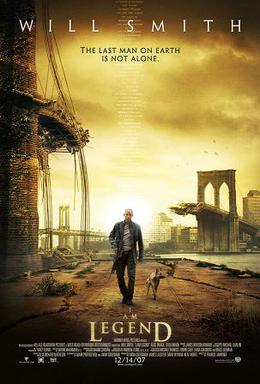
I am Legend (Lawrence, 2007) finally made its way to the top of my Netflix queue this week. I didn't really care if I ever saw it, but my wife thought it sounded good. Ironically (or maybe due to our various levels of expectation), she ended up thinking it was really boring and too slow, and I ended up thinking it wasn't too bad.

I liked the slow, quiet parts of the film that explored the psychology of Will Smith's character Robert Neville. I haven't read the original novel, and I haven't seen the Charleton Heston version The Omega Man (Sagal, 1971), so I couldn't be disappointed in how unfaithful the film was to the earlier versions. And, sure, the special effects are bad and the zombies look like computer generated cartoon characters, but that kind of thing doesn't bother me. I'm more interested in story, character, and theme. So I was pleasantly surprised to find out that the film was about one of my philosophical interests: the problem of evil. Unfortunately, I'm not sure the movie has much to say of philosophical interest.

The movie sets up the problem in its starkest form. When he finally meets another human survivor, Anna, who claims to have been led to him by God, Neville responds by rehearsing the havoc wreaked by the zombie-creating Krippen Virus: "Let me tell you about your 'God's plan'. Six billion people on Earth when the infection hit. KV had a ninety-percent kill rate, that's five point four billion people dead. Crashed and bled out. Dead. Less than one-percent immunity. That left twelve million healthy people, like you, me, and Ethan. The other five hundred and eighty-eight million turned into your dark seekers, and then they got hungry and they killed and fed on everybody. Everybody! Every single person that you or I has ever known is dead! Dead! There is no God!"

Anna wants to take Neville to a colony of survivors, but Neville doesn't believe there is any such colony. Not only is there no God, there are no other humans: we are utterly alone in the universe. But at the climax of the film, Neville does indeed hear the voice of God telling him to sacrifice himself to save the world. He becomes so obvious a Christ-figure that it is literally his blood which will provide the cure to the virus. Then Anna takes the cure to the colony of survivors, giving them hope for the future.

So what's the point? Is it simply that we should not give up hope? That we should have a kind of blind faith that there is a God, that God has a plan, and that we are not alone? Whatever the message of the movie is, it seems to be summed up by Neville's speech about reggae musician Bob Marley: "He had this idea. It was kind of a virologist idea. He believed that you could cure racism and hate — literally cure it, by injecting music and love into people's lives. One day he was scheduled to perform at a peace rally, gunmen came to his house and shot him down. Two days later, he walked out on that stage and sang. Somebody asked him 'why' he said: 'The people that are trying to make this world worse are not taking a day off — how can I? — Light up the darkness." Again, the point seems to be that we should keep the faith and continue to fight the good fight in spite of the fact that, to all appearances, we are making no difference. It's a rather traditional theodicy.

Note the line about "the people that are tyring to make this world worse". Combined with the fact that this movie takes place in New York City which Neville refers to as "ground zero", this seems to be a reference to the war on terror. Interestingly, there may be a critique here of the Bush administration's characterization of the terrorists as people who "hate freedom" and want to destroy civilization. When Neville kidnaps a female zombie to use as a guinea pig for his anti-virus research, a male zombie risks his life to save the female. Neville rather obtusely interprets the event this way: "Behavioral note - an infected male exposed himself to sunlight today. Now it's possible decreased brain function or growing scarcity of food is causing them to ignore their basic survival instincts. Social de-evolution appears complete. Typical human behavior is now entirely absent." Of course, what's really going on is that the zombies are not entirely inhuman monsters but have genuine love for one another. (This theme is made explicit in the alternate ending to the film, available on the DVD's bonus disc.)

At another point, Neville refers to the fact that the zombie virus was a product of human technological experimentation gone wrong: "God didn't do this, we did." This line serves both to reinforce the traditional theodicy (by presenting evil is a result entirely of human sin and free will) as well as to suggest again a liberal viewpoint on terrorism (by implying that terrorism was in fact cultivated by America unjust foreign policies and cultural imperialism).

Whichever interpretation we emphasize (whether the reading of Neville as a Christ-figure battling absolutely evil zombies or the reading according to which both sides are morally ambiguous), the point seems to be the same: God is found in our relationships with others. It is when Neville is absolutely alone that he falls into despair about the death of God. But when he meets Anna, he learns again to hear God's voice (significantly, through a memory of his daughter's voice). And what is God's voice telling us? In the words of Neville's daily radio broadcast, "You are not alone. There is hope." In the words of Bob Marley, we can "light up the darkness" by spreading human love like a virus.

As an answer to the problem of evil, it's not terribly deep or original. But it's not entirely wrong, either.

Thursday, May 22, 2008

The Symbolism of Evil

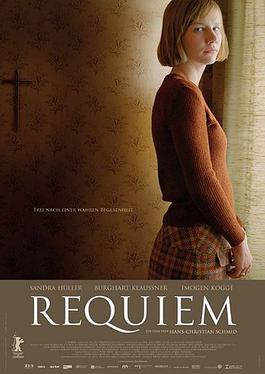
Recently there were two movies made based on the life of Anneliese Michel, a German college student from the 1970s who claimed to be possessed by a demon. My fellow Biola University alum Scott Derrickson updated the story to 2000s era America in his horror genre film The Exorcism of Emily Rose (Derrickson, 2005). German filmmaker Hans-Christian Schmid made a more straightforward dramatic biography of Anneliese in Requiem (Schmid, 2006). The result was a far more subtle and interesting film. (Sorry, Scott!)

Derrickson’s movie is set up as a courtroom investigation which asks us to decide whether we think Emily is really possessed or not. Requiem is not interested in that question. In fact the film seems to assume that the girl (in this version called Michaela) is not really possessed. Indeed, it seems to assume that she knows she’s not really possessed. Instead, the film asks us why, if she knows she is simply sick and not really possessed, she would go along with her mother and priest’s exorcism scheme? The answer the film suggests is that she wants to recontextualize the meaning of her suffering. If she is simply sick, then her suffering is random and meaningless; but if she is possessed, then she is a martyr.

Once Michaela interprets her own life through the lens of St. Catherine, her own favorite saint, she is able to accept her suffering with peace. Prior to this, she is “ashamed” of her illness, and wants to be a normal kid. The “voices” she hears are her mother’s voices telling her she is a “slut” and that she is not capable of going to college. But when she first attempts to interpret these feelings as demonic possession, her liberal priest tells her that the Devil is only a symbol and recommends she seek medical attention. Then, when, the stress of school almost prevents Michaela from completing the first semester, and her boyfriend wonders if maybe college is not the best place for her, she realizes her mother will be proven right. She begins to give herself over to her symptoms in order to press the possession interpretation, and to show that it is not her weakness that is preventing her success but the Devil. Hence the movie suggests one use of the symbolism of evil is to allow us to create a meaningful narrative out of our suffering.

Note that on this interpretation the film is not necessarily arguing the liberal point that the Devil is just a symbol. The film’s view that Michaela is using the Devil as a symbol is compatible with the conservative Christian view that the Devil is also literally real and can possess other people. More likely, however, the film is making a post-liberal point: it is the Devil oppressing Michaela – in the form of her mother’s criticism (and to a lesser degree in the form of her physical handicap). In other words the Devil is a symbol, but the Devil is not just a symbol, because symbols have their own kind of reality and so no symbol is just a symbol.

Question: I haven't read Paul Ricoeur's The Symbolism of Evil, but from what I understand my reading of Requiem is similar to the kind of thing Ricoeur is doing in that book. Does anybody out there have any insight on this?

Wednesday, May 21, 2008

"We all need mirrors to remind ourselves who we are."

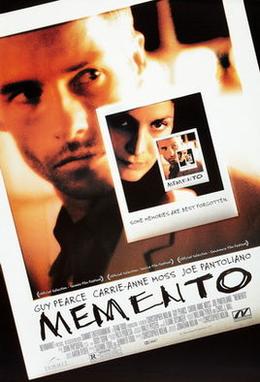
In recent posts, I've been exploring films that generate in their views a kind of self-deception. Today, I want to discuss a film that doesn't necessary trick us in this way, but rather explicitly addresses the issue of self-deception: Christopher Nolan's Memento (1999).

In Memento (as I'm sure you remember), Leonard Shelby has this "condition" called anterograde memory loss in which he can't make new memories. (It's the same problem Drew Barrymore has in 50 First dates, a "less depressing" movie as one of my students pointed out to me, but also a less philosophically interesting film as I pointed out to him.) I find it interesting, that whenever Leonard talks about his memory problems, he refers to it as a "condition". I'm sure its a sign of nothing so much as my own insanity, but when I hear the term "condition", I can't help but think of the philosophical concept of "the human condition".

Leonard has the words "Remember Sammy Jankis" tattooed on the back of his hand. Leonard says he tells people about Sammy "to help them understand. Sammy's story helps me understand my own situation." In the last lines of the film, Leonard claims, "We all need mirrors to remind ourselves who we are.” In his essay in Movies and the Meaning of Life, Michael Baur argues that Memento is one of the mirrors that can remind us who we are. Just as Sammy's condition is Leonard's condition, so Leonard's condition is our condition. Baur convincingly reads the film as an exploration of the problem of personal identity, in particular giving a Heideggerian critique of Locke's memory theory of identity. I highly recommend Baur's essay. Movies and the Meaning of Life is one of the best anthologies of film-philosophy out there, and Baur's essay is one of the best in the book. I don't wish to challenge his reading. But I do want to add an additional reading. I propose that Memento can also be read as an exploration of what Lyotard called "the postmodern condition". (Again, it's probably just my own insanity, but I can't help hearing a verbal connection between the names Leonard and Lyotard.)

Jamie Smith
has already explored some of Memento's connections to postmodern philosophy in his book Who's Afraid of Postmodernism? Taking Derrida, Lyotard, and Foucault to Church, but he focused specificaly on themes from Derrida. I'd like to take a more general approach to postmodernism, borrowing a familiar narrative about modernity as the quest for certainty and postmodernity as the acceptance of human finitude. On this narrative, see the work of Richard Rorty, Stephen Toulmin, Nancey Murphy, et al.

(By the way, Smith's Who's Afraid of Postmodernism? should be read by everyone interested in the future of the church. His discussions of postmodern philosophy are basic, but his application of postmodernism to the emerging church is brilliant. He shows why a truly postmodern church needs more than just candles, ambient music, and video screens -- it needs traditional liturgy, the lectionary, spiritual disciplines, etc. Too many of my friends in the Episcopal strand of the emerging church movement are giving up these things in favor of worship practices that are basically just Gen X versions of old-school modernist "seeker sensitive" churches. Smith is right that a truly postmodern church will need to recover its Catholicity. Anyway, back to Memento....)

Let's start at the beginning -- which, in Memento is actually the end. The first image in the film is a polaroid photograph. But the shot is played in reverse so that the image gradually fades away before being reinserted into the camera. I take this shot to be a summary of the entire film. One of Leonard's tattoos reads "Buy film. Camera doesn't lie. Notes can be lost." In one scene, Leonard tells Teddy: “Facts, not memories. That's how you investigate. … Memory can change the shape of a room; it can change the color of a car. And memories can be distorted. They're just an interpretation, they're not a record, and they're irrelevant if you have the facts.” So I take Leonard's polaroids as a symbol of objective evidence -- he thinks of them as pure, uninterpreted access to the Truth. But the film gradually undermines this view.

On this reading, the opening shot of the fading photograph symbolizes the loss of objective evidence: the postmodern condition as the awareness that all facts are mediated by the perspective one brings to them.

If Leonard's photographs suggest a modernist desire for objective evidence, perhaps we can read Leonard's memory problem as another symptom of modernity: the loss of tradition. Modernity, especially in its radical Enlightenment form, was the rejection of the authority of tradition in favor of, as Kant put it, "daring to know" for oneself. (Hence the Protestant Reformation.) Leonard's condition requires us to "learn to trust your handwriting. ... You have to be wary of other people writing stuff for you that is not going to make sense or is gonna lead you astray." Hence modernity involves radical individualism and autonomy.

Moreover, as Leonard says, in a world without memory, "You really need a system if you're going to make it work", recalling the desire of early modernists like Descartes and Francis Bacon to find the proper scientific and philosophical "method" by which to generate a perfect system of knowledge. Descartes's version of the method involved radical doubt, questioning anything that couldn't be proven with certainty. What he found using this method was that the only indubitable foundation of knowledge is one's own consciousness: "I think, therefore I am." (On this point, consider how much of the dialogue in Memento is Leonard's subjective thoughts in voiceover.)

The problem then becomes how to build a bridge from the subjective to the objective, to prove that as Leonard puts it at the end of the film, "a world outside my own mind." But Memento, following postmodern philosophy, argues that this is impossible. The problem is not just that it is impossible to overcome Cartesian skepticism about the external world, but that there is no such thing as "the" external world. Reality is not "given" to us, but must be interpreted by the knower.

The structure of the film reveals this fact to us. We are shown a scene and then are shown what happened just before that and then what happened just before that, etc. With each scene we are "thrown" (as Heidegger might put it) into the middle of an event and forced to interpret what's going on along with Leonard: "Ok, what am I doing? I'm chasing this guy. ... No, he's chasing me!" But with each new scene we are forced to reinterpret the previous scenes -- every interpretation is revisable, and certainty is impossible.

The most obvious example of this is the scene where Natalie manipulates Leonard. First we see Natalie crying and telling Leonard that a guy named Dodd has beaten her up and Leonard agrees to go "get rid of" Dodd for her. Then we see what took place just before this: Natalie provokes Leonard into beating her up. She takes all the pens with her and leaves the room so that Leonard can't write down what happens. Then when he forgets what he has done, she returns and pretends to cry, etc. What we took to be self-evident, unmediated observation of the scene has been shown to be just one interpretation.

The point is not that there is no such thing as truth (as some modernist philosophers claim postmodernists believe). Clearly, not all interpretations are equally good. But what we need if we are to make better interpretations is context. Leonard points out that, “If people scratch their nose a lot experts will tell you they’re lying. It really means they’re nervous. People get nervous for all kinds of reasons. It’s all about context.” The problem is that without memory, we have no context: “How am I supposed to heal if I can't feel time?”

The first line of the film is "So, where are you?" and the last line is "Now, where was I?" In order to understand who we are, we need to know where we are, how we got here, and where we're going. In other words, we need to be able to tie our present to a past and a future: we need to reconnect to traditional narratives (without necessarily turning them into what Lyotard calls "metanarratives").

As Teddy tells Leonard says, "You should start investigating yourself". In a world without memory, “You don’t know who you are" or "what you’ve become”. Without a narrative context in which to interpret our lives, we are left with no "meaning" of life. But in modernity we have rejected all traditional narratives. The only way to give our lives meaning is through self-deception, creating a narrative and then pretending it is simply a self-evident uninterpreted fact and not a narrative (a process Lyotard describes in The Postmodern Condition).

This is exactly what Leonard does. He gives himself "a reason to make [life in his condition] work" -- revenge. But at the end of the film, we realize that Leonard's revenge-narrative is based on a self-deception. Leonard spoke more than he realized when he said "Sammy's story helps me understand my own situation." It turns out that Sammy's story is Leonard's own situation. And hence as Leonard says of Sammy, "His condition was psychological not physical." In other words, Leonard is repressing his memory due to psychological trauma -- he doesn't actually have brain damage.

On one level, Leonard's psychological trauma is the rape of his wife. But on another level, his trauma is nothing less than the problem of evil. (Like Rashomon, discussed in an earlier post.) The injustice he has experienced makes it impossible for him to fit his world into a morally intelligible narrative. The universe just doesn't make sense to him. Life seems meaningless, and so he creates a false sense of justice to give his life purpose and meaning again: "I'm not a killer," Leonard says, "I'm just someone who wanted to make things right."

Note the multiple levels of self-deception here: Leonard is a killer; revenge is not justice; things are not right, but neither are they wrong in the way Leonard thinks they are (his wife wasn't murdered; she died of a semi-intentional insulin overdose); Leonard is now killing relatively innocent people, not trying to "make things right"; etc.

In order to give his life meaning, Leonard needs to find a life-defining project around which to construct his life-narrative. And in a postmodern world without objective evidence, the more resistant to contingency's project, the better. Teddy says Leonard wanted “to create a puzzle you could never solve.” Thus Leonard creates an unsolvable murder mystery for him to investigate and covers up this self-deception with the further self-deception of Sammy Jankis, a fiction in which he hides his own knowledge of the truth.

After telling Leonard that “You don't want the truth. You make up your own truth”, Teddy adds “So you lie to yourself to be happy. There's nothing wrong with that. We all do it.” But if we reject modernity's equation of truth with objectivity and its suspicion of narrative, then Teddy is wrong. We don't have to lie to ourselves to be happy. We can find happiness in life together, connecting our own life-stories to a communal narrative in which we serve as "mirrors" to remind one another who we are, guarding each other from self-absorption, self-deception, and self-destruction.

Tuesday, May 20, 2008

"What's this war at the heart of nature?"

Today we watched Terrence Malick's The Thin Red Line in my course on the problem of evil in contemporary cinema. One of these day's I'll post my reflections on the film. But for now, I just wanted to list out some of the more interesting lines from the film:
  • What's this war in the heart of nature? Why does nature vie with itself, the land contend with the sea? ls there an avenging power in nature? Not one power, but two?
  • This great evil. Where does it come from? How'd it steal into the world? What seed, what root did it grow from? Who's doin' this? Who's killin' us? Robbing us of life and light. Mockin' us with the sight of what we might've known. Does our ruin benefit the earth? Does it help the grass to grow, the sun to shine? Is this darkness in you, too? Have you passed through this night?
  • Darkness, light. Strife and love. Are they the workings of one mind? The features of the same face?
  • Maybe all men got one big soul who everybody's a part of. All faces of the same man. One big self.
  • Who are you to live in all these many forms? You’re death that captures all. You, too, are the source of all that's gonna be born, your glory, mercy, peace, truth. You give calm a spirit, understanding, courage, the contented heart.
  • I remember my mother when she was dyin', looked all shrunk up and gray. I asked her if she was afraid. She just shook her head. I was afraid to touch the death I seen in her. I couldn't find nothin' beautiful or uplifting about her goin' back to God. I heard of people talk about immortality, but I ain't seen it. I wondered how it'd be like when I died, what it'd be like to know this breath now was the last one you was ever gonna draw. I just hope I can meet it the same way she did, with the same... calm. 'Cause that's where it's hidden - the immortality I hadn't seen.

Friday, May 16, 2008

Rashomon and Other Misunderstood Clichés

Any time I tell people I am interested in philosophy and film, they inevitably say "Oh, like The Matrix?" This cliché even comes from professional philosophers -- The Matrix is at least mentioned in every textbook I know on using film to teach philosophy.

As for myself, I actually never found The Matrix to be very interesting. I thought it was a whole lot of fun as an action movie, but a bit confused as an exploration of modern epistemology and metaphysics. Ditto with one of professional philosophers' other favorite films Bladerunner: I thought it was a brilliant feat of cinematic style and production design but a rather shallow discussion of artificial intelligence and other problems in the philosophy of mind (such as the problem of other minds).

But then I read Stephen Mulhall's book On Film. (An earlier draft of the section on Bladerunner is available online here. By the way, if you follow the link on Mulhall's name you can see a picture of him in which he looks a little like David Lynch!) Mulhall convincingly argues that Bladerunner is really about Heideggerean anxiety in the face of death. Once pointed out, this reading seems obvious -- how could I have thought it was about the boring old problem of other minds? (Mulhall does discuss skepticism about other minds, but he approaches it not through the classical framework established by Bertrand Russell but through the much more helpful perspective of Stanley Cavell's work on "acknowledgment" of the Other in The Claim of Reason and Pursuits of Happiness, his seminal book about philosophy in classic Hollywood screwball comedies).

I found similar unknown depths in other philosophy class clichés like Rashomon and Crimes and Misdemeanors. And this sent me back to The Matrix to see what else might be found there.

One problem with most philosophical readings of films is that philosophers tend to read their own concerns into the films rather than taking seriously the film's own ideas. Part of the problem here is lack of education in how to "read" of film, but a deeper problem is an overly narrow idea about what counts as a "philosophical" discussion. I hope to discuss the latter issue at some point on this blog. And I'll probably come back to Bladerunner and Crimes and Misdemeanors at some point. But for now let me focus on The Matrix and Rashomon, both of which are usually misread in terms of the standard epistemological problem of skepticism, but are both actually interested in exploring the reasons professional philosophers tend to misread them.

Let's start with Rashomon (Kurosawa, 1950). Through a series of flashbacks, related by a woodcutter and a priest to an unnamed commoner, the film tells the story the murder trial of a bandit accused of killing a samurai in the forest. We see the court testimony of the woodcutter who found the samurai's dead body and reported it to the police, a priest who happened to be walking by the scene, the bandit himself, the samurai's wife, and even the dead samurai himself (whose ghost is channeled by a psychic medium). But each eye-witness gives incompatible versions of the events and we are left with the skeptical conclusion that we can never know what really happened.

In the opening scene the priest says he has “finally lose my faith in the human soul” because of the “horrible” story he has heard -- even more horrible than war, famine, plague, earthquakes, etc. What does he think is so disturbing? The problem seems to be, in part, because we can’t know what really happened in the forest. But why is that so disturbing? Each witness tells the story so as to make themselves look good. But note that the reason we can’t know what happened is not just that the witnesses lied. The problem is that each one experienced the situation differently.

For example, in the bandit's flashback, the sword fight between him and the samurai is typical action movie fare. But in the woodcutter's flashback, it is a more realistic farce with both fighters clearly scared out of their minds and falling all over each other etc. But I don’t think the bandit was lying about how the battle took place: in his own mind it was much more glorious than it was the way the woodcutter saw it. Likewise, despite the fact that the bandit, the samurai, and the wife give three very different versions of the woman’s request that the men fight, these differences could easily be read as different interpretations of the same event. In other words, the point is that we all see the world from our own biased perspective. The problem is that we don't know that we are biased. We think our own perspective is the uninterpreted self-evident truth.

Now the film is usually used in philosophy classes to introduce the problem of relativism: is truth just relative to each individual's perspective? And that is certainly one of the issues in the film. But that is not why the priest is so disturbed in the opening scene. I see the film as not so much an affirmation of epistemological relativism as psychologically-based rejection of Cartesian foundationalism. Remember that Descartes was responding to the post-reformation problem of finding a religiously and politically neutral basis for knowledge. He thought he could base the entire structure of knowledge on the “foundation” of human reason. Remember also that Descartes’s proposal was to prove everything using abstract mathematical and logical Reason since people can’t agree on philosophy, ethics, politics, or religion but but they can agree on math and science.

In my view, Rashomon challenges the possibility of basing knowledge on universal human Reason, not simply because each person reasons from his or her own perspective (though, again, I agree that that is part of the point of the film), but also for the more radical reason that humans are not rational. We repress what we know to be true in order to be happy. In particular we repress our awareness of human depravity. The "horror" that disturbs the priest is the same horror we Joseph Conrad called "the heart of darkness" -- "the horror, the horror" chillingly lamented by Marlon Brando in Apocalypse Now.

In the first line of the film, the woodcutter says, “I don’t understand.” In the last scene, he clarifies what he means: “I don’t understand my own soul.” The problem isn't that we lie to each other it's that we lie to ourselves. At one point the priest says, “It is because men are weak that they lie, even to themselves.” And when the priest says, “I refuse to believe anyone could be so sinful”, the commoner replies, “But is there anyone who's really good? Maybe goodness is just make-believe. … Man just wants to forget the bad stuff, and believe in the made-up good stuff. It's easier that way.”

Now, here is where things get really interesting -- and here is where professional philosophers focus on epistemology at the expense of psychology. I believe the film is set up to demonstrate the fact of self-deception with its own viewers. The film's ending seduces us into forgetting the dark lessons of the trial.

Most interpreters criticize the film for its apparently overly-optimistic ending: an abandoned baby is found in the ruins where the storytellers are, and when the woodcutter (seemingly) altruistically takes it in, the priest says he has regained his faith in humanity. This seems a suprisingly sentimental ending to a pessimistic film, and most critics see Kurosawa as losing his nerve at the last minute. But I think the point the film is making is the exact opposite of this optimistic reading.

It seems to me that the film includes deliberate hints to undermine this optimism, for it is possible that it was the woodcutter that abandoned the baby in the first place. Consider these usually overlooked details:
  • He already has six children, so it makes sense that he would think he couldn’t take care of another one.
  • He is very protective of the baby when the commoner takes the baby’s kimono.
  • He defends the baby’s parents for going through a lot of trouble to leave an amulet to protect the baby, recalling his original statement to the police in which he says he found an “empty” amulet case.
  • The baby stops crying as soon as the woodcutter takes him.
If I am right, then the woodcutter is not doing something heroic and selfless by taking the baby in. He is only doing his minimal duty to his own child and taking him in due to a guilty conscience. So the priest’s renewed faith in humanity is based on a lie. And if we as the audience share his optimism, we are mistaken, too. Moreover, this unjustified faith in humanity is due to self-deception. All the evidence is there for us to know that the woodcutter is lying, but we choose not to see it since we want to imagine human beings to be good. And when, on repeat viewings we realize that we have been seduced into easy optimism, we realize that the temptation to self-deception is a reality in our own hearts, not a general possibility "out there" in the world.

In this way Rashomon takes us to the core of the problem of evil. Is our belief that the world is meaningfully ordered -- that justice is possible and life is worth living -- simply a form of self-deception? Is faith in goodness, as Woody Allen will argue through the film Crimes and Misdemeanors, a form of blindness to reality?

Thus Rashomon contains within itself the seeds of deconstruction -- not a deconstruction of itself so much as a deconstruction of a standard but superficial reading of the film which demonstrates our unwillingness to face the darkness in our own hearts. It's a whole lot easier to turn the film into an exercise in abstract theoretical concerns. And I think analytic philosophers make a similar mistake with The Matrix which is not really about metaphysics and epistemology but is really about politics. More shockingly, I will argue that The Matrix does not have a Platonist or Gnostic metaphysics but is actually anti-Platonic. But since this post is getting long, I think I'll save that discussion for next time... [You can find my post about The Matrix here.]

Thursday, May 15, 2008

Theodicy at the Movies

I am currently teaching a course at Azusa Pacific University on "God, Evil, and the Meaning of Life in Contemporary Cinema".

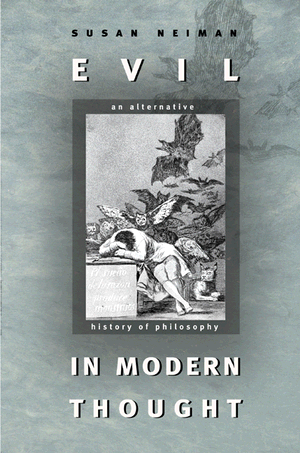
My approach to this course is based on the historical analysis of Susan Neiman and Julian Young. Neiman argues that the history of post-Enlightenment philosophy can be read as an attempt to solve the problem of evil. Here, “the problem of evil” means not just the problem of how a good God could allow evil to exist, but means something closer to the problem of the meaning of life: how are we to make sense of the world and our place in it? Young gives a complementary analysis of contemporary philosophy as the attempt “to respond to the question of what can be said about the meaning of life in the light of the death of the God of Christianity”.

But if contemporary philosophy is about the problem of evil and the meaning of life, then contemporary philosophy is done as much through cinema as it is through academia. So in this course we're watching movies such as Diary of a Country Priest, Crimes and Misdemeanors, No Country for Old Men, etc. and analyzing them in juxtaposition to the thought of philosophers such as Hegel, Schopenhauer, Kierkegaard, Nietzsche, Heidegger, etc.

In the weeks to come, I plan to blog my reflections on the films. I hope you enjoy reading my thoughts, and I look forward to reading any comments you post in response.