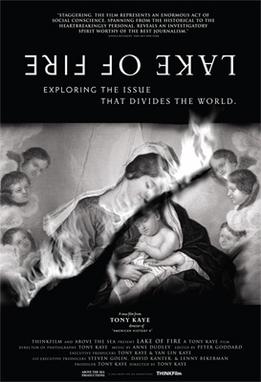
 When I return to teaching, I plan to assign my students to watch the abortion documentary Lake of Fire (Kaye, 2006). Along with the Jewish homosexuality documentary Trembling Before G-d, it's one of the most stimulating movies I've seen about a contemporary ethical issue. And, like movies such as Waking Life and My Dinner With Andre, the film is made up almost entirely of philosophical discussion, priming the audience's intellectual pump for class discussion.
One caveat I have about the film, though, is that I don't think students will be able to digest the material without expert commentary. Much of the footage is presented without editorial comment -- there is no narrator and very few on-screen titles -- and hence lacks any sort of context and ends up being misleading.
Because of this lack of commentary, most reviews of the film claim that it is fair to both sides of the debate -- something unusual in the abortion contoversy. But I didn't find the film to be fair and openminded at all. Filmmaker Tony Kaye is not unbiased -- he's obviously pro-choice. I actually have a hard time understanding why anyone would miss this point. Why would reviewers think Kaye is anything but pro-choice? Surely professional film critics don't need the director to come right out and say he is pro-choice before they can detect his viewpoint. (Maybe they've seen too many Michael Moore movies!)
A more charitable interpretation of the critical blindspot is that since the film includes graphic footage of late-term fetuses, perhaps reviewers were led to think Kaye is sympathetic to the view that abortion is murder. After all, these fetuses look exactly like post-birth babies, and hence exactly the same sort of footage is used in many anti-abortion propaganda movies. (This, by the way, is one of the misleading scenes. The fetuses are clearly in their second-trimester of development. But without being told that almost 90% of abortions take place in the first-trimester when the fetus looks more like a sea monkey than a baby, viewers might think that all aborted fetuses look like this.)
Another reason people may mistakenly believe the film is ambivalent is that, in part because of the graphic footage but also because it presents such an array of voices from every side of the debate, the film is so unsettling that it creates a kind of ambivalence in the viewer. It's not that Kaye doesn't know what he thinks about abortion or that he keeps his own viewpoint hidden in the film -- it's that after watching the film, you no longer know exactly what you think about abortion. And that's the most significant aspect of the film. It's also one of the most pro-choice aspects of the film. The film wants to convince us that this is a hard issue that is not as black and white as it is usually presented in political debates. Therefore, the film suggests, we should leave the choice about abortions up to individuals.
Another caveat: I'm not sure the film is primarily a debate about abortion at all. It is a documentary about the people involved in the abortion debate. And it's mostly about fundamentalist Christians who believe that abortion doctors should be assassinated. In some ways, the film is presenting a philosophical challenge to pro-life advocates, asking them "if you agree that abortion is murder, then what makes you different than these extremists?" (Again, I don' t think the film is even trying to be unbiased.) It's a fascinating question: if abortion really is parallel to the holocaust, then why shouldn't pro-lifers declare open war on abortionists like the Allies declared on the Nazis?
Brett McCracken, an Evangelical reviewer, misses this challenge. He complains in his Christianity Today review that the film "purposefully avoids featuring any thoughtful, articulate, or moderate Christians". From the rest of the review, I have to assume that by "moderate", McCracken means a Christian who condemns abortion as murder but also condemns the murders of abortion doctors. While this may be true, the film nevertheless presents the positions of moderate Christians, while putting them in the mouths of extremists. And what this move does is make the extremists look like they have some good points and that they are not (entirely) crazy. So I actually take this to be a rhetorical virtue of the film.
Moreover I reject McCracken's definition of "moderate Christian". I think any view according to which abortion is obviously murder is a pretty conservative one. A truly moderate Christian is one who admits that this is a hard issue about which the Bible has little to say, and who is willing to allow diversity of opinions about abortion. A liberal Christian is one who simply accepts the pro-choice viewpoint as obviously true.
McCracken seems to think that what separates his own (supposedly "moderate" view) from other "fundamenatlist" or "expremist" views, is that he is not interested in forcibly converting nonbelievers. He complains that the film makes all pro-life advocates look like "mindless pawns in a larger and more malicious march toward theocracy". In other words, the film assimilates anyone who votes against abortion rights to the "reconstructionist" viewpoint that the laws of the United States should be revised to match the laws of the Old Testament so that, for example, anyone who uses the Lord's name in vain should be put to death. (Someone in the film actually gives this example!)
Again, McCracken's observation is true: the film does attempt to blur the line between extremist theocrats and more moderate run-of-the-mill pro-life Republicans. But again this is a virtue of the film. I think a strong case could be made (though the argument is left implicit in the film) that anyone whose position on aborion legislation comes from their Christianity and not from publically shared reasons is, indeed, a theocrat. (This point is even more clear when it comes to the issue of gay marriage.) The fact that McCracken is so defensive suggests that, on some level, he knows this critique to be on target.
It's this ability to challenge us to rethink the implications of our deeply held beliefs about abortion that I think is the film's biggest philosophical strength. Without the Socratic ability to recognize that we lack wisdom, we have no hope of escaping the unproductive torment of the "lake of fire" the abortion controversy has devolved into.