Showing posts with label TV. Show all posts

Tuesday, January 27, 2009

"These are the fittest, well-fed, best-kept horses I've ever seen."

Recently actor Liam Neeson was a guest on The Daily Show With Jon Stewart. He was supposed to be there to discuss his new movie, but the interview ended up focusing on a local New York City political debate about the horses used to pull carriages around Central Park. Stewart maintains that animals "would rather run" freely than pull carriages and deserve "a better life" in a "pastoral existence". But Neeson argues that domestic animals like cows and horses have "been trained for thousands of years" to do this work and actually enjoy it. Neeson's suggestion is that domestic animals can actually be fulfilled by their work (when given humane working conditions) in the same way that humans can be fulfilled by their jobs.

I couldn't get the embed function to work, but you can watch the video here. (The relevant discussion starts at 1:40 and ends at 5:04.)

Neeson's view reminds me of C.S. Lewis's argument in The Problem of Pain that it is the human vocation to domesticate all animals. In contrast to what he calls “atheistical thought” which sees wild animals as natural and domestication as artificial, Lewis argues (based on God's command in Genesis 1:28 to "subdue" the earth and "have dominion" over the animals") that the tame animal is “in the deepest sense, the only ‘natural’ animal – the only one we see occupying the place it was made to occupy".

For a reconstruction of Lewis's view see my essay "Animal Pain and the Community of All Creatures" (esp. p. 10ff) available on my website.

Thursday, October 30, 2008

"Barack Obama will win: It’s all in ‘The West Wing.’"

Here's a fun article comparing the current presidential election to the final season of the best TV shows in history: The West Wing (Sorkin et al, 1999-2006).

Tuesday, October 14, 2008

"Churches could lose their tax-exemption status."

It seems like every time I watch TV there's an anti-Prop 8 commercial on. (For those of you outside California, Proposition 8 is a voter initiative to amend the state constitution making same sex marriage illegal. This is in response to the recent state Supreme Court decision saying that the California constitution guarantees equal rights to same sex couples.)

Here is a link to the video. (I couldn't get it to embed in this post.) The ad is a point by point response to an earlier commercial for Yes on Prop 8 (embedded below):


Now, one claim from this ad sticks out to me: "Churches could lose their tax-exemption status." The "No On Prop 8" people ridicule this claim because the Supreme Court decision explicitly states that religions will not be affected. But I actually think that, while they are usually paranoid, the religious right is correct in their fears about this proposition. Why wouldn't the same sort of reasoning apply in the same sex marriage case that applied in the interracial marriage case when Bob Jones University lost their tax exempt status for their racial discriminatory policies?

I actually don't know what I think about this issue. I totally agree that Bob Jones's policies were evil. And I agree that the same-sex marriage issue is parallel. But I also think it was part of Bob Jones's religious freedom to keep the races segregated according to their (evil) fundamentalist doctrines. Maybe no churches should be tax exempt. But it seems wrong to dole out tax exemption in such a way that it pressures churches to violate their own religious teachings.

This issue reminds me of the issue of polygamy. Sometimes opponents of gay marriage argue that if we allow same sex couples to marry, there will be no stopping the slide down the slippery slope to allowing group marriage. Again, I think this is a place where the religious right is absolutely correct. But again, I'm not sure that it would be such bad thing to allow polygamous marriage. It was evil of the U.S. government to persecute the Mormon church for their marriage practices -- and it was even more ridiculous for the Mormons to change their doctrines in order to gain public acceptability. If the Mormon religion teaches polygamy, then it is their First Amendment right to practice polygamy.

For more reflection on polygamy, check out HBO's series Big Love, starring Bill Paxton as a man married to three wives. The show is a fascinating look at a variety of viewpoints on polygamy. It does not shy away from the dark side of polygamy as it is practiced in the fundamentalist Mormon "compounds" (forced marriage, pedophilia, incest, etc., not to mention repressive patriarchy), but the central characters' suburban polygamous family is surprisingly healthy. The show seems to be arguing that polygamy is not necessarily evil: if we brought polygamy out of the shadows of criminalization it could be made to work.

And the show's fundamentalist Mormon patriarch gives the best argument against Prop 8 I've heard: If we define marriage as the union between one man and one woman, then we criminalize many of our Biblical forefathers such as Abraham, Jacob, David, etc. In other words, the "traditional" definition of marriage does not seem to be limited to heterosexual monogamy.

Wednesday, July 2, 2008

"Some labels are best left in the closet."

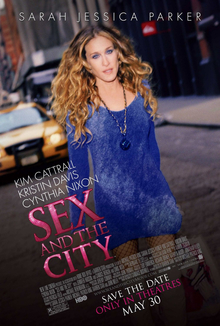
This week my wife dragged me to see Sex and the City (King, 2008). I don't have much to say about the movie itself. But I do want to comment on a recurring criticism of the movie. Many reviews complained that it is "too long". But the movie is only 148 minutes. That's just under 2 1/2 hours. Titanic was 3 1/4 hours! In fact, according to my calculations, the average length of the top 25 grossing American movies of all time is 142 minutes -- only six minutes shorter than Sex and the City.

So when people complain about the movie being long, I think they mean it feels long. As Einstein taught us, time is relative. The average length of the top 25 grossing Bollywood movies is 164 minutes long (2 hours and 44 minutes). Clearly there is a cultural difference here. But I don't think it has anything to do with Indian vs. American attention spans. I think it has to do with our expectations of narrative structure.

When I saw Sex and the City, I actually thought the movie wasn't quite long enough. As a viewer of the TV series, I thought poor Charlotte's storyline about getting pregnant didn't get full screen time the way the other three women's storylines did. Charlotte had some great scenes in Carrie's storyline about marrying Big. But on TV, there would have been more truly Charlotte-centric scenes. At 2 1/2 hours the movie is only the length of 5 episodes of the TV show. That's not a long movie, it's a short TV season. In short, I'm arguing that the movie felt long to people because its narrative was structured like a multi-episode arc of a TV series rather than a typical Hollywood movie.

In film school Hollywood screenwriters are taught to build their scripts around a three-act structure (a device which I believe was developed by Syd Field in the 1970s, though some people mistakenly try to trace it to Aristotle's Poetics.). Sometimes (for example in the work of screenwriting teacher Chrisopher Vogler) this three-act structure is combined with features of Joseph Cambell's structuralist-inspired theory of mythology. Here I am suggesting (pace Cambell) that the problem with any of these theories is that they are culturally relative. But because Hollywood has structred movie narratives this way for so long, mainstream audiences have come to expect these structural rhythms. Movies that violate this pattern -- such as Bollywood movies, art movies, and Sex and the City -- feel too long, too slow, or otherwise wrong to audiences used to Hollywood three-act structure.

I think that's why Bollywood movies feel so long to me. I was actually surprised when I added it up and found that the average length is less than three hours. My standard comment to the uninitiated is that most Bollywood movies are, like, four hours long. But thinking in terms of a three-act structure helps me see why I thought this. What I was feeling was that Indian movies are twice as long as American movies when in fact they are less than one and a half times as long. This is because many Bollywood movies are structured around two sub-stories. There is a beginning, middle, and end -- and then another beginning, middle, and end. For example the film may start with be a romance story that culminates in a wedding halfway through the film. But whereas a Hollywood movie would stop here, Bollywod filmmakers start up a new plot. Maybe there is a baby born, or the hero's father dies, or the heroine's brother strikes up a new romance with the hero's sister. In short, it feels to American audiences that the film has been attached to its sequel.

So what's the lesson of all this? I suppose a Hollywood studio executive could draw the conclusion that movies ought never deviate from the standard structure or audiences won't understand it. I would rather draw the conclusion that it is possible to learn alternative structures. I encourage my screenwriter friends to experiment with teaching us new ways of storytelling -- as I believe most young filmmakers are already doing. Finally, I would like to conclude that, because TV is structured around episodes, its structure is more flexible. You can have a one episode story-arc, or a three episode arc, or a one season arc, or an arc that lasts the entire series. The best shows have all these layers of narrative going on at the same time. Thus TV is amenable to a wider variety of story structures, TV is often a better medium for narrative than film is.

In conclusion: Movies are about spectacle, but if you want to tell a story, then use television. Of course, TV still has some growing to do as an artform. But with the history of TV during the last two decades -- from Seinfeld (1989-98) and Twin Peaks (1990-1) to Buffy the Vampire Slayer (1997-2003) and The West Wing (1999-2006) on to cable shows like Six Feet Under (2001-2005) and Weeds (2005-2008) just to name a few of my own favorites -- we are well on our way to a truly golden age of TV.

Wednesday, May 28, 2008

Nonviolent Heroes and the Failure of the Christian Imagination

Last year I went to a conference on “Faith, Film, and Philosophy” at Gonzaga University. I gave a paper on what Batman Begins can tell us about the nature of fear and the relationship between justice and revenge. (One of these days, I will post my thoughts about that film.)

One of the keynote speakers was my good friend Ralph Winter, producer of (among other things) the X-Men movies. He gave his standard lecture about advice on being a Christian in Hollywood. His two main points were: (1) Focus on quality filmmaking, not propaganda, (2) Don’t be afraid of dark subject matter since real life isn’t always G-rated.

Now, I don't deny that this is good advice. And I'm not criticizing my friend Ralph. But I do think Christians should be beyond this advice now. People have been saying this same stuff since the 1980s. The problem for Christian filmmakers today is no longer quality. Many of the student films I see at Biola University, Azusa Pacific University, and other Christian film programs are of a very high technical quality. The problem now is what kind of film do you make after you master the craft of filmmaking? Likewise with Ralph's second point. The problem is not being willing to show the darkness. Christian kids these days are really into that. (The class I taught on horror film at Biola was very popular.) The problem is how do you show the darkness truthfully and not just make the world look like a sick place beyond redemption?

The other keynote speaker at the Gonzaga conference was Thomas Hibbs, a philosopher from Baylor University. I highly recommend to you Hibbs’s book Shows about Nothing: Nihilism in Popular Culture from the Exorcist to Seinfeld. (A really nice interview with Hibbs can be found here. I am currently reading his follow-up Arts of Darkness: American Noir and the Quest for Redemption. I'll let you know how it is.) Hibbs argues that recent films have tended to “aestheticize evil”, making it look interesting if not necessarily attractive. He gives examples like The Exorcist, and The Silence of the Lambs. But, drawing on Hannah Arendt's idea of “the banality of evil”, Hibbs argues that these films misrepresent evil. Moreover, he argues that one reason this has happened is that our culture has lost the ability to make goodness interesting and attractive. Think about how much more interesting Batman is than Superman or Han Solo than Luke Skywalker.

I think this phenomenon is partly because, as Ralph Winter points out, real life heroes are not always perfect. But it is also because, as Thomas Hibbs points out, Christians have demonstrated a failure of imagination. We don’t know how to make goodness seem attractive.

This is related to a question Christian media scholar Bill Romanowski poses regarding The Passion of the Christ: “Why did the director have Jesus stand up to invite more scourging by the Roman soldiers? Is this historically accurate, a reflection of Gibson’s theology, or does it disclose a contemporary attitude?” (Eyes Wide Open: Looking for God in Pop Culture, rev. ed. p. 100). Romanowksi never comes right out and says it, but I think he is suggesting that this is a manifestation of Mel Gibson’s image of masculinity and heroism (compare Braveheart), an image formed more by macho American action movies than by scripture.

This line of thinking led me to ask my students at Biola, what would a truly Christian hero look like? How could you represent a hero with specifically Christian virtues of love, joy, peace, patience, kindness, goodness, faithfulness, gentleness, and self-control? In the context of Amerian cinema, would such a person be a hero or a wuss? Attractive or boring?

Hibbs is right: there has been a failure of Christian imagination. We have failed to imagine truly Christian heroes. The most Christlike movie heroes I can think of are actually Hindus and Buddhists: Think the title character in Gandhi, Li Mu Bai in Crouching Tiger, Hidden Dragon, and Ashitaka in Princess Mononoke. I might also mention Xander from the finale to Buffy the Vampire Slayer Season Six, and the title character from MacGyver. All of these heroes use intellect and compassion to disarm their enemies nonviolently and then either reconcile with them or at least bring them to (nonlethal) justice.

Can you think of any other examples? The Biola students hated this question and refused to participate in my discussion. Part of the problem was that I assumed that a Christian hero would be a pacifist. Having been indoctrinated into right-wing politics at their Orange County evangelical churches, the Biola students rebelled at my suggestion that Jesus wouldn't support war or killing, even in self-defense. (Somewhat shockingly, when I confronted them with Scriptural evidence of times when Jesus refused to use violence to protect himself from attackers, the students actually argued that we are not supposed to imitate Christ!) But surely we can all agree that peaceful resolution to conflict is better than violent resolution. So even if one wants to defend the just war theory point that Jesus could condone violence under certain circumstances, the fact remains that we need to do serious thought about how to make a movie about peace seem "cool".

And it is not just the question of heroes. The challenge of the Christian imagination arises in any number of cinematic genres: What would it look like to make a comedy that is not dehumanizing (i.e., that never asks us to laugh at someone's misfortune)? What would a romance look like that doesn't trivialize sex or reinforce repressive gender roles? What would an action movie look like that doesn't aestheticize or otherwise glorify violence? What would a "message movie" look like that respects its audience's intelligence and ethical autonomy (i.e., is not manipulative propaganda)? If there are no answers to these questions, I think we should conclude that Hollywood filmmaking and Christianity are incompatible. But I don't believe that. I trust that great Christian artists can solve these problems, if only they would bother to take theses issues seriously.

So let's engage our Christian imaginations, starting with the concept of a hero. How could we portray a hero who is both genuinely Christian and cinematically attractive? Any ideas?