Showing posts with label theology. Show all posts

Saturday, July 18, 2009

"What is a saint anyway?"

It's been a month since I posted on this blog. During that time I've been moving (from Berkeley back to L.A.) and running an emerging church chapel in the midst of the exhibition hall at the General Convention of the Episcopal Church.

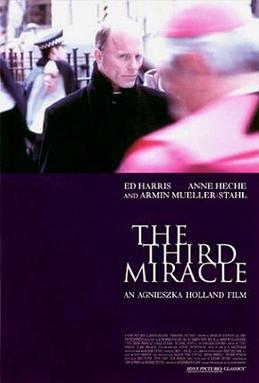
You may have seen news reports about the Episcopal Church's controversial legislation regarding same-sex marriage rites and gay bishops. But one thing you might not have heard about is our new list of "saints". The Episcopal Church has always had an unusual understanding of sainthood. The movie The Third Miracle (Holland 1999) is a meditation on sainthood. When someone asks the main character (a priest played by Ed Harris) "What is a saint anyway?", he answers "A saint is a person who is with God in heaven. If you pray to that person and your prayers are answered that means that person has a special connection with God." So the Catholic Church looks for miracles to prove that a person is in heaven and has a special relationship with God. The Episcopal Church, however, is a Protestant church that rejects priestly mediation and hierarchy. We think all Christians have a direct connection to God and can be sure they are going to heaven.

To be fair to The Third Miracle, this might be the point of the film. The representative of the Church hierarchy says "We live in a fallen world. Martyrdom, the great act of faith, seems impossible. Therefore, acts of simple goodness, a soup kitchen, kindness to the poor, have come to seem worthy of saint. But true sainthood is of another world. ... A saint loves God beyond the ordinary human power to love God." But the film presents him as unreliable and hypocritical, suggesting that there can be such a thing as an ordinary saint.

In any event, the Episcopal Church recognizes ordinary saints. We remember people for their contribution to the life of the Church, even if they did not demonstrate any "heroic virtue". In other words, most of our saints are along the lines of what Roman Catholics call "Doctors of the Church".

But unlike the Catholic "doctors", we do not limit our saints to theologians. We recognize artists and scientists as saints, too. For example, poets George Herbert and John Donne were already saints. At the last convention, we added C.S. Lewis. This year we added writers John Bunyan and G.K. Chesterton, composers Bach, Handel, Purcell, William Byrd, and Thomas Tallis, hymn writers Fanny Crosby and Isaac Watts, artists Albrecht Durer, Matthias Guenewald, and Andrei Rublev, and scientists Copernicus and Kepler.

Moreover, if you didn't notice from the above list, the Episcopal Church is unlike most churches in that we recognize saints outside our own tradition. For example, joining the likes of Martin Luther and Dietrich Bonheoffer, this year we added John Calvin, Karl Barth, Thomas Merton, and John of the Cross.

Finally, we let in philosophers. Joining Augustine, Aquinas, Berkeley, and Joseph Butler, we now have Soren Kierkegaard.

St. Clive? (as in Clive Staples Lewis) St. Kierkegaard? These are saints who inspire me to heroic virtue!

Wednesday, June 17, 2009

"The medium is the message."

Here is an interesting audio interview with Todd Bouldin, founder of Pepperdine University's MFA in Screenwriting. I disagree with Bouldin's theory of the Church's relationship to the secular culture, but the interview did make me realize something. Bouldin started out wanting to make an "impact" for Christ in law and politics and then decided that the media is a more important influence on American culture. This connection between politics and the media helped me see what has been bothering me about the typical theory of how Christians should relate to Hollywood.

In the interview, Bouldin expresses a viewpoint similar to H. Richard Niebuhr. Niebuhr rejected what he called the “Christ-against-culture” position in favor of “Christ-transforming-culture” position. (The fun pictures to the left come from this blog post.) This move has become the party line for Evangelicals in Hollywood. The claim is that Christians in the middle part of the 20th Century rejected involvement with secular culture as sinful. But, having been abandoned by Christians and left to their own secular devices, the centers of culture like Hollywood, Washington DC, and Harvard, only got worse and worse and eventually dragged down all of America with them. According to this narrative, the only hope for redeeming American culture is for Evangelical Christians to move from cultural non-engagement to engagement – from Christ-against-culture to Christ-transforming-culture.

But while Evangelicals in Hollywood are still following this party line, many Evangelicals in Washington have changed their view. (I’m not sure about the Harvard folk.) The difference seems to be that Evangelicals haven’t yet tasted any real power in secular media, but they have in politics. The United States had an Evangelical president. There’s nowhere else to go from there. But despite having achieved genuine power (not just the presidency, but many other influential governmental positions), Evangelicals have failed to transform culture. America is just as godless as ever – maybe more so. Some of the founders of the Religious Right have now admitted that they were “blinded by might” and corrupted by the power they achieved. (Here is a nice summary of this theory.) Instead of the Church transforming culture, culture transformed the Church. Baby boomer Evangelicals still seem intent on the old model (witness Sarah Palin), but younger evangelicals seem to understand the failure of their parents’ ideas (they voted for Obama). Many young people are leaving politics behind for direct engagement with the world. They’re less interested in top down transformation of culture than bottom up revolution. Why bother with ineffective politicians when we can, for example, make a real economic difference by living and working in the inner city?

What we are seeing is that Niebuhr’s categories are misleading. Everyone – even those like Tertullian, Tolstoy, and the Quakers who Niebuhr cites as paradigmatic defenders of the Christ-against-culture position – want to transform culture. The question is not should we transform culture, but how can we transform it. The Christ-against-culture position rejects the idea – held by the Christ-tranforming-culture position – that Christians can use the tools of cultural power (e.g., politics, the arts, higher education, etc.) to transform culture. Rather the Christ-against-culture position holds that the Church has its own tools and its own very different understanding of power. On this view, whenever the Church attempts to use the world’s tools, the Church only succeeds in transforming itself into the world. For example, when the Church uses advertising techniques to market itself, it positions itself as just another product to be consumed and ceases to be an alternative to consumer culture. This is what Marshall McLuhan was talking about about when he said “The medium is the message.”

Unfortunately Evangelicals in Hollywood haven’t learned the lessons of Evangelical engagement in politics. Evangelicals still dream of “impacting” Hollywood by lifestyle evangelism (as Bouldin says, “simply being there”). The assumption of this strategy is that if individual filmmakers “get saved”, then culture will change. The problem is that it won’t work. If getting the President of the United States saved couldn’t transform American culture, then why think getting the president of Disney saved would work better? It is mystifying to me that Bouldin could understand that politics can’t transform culture but think the media can.

What if we give up pursuit of Hollywood power for the kind of direct engagement in the world that young people are discovering in the political realm? This would look like making independent films by, for, and about Christians. I’m not recommending cheesy evangelistic movies of the past, but serious (both dramatic and comic) artistic engagement with the issues that matter to us but which secular filmmakers simply can’t understand. What we need is a Christian version of Spike Lee who makes excellent art by, for, and about, African-Americans. This is a Christ-against-culture position. But it is not a call to hide in some self-imposed Christian ghetto. We shouldn’t create a parallel Christian movie studio. That would be like rejecting both the Democrats and the Republicans to create a third party for Christians. Instead we should -- if we want to transform American culture – reject politics/Hollywood altogether and do something entirely new.

There’s nothing wrong with working in Hollywood or Washington, DC as long as we don’t fool ourselves into thinking that we’re secret missionaries who will have some sort of “impact”. True transformation will have to come from a more radical strategy, the strategy of the Cross. Politics is all about power, but the Cross repudiates power in favor of weakness. That’s why Jesus says thinks like “My Kingdom is not of this world” and “Give to Caesar what is Caesar’s”. You might be able to be a Christian who is involved in politics, but you can’t be a Christian politician who uses the tools of Washington to further the cause of Christ. Similarly, the media is all about money, but the Cross reveals money to be an idol. That’s why Jesus says things like “You can’t serve God and money” and “Sell all you own, give to the poor, and follow me.” Again, you might be able to be a Christian who works in Hollywood, but you can’t be a Christian filmmaker who uses the tools of Hollywood to further the cause of Christ.

Am I wrong? Please let me know by posting a comment. I welcome any friendly criticism you can offer.

Friday, May 8, 2009

"To progress by moving backwards"

I was walking down the street the other day and saw someone pushing a Bugaboo Cameleon stroller. Bugaboo is one of the hippest brands of stroller, largely (I think) because it is the most expensive brand. Personally I prefer both Stokke and Quinny strollers. (Both are only slightly less outrageously priced than the Bagaboo. We were lucky enough to get a gently used Quinny for Maggie at half the list price.) But if I had to buy a Bugaboo, I'd go for the "Cameleon" model. In one of its configurations it transforms into an old-school British-style pram. (The Cameleon is pictured to the left, and an antique pram is pictured to the right.)

This is great example of retrofuturistic design. I discussed retrofuturism in my earlier post on the movie Steamboy. By the way, the current Wikipedia article on retrofuturism has got it wrong. That article limits the use of the term "retrofuturism" to nostalgic representations of what past eras thought the future would look like. For example, if Old Navy started selling silver jump suits, that would be retrofuturistic. And that is definitely one common use of the term. But, as Wikipedia itself notes, the term was originally coined by conceptual artist Lloyd Dunn who used it to mean "the act or tendency of an artist to progress by moving backwards." Dunn was an early practicioner of what has come to be called mashup in which parts of several existing artworks are combined to form a new artwork. Here is an excellent article about the history of the term, written by people who worked with Dunn. The article explains that:


Retrofuturism is an idiom in which expressions are constructed, as in any natural language, out of pre-existing conventional elements. The machine arts (photography, xerox, audiotape, video, etc.), like the work of the contemporary language poets, coin new "words" like no other media in history. Because they are mechanistically reproductive, they also conventionalize and codify information. Conventionalized material, like the cliché (a form of verbal shorthand which collapses entire narratives, often into a few syllables) becomes the raw material for for the construction of new metalogic expressions. Artworks are also complex, like real words, which have an internal syntax all their own. Retrofuturist artworks do them one better by being like sentences, recursive collections of (themselves) recursive words; all parts of which exhibit syntactic structure (and play with it) to express new thoughts (and old ones in novel juxtapositions).

So in its broadest use "retrofuturism" is just another name for "mashup". In its more common use, retrofuturism means the use of design conventions and clichés from past artistic periods to present something that looks modern, even futuristic. This is the way the Museum of Contemporary Art used the term when it applied it to a show of car designs by J Mays (the artist who designed the new VW Beetle, Ford Mustang, and Ford Thunderbird). (You can read more about the show and see some pictures here. And you can get a good sense of what Mays is doing if you compare the 1955 Thunderbird seen here with the 2002 Thunderbird seen here.) And this is what the Bugaboo pram is doing.

Seeing this retrofuturistic pram also made me realize that this is what the emerging church is doing, too. (See my earlier post on the emerging church and/as avant garde.) Having realized that the church's links to philosophical modernism has left it theologically bankrupt, emerging theologians are attempting to return to premodern ancient and medieval theology for resources in constructing a postmodern theology. (Hence such formulations as "ancient-future faith".) In other words, they are looking to the past to find a way to move forward. In still other words, the emerging church is retrofuturistic religion.

Wednesday, May 6, 2009

"BSG expressed what we really are: all messed up and barely hanging on."

It's been about six weeks since Ronald D. Moore's remake of Battlestar Galactica (Moore et al, 2003-2009) ended its television run. I have to admit that, depite its defender's hyperbolic claims of greatness, the series left me cold. While I am a fan of science fiction, but I don't feel the need to watch every sci-fi show on TV. I only watch the good ones. And all I can say for Battlestar is that, while it certainly isn't one of the bad ones, it doesn't quite reach the level of the good ones. In that category I would include The Twilight Zone, Star Trek (especially The Next Generation and Deep Space Nine), Twin Peaks, The X-Files, Buffy The Vampire Slayer, Angel, Firefly, Lost, and Dollhouse. When compared to these shows, Battlestar is just mediocre.

Battlestar is only a "brilliant" sci-fi show when you compare it to lesser shows such as Stargate, or Heroes. It took me a while to figure out that that's what Battlestar's defenders were doing. Hard core sci-fi geeks are so amazed when a sci-fi show doesn't absolutely suck that they tend to overpraise it. A comment by Geoff Holsclaw over at the Church and Postmodern Culture blog helped me realize what was going one. Holsclaw writes:


Once Firefly was canceled (which still remains unrivaled in my opinion) I thought there would never be redemption for televised science fiction. I thought I was condemned to watching Andromeda or Stargate forever. I thought that I would eternally dwell in a universe created by Gene Roddenberry.

Holsclaw admits that Firefly is far better than Battlestar but then declares the latter great in comparison to crap like Andromeda and Stargate.

But I can't let him get away with his denigration of Star Trek creator Gene Roddenberry. Holsclaw's reason for thinking that Battlestar is better than Star Trek is that the latter was "really just a liberal, multi-cutlural fantasy giving us an image of what we aspired to be as a society without calling us out everything that hindered us." Now, the first half of this statement is true. Star Trek is a fantasy of why liberals aspire society to be. But I disagree that Star Trek didn't criticize liberal society's failings. On the contrary, every alien society the Starship Enterprise encountered was a thinly veiled metaphor for 20th Century Earth. While the future Earth as Star Trek envisioned it was perfect, each of the alien planets had some problem that the Star Trek writers saw in America. The show was specifially designed to critique the failings of our society and point us toward an idealized vision of the future.

As a postmodern Christian I see much to criticize in Star Trek. I think what Holsclaw is Star Trek's liberal assumption that the ideal society would be perfectly godless and secular. But that's not what he explicitly criticizes in Star Trek. He does not criticize its particular vision of the idealized society, rather he attacks the aesthetic of idealization itself:


As someone said, Star Trek was a symbol of what we hoped to be while BSG expressed what we really are: all messed up and barely hanging on. For the most part BSG unflinchingly dealt with the tragic aspect of humanity, that we are simultaneously cylons and humans, uh, I mean sinners and saints.

But I reject his premise that only realistic (as opposed to idealistic) art can be good. Art has both realistic and idealistic functions. Take 80s sit-coms, instead of sci-fi. While it might be important to have sit-coms like Roseanne or The Simpsons which show us a realistic portrait of a messed up family, it is just as important to have sit-coms like The Cosby Show and Family Ties which give us idealized families. An idealized TV family gives us something to aspire to and helps form our moral imaginations with images of what is possible rather than leaving us stuck with our current problems. Maybe no father is as perfect as Bill Cosy's Cliff Huxtable, but that doesn't mean we shouldn't try to live up to that standard.

Note: I blogged about this issue before in my post on Thomas Hibbs's idea that recent Christian artists have failed to imagine a world where goodness is attractive.

Friday, April 10, 2009

"You don’t have to decide if a landscape is beautiful. You just know."

There was an interesting Op-Ed in the New York Times this week in which David Brooks comments on recent work by cognitive scientists that shows that our moral reasoning is more akin to making an aesthetics judgment than to working out a math problem. This is not really a new "discovery". One of my favorite books on this subject (Mark Johnson's Moral Imagination)was published in 1994! And this view was defended by David Hume as long ago as the 18th Century (the topic of my PhD dissertation). Similar comparisons between aesthetics and ethics (at the expense of mathematical reasoning) were also made by ancient Greeks such as Aristotle and (arguably) Plato.

So, despite Brooks's headline, these "discoveries" don't mark "The End of Philosophy". Also, the fact that our brains make unconscious decisions implies neither that we can not nor ought not to guide our moral jugdments with consious reasoning. Brooks writes:

Most of us make snap moral judgments about what feels fair or not, or what feels good or not. We start doing this when we are babies, before we have language. And even as adults, we often can’t explain to ourselves why something feels wrong. In other words, reasoning comes later and is often guided by the emotions that preceded it.

This is true, but it does not make moral judgment merely a matter of taste. Well, maybe it does, but there is no reason to think that taste is "a matter of taste". Even if we think ethics is analogous to aesthetics, we can still think some aesthetic judgments are better than others.

So I am puzzled by Brook's conclusion:

The rise and now dominance of this emotional approach to morality is an epochal change. It challenges all sorts of traditions. It challenges the bookish way philosophy is conceived by most people. It challenges the Talmudic tradition, with its hyper-rational scrutiny of texts. It challenges the new atheists, who see themselves involved in a war of reason against faith and who have an unwarranted faith in the power of pure reason and in the purity of their own reasoning.

Why wouldn't "bookish" philosophy help us guide our emotions? And the "new atheists" are mostly evolutionary scientists. What reason would they have to question the conclusions Brooks is discussing?

Most of all, I'm puzzled by the claim that Talmudic tradition is opposed to this view. It seems to me that Talmud anticipates postmodern aesthetics in a lot of ways. (Here is an interesting article about Derrida and Jewish Studies.) Importantly, the Jewish tradition has always allowed for alternate readings of sacred texts and has preserved them side-by-side rather than suppressing one or the other. (Here is a discussion of a brilliant lecture by Old Testament scholar Walter Brueggeman in which he argues that the polyphony of Scripture should lead us to reject religous absolutism.) Why wouldn't the recognition of the aesthetic basis of ethical reasoning should lead us to pay more careful attention to our traditions and sacred texts rather that to make snap decisions?

Sometimes you do have to decide if something is beautiful. But your decision will be based on a combination of emotion, reason, tradition, etc. It won't look anything like a mathematical proof.

Friday, March 20, 2009

"Goodbye, Mary Poppins, don't stay away too long."

Here's a clever analysis by Matthew Moretz of one of my favorite movies, Mary Poppins (Stevenson, 1964). Father Matthew (an Episcopal priest) argues that the title character can be seen as a Christ-figure.

Saturday, March 7, 2009

"Historically, many of the greatest philosophers have argued that homosexual acts are morally objectionable."

I haven't posted for a while, because for the past month I've been deeply immersed in my dissertation. And it looks like I'll be at that for a couple more months still. But something happened that I thought I needed to share with you. I accidently signed a petition asking the American Philosophical Association not to penalize Christian colleges for discriminating against gays and lesbians in their hiring practices. Twice. I accidently signed the petition, and then I did it again.

Actually, I signed the petition on purpose, but I tried to attach a comment explaining that while I didn't agree with discrimination, I did agree that the schools had the right of religious freedom and if the schools had theological reasons for discrimination, then they should be allowed to hire whoever they wanted. But the comment function on the online petition didn't work. So now it looks like I support the cause without reservation. Oh well.

Here's a link to the petition. It's actually a counter-petition in response to a petition asking the APA to censure the Christian colleges. Here's a link to that original petition. As discriminatory schools, it specifically mentions "Azusa Pacific University, Belmont University, Bethal University, Biola University, Calvin College, Malone College, Pepperdine University, Westmont College, and Wheaton College", many of which I would love to work for, and two of which I have already worked for.

Anyway, here are my comments on the counter-petition -- the one I signed but don't entirely agree with:

This petition's distinction between act and disposition is compelling. It says "Institutions can require their faculty to agree to abide by ethical standards that forbid homosexual acts while not ipso facto discriminating on the basis of sexual orientation." In other words, they are not technically violating the letter of the APA anti-discrimination policy. This should be enough to allow these schools to avoid official censure.

At the same time this distinction is somewhat disingenious in that a job candidate at most of the schools in question who was open about having a "homosexual orientation" and did not "repent" of that orientation would be disqualified for the job -- even if he or she promised to remain celibate and to abstain from "homosexual acts". In other words, many of these schools really do discriminate on the basis of sexual orientation.

But for me this is an issue of religous freedom. As the petition points out, the discriminatory schools are simply "abiding by their long-standing and coherent ethical norms" -- despite the fact that, as I believe, their ethical norms have turned out to be false. Their position on homosexual acts is deeply grounded in their theological system such that they could not change their position without giving up their entire religious way of life. For that reason I believe these schools should have the right to discriminate based on sexual orientation.

This may or may not be a right we wish to reward with government funding (see my post on Prop 8), but a private organization such as the American Philosophical Association -- which was founded (according to the APA website) "to promote the exchange of ideas among philosophers, to encourage creative and scholarly activity in philosophy, to facilitate the professional work and teaching of philosophers, and to represent philosophy as a discipline" -- should allow for a diversity of moral viewpoints.

P.S. The petition's appeal to authority (quoted in the title of this post) is not exactly convincing. Most modern philosophers see appeal to authority as a logical fallacy. At the same time, it is fun to notice that many excellent philosophers have signed the petition. My favorite is Alasdair MacIntyre. Predictably all my Biola professors and collegues signed. Also: Peter Kreeft, Hugh J. McCann, Alvin Plantinga, Peter van Inwagen, Linda Zagzebski. Even my fellow Hume scholar Donald W. Livingston.

Saturday, January 31, 2009

"I just try and refresh folks memory by way of illustration."

One of my favorite movies about filmmaking is The Five Obstructions (von Trier and Leth, 2003). It is a non-fiction film in which director Lars von Trier challenges his friend, fellow Danish filmmaker Jørgen Leth, to remake his 1967 short film "The Perfect Human" five times, each time under different constraints. For example, once Leth must remake the film with no shot longer than 12 frames (half a second), another time he must make the film as an animated cartoon. Each time Leth remakes the film, he approaches the same material from a slightly different angle thereby revealing a different aspect of the infinitely complex truth of the human condition.

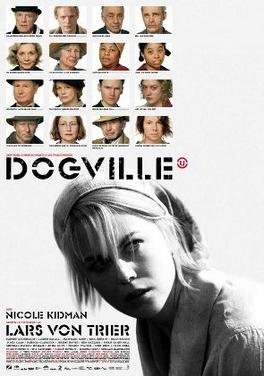
Today I was watching von Trier's own film from the same time period Dogville (von Trier, 2003), and it struck me that von Trier's entire English language career (his Danish language films are another story) has been a Five Obstructions-style series of remakes. Von Trier keeps remaking the same movie a female Christ-figure -- a pure-hearted woman who suffers unjust torments in order to save someone she selflessly loves. In Breaking the Waves, von Trier challenged himself to shoot the film in a hyper-realistic hand-held camera style; in Dancer in the Dark he remade the story as a musical; and in Dogville he remade the film on a single sound stage without any sets in the manner of Thornton Wilder's Our Town or a Bertolt Brecht play.

The strange thing is that Dogville ends quite differently than the previous films it is remaking. In the earlier films, the suffering woman is eventually killed but brings a kind of redemption through her death. These are clearly New Testament sort of stories. At first Dogville seems to be following the same narrative, but in its last ten minutes the story suddenly turns Old Testament: a God-like gangster shows up and convinces the film's Christ-figure to choose judgment over forgiveness. I'm not sure what to make of this. Is von Trier repudiating the earlier films? Or is he merely showing us another aspect of the infinitely complex truth?

At one point, the philosopher-novelist character says he is writing a story based on the events of the film. When he adds that he hasn't come up with a good name for the town yet, the heroine asks him why he doesn't just call it Dogville. He replies: "It wouldn't work. It's got to be universal." Well, if the movie we're watching is called Dogville, does that mean it isn't (and isn't intended to be) universal? So perhaps the point of the film is not to reject forgiveness and mercy entirely but to remind us that grace is not the whole story: there is judgment and justice, too. Rather than read Dogville as a critique of the Gospel narratives, perhaps we should read it as a retelling of the Sodom and Gomorah narrative: God sends an angel to the town but the people rape her and so God destroys the town. This isn't the prettiest story in the Bible, but it is still in there and must be reckoned with.

Starting from this reading it is tempting to see the film as von Trier's reaction to the terrorist attacks of September 11, 2001. (This was von Trier's first film made after 9/11.) Perhaps, like Jeremiah Wright and Jerry Fallwell, von Trier is interpreting the terrorist attacks as God's judgment on the United States. Especially in light of the closing credits which plays David Bowie's "Young Americans" over images of American crime and poverty, combined with the film's Prologue about the philosopher's attempt to teach the town a lesson about their inability to receive good gifts, von Trier seems to be saying that God has given the U.S. grace upon grace but we have not provided God's gifts with a hospitable place in which to live and bear fruit. And if we persist in our inhospitality we will face God's wrath.

Fortunately this is only one aspect of the infinitely complex truth. Instead of following the townspeople of Dogville, we might instead follow the selfless heroines of Breaking the Waves and Dancer in the Dark. We might choose to take the world's suffering on ourselves and to transform it into an opportunity for love.

Tuesday, January 27, 2009

"These are the fittest, well-fed, best-kept horses I've ever seen."

Recently actor Liam Neeson was a guest on The Daily Show With Jon Stewart. He was supposed to be there to discuss his new movie, but the interview ended up focusing on a local New York City political debate about the horses used to pull carriages around Central Park. Stewart maintains that animals "would rather run" freely than pull carriages and deserve "a better life" in a "pastoral existence". But Neeson argues that domestic animals like cows and horses have "been trained for thousands of years" to do this work and actually enjoy it. Neeson's suggestion is that domestic animals can actually be fulfilled by their work (when given humane working conditions) in the same way that humans can be fulfilled by their jobs.

I couldn't get the embed function to work, but you can watch the video here. (The relevant discussion starts at 1:40 and ends at 5:04.)

Neeson's view reminds me of C.S. Lewis's argument in The Problem of Pain that it is the human vocation to domesticate all animals. In contrast to what he calls “atheistical thought” which sees wild animals as natural and domestication as artificial, Lewis argues (based on God's command in Genesis 1:28 to "subdue" the earth and "have dominion" over the animals") that the tame animal is “in the deepest sense, the only ‘natural’ animal – the only one we see occupying the place it was made to occupy".

For a reconstruction of Lewis's view see my essay "Animal Pain and the Community of All Creatures" (esp. p. 10ff) available on my website.

Monday, January 5, 2009

"If you want more meaningful art, build a more meaningful world."

I found myself with some time to kill in a bookstore recently. Mostly I read philosophy and theology books, but brick-and-mortar bookstores rarely carry a very good selection of such books. I have to go to Amazon to find most of the stuff I'm looking for. So I often turn to the periodical section to kill my browsing time.

This time I ended up reading the Nov/Dec 2008 issue of Adbusters magazine. I've been a fan of the Adbusters anti-capitalist artwork (such as the image above), but I've never read the actual magazine. There were several really interesting articles in this issue.

The first one that caught my eye was about pop art (foreshadowed by Ducham's dadaism) as a critique of American capitalism's implicit nihilism. Author Sarah Nardi quotes Warhol as saying he "wanted to paint nothing" and Murakami as saying he tries to "express hopelessness." You can read the article here.

But a more thought-provoking article was "Virtual Morality" by Andrew Tuplin. Tuplin explores the phenomenon of violent video games such as Gand Theft Auto and amoral virtual worlds such as Second Life. These and other computer programs allow users to act out violent and sexually deviant fantasies.

Tuplin points out that the Enlightenment conception of morality (which most Americans have) is more or less libertarian: the purpose of morality is only supposed to allow us to pursue our own freely chosen goals while preventing us from hurting others in the process. In short, something is morally wrong only if it harms someone. And "harm" is defined as doing something against someone's will. Note that on this view it is conceptually impossible to "harm" oneself (as long as you are not acting out of some sort of confusion or insanity such as addiction). So for those with this conception of morality, there could be nothing wrong with acting out fatasies of rape, torture, pedophilia, etc. if these fantasies are simulated and do not harm any actual person.

Then Tuplin argues that religious ethics can provide an alternative to this view. According to Tuplin, religious ethics teaches that something is wrong if it offends God and that God is offended by our thoughts and desires as well as our actions. On this view, it is morally wrong even to want to rape or torture whether you act on those actions or not. So for those who have this conception of morality, there is no significant difference between virtual and actual behavior.

Now, I see what Tuplin is going for. The subtitle of his essay asks the question "Are we free to do anything we want in a virtual world, or are some things inherently wrong?" So he is attempting to reject the ethical view called "consequentialism" according to which something is wrong only if it harms someone. Instead he want to affirm a form of "deontology" according to which actions are inherently right or wrong regardless of their consequences. But he doesn't seem to understand that one need not be religious to affirm deontological ethics.
And he doesn't seem to understand that one need not hold to a divine command ethics in order to be religious. Historically, the majority of Christian theologians have rejected the sort of ethics Tuplin calls "religious". Indeed, I would argue that, it is logically incoherent to think that morality is based on what offends God.

But Tuplin is on to something when he says "The humanist or secular view of morality is concerned only with what we do. True religious morality is concerned not only with what we do, but with who we are, with what we desire to do." If we disregard his characterization of the two views as religious vs. secular, Tuplin has indeed given us a good alternative to Enlightenment ethics. The point is that for pre-Enlightenment views morality is as concerned with character as with behavior. (Note that this was the view of the Greek philosophers and is not essentially tied to religion.)

The important difference between this view and the Enlightenment view is that morality is not simply about preventing harm to others, but involves preventing harm to oneself. "Harm" on this view is doing something against an ideal, not simply doing something against one's will. This is a health model of morality. If you act in a way that is not healthy (i.e., it is not living up to the ideal of human nature), then you harming yourself and are acting immorally even if you don't harm anyone else.

This view gives us a way to criticize violent and sexually deviant fantasies: it is an abuse of one's own character to have immoral desires even if one never acts on those desires.

Thursday, December 25, 2008

"What's Christmas but a time for finding yourself a year older and not a day richer?"

I'm with my in-laws for Christmas, and last night I got raked over the yule log for suggesting that children should be taught not to care about getting presents for Christmas. I was arguing that Christians especially should be brought up to reject consumeristic celebration of the secular holiday (call it Festivus, if you wish, though I'm not referring to the Seinfeld holiday) on which American children worship the false god named Santa Claus. Though not in so many words, I was more or less accused of being a Scrooge.

Tonight we're watching Scrooge (Neame, 1970), the best musical version of A Christmas Carol, and it struck me that it's the American consumer culture that is Scrooge, not me. Modern Christmas is the triumph of the Scrooges over the Dickensian sentiment.
I don't know how I missed it before, but A Christmas Carol is obviously an anti-corporate screed. It is a critique of Scrooge, a capitalist who refuses to give his employees fair working conditions: no living wage, no eight hour working day, no five day work week, no vacation days, no day off for Christmas, etc. Scrooge hates Christmas, not because he hates people in general (as the musical version would have it), but because Christmas is bad for business. He is being asked to give Bob Cratchit a day off with pay and to give money to various charities. He thinks the whole holiday is a scam by lazy poor people to get money out of hard working rich people. But in the 20th Century, Scrooge got his revenge. He managed to turn Christmas into a money-making business. Even if he has to give people a day off from work, he still makes a profit because he has made their celebration of the holiday all about getting and spending.

I don't have it in for celebration of what Dickens calls the spirit of Christmas. In fact, Dickens's point seems to be that the spirit of Christmas is to be generous to those less fortunate than yourself. (The ghost of dead businessman Jacob Marley tells Scrooge that "'Tis mankind should be our business, though we [capitalists] rarely attend to it.") And I don't even have it in for making merry -- decorating trees, dancing, driking, exchanging gifts. I've written on this blog about my theory of Christian art as redemption of secular culture, and that's what most of our Christmas traditions are about: baptizing pagan rites for Christian purposes. But there are some things that can't be redeemed. Violence is one of them. Consumerism is another. When you try to sell Christmas, the pagan (in this case, American capitalist) element wins, and the Christian attempt at redemption is overwhelmed.

So I say a hearty "Humbug!" on Scroogified gift-centered capitalist Christmas. And wish you instead a truly Dickensian semi-socialist merry Christ-Mass.

Sunday, December 14, 2008

"Only in theory do we begin to suspect the power of aesthetics to shape our lives."

I was in the doctor's office waiting room this week, and I happened to pick up an old issue of The New Yorker from back in June. I was pleasantly surprised to find an essay by Tobias Wolff about a time when he saw Bergman's Winter Light at a church screening in Oxford. I really liked Wolff's optimistic reading of the film:
Bergman takes care to show that Tomas and the fisherman are not alone in their suffering, and that others, equally afflicted—the fisherman’s wife, the pastor’s steadfast lover, his hunchbacked assistant—are able to bear their pain into a still deeper faith and capacity for love.
This is how I want to read Winter Light. It is an unexpected affirmation of faith, not a rejection of faith as it is normally read.

But the point of the essay is not really about Winter Light. It is about the importance of art and beauty. After seeing the film, Wolff says he "felt harrowed, crust broken, buried things churning to the surface." At that point in his life Wolff was an atheist, but he was open to hearing what the minister might say about the film. Until the minister put up a slide of William Holman Hunt's painting "The Light of the World" which Wolff found "garish, melodramatic, cloying in its technique and sentimentality". Wolff ended up continuing in his life as a disbeliever until, years later, he discovered the poetry of George Herbert, Gerard Manley Hopkins, and T.S. Eliot.

Wolff concludes:
We like to think of our beliefs, and disbeliefs, as founded on reason and close, thoughtful observation. Only in theory do we begin to suspect the power of aesthetics to shape our lives.
But he notes that not everyone experiences beauty in the same way. A friend of his who was with him at the Winter Light screening was converted by the Holman Hunt painting that put Wolff off. His encounter with the painting put him on a path that eventually led him to being a missionary in Africa. Peggy Rosenthal over at the Image Journal interprets this as a lesson about the power even bad art can have to point us toward truth:
We must admit that in our popular culture plenty of bad art stirs people to genuinely good religious faith, a faith that issues in loving actions and a Christ-like spirit.
I'm not sure that's quite right. This is a lesson about the importance of context. Wolff writes that "the contrast between Bergman’s severe, honest art and this painting, on the same screen, chilled me" (my emphasis). I actually don't hate the Holman Hunt painting. I think it does have a (perhaps simplistic) kind of beauty. But I can see how in juxtaposition to Bergman's film it would come off banal. So why didn't Wolff's friend notice this jarring juxtaposition? The context of film appreciation is not entirely external. It is internal and subjective, too. We bring our own context to the work.

If all we look at is the objective context of the chapel in Oxford on a night in the winter of 1970, then all we see is the contrast between Winter Light and Holman Hunt. But if we could see into the heart of Wolff's friend, we could see why he was able to experience the beauty of the painting while for Wolff that small beauty was outshone by the brilliance of Bergman's film. Every object has some beauty in it, and every beauty has some truth. And the power of beauty's truth is so strong that it can work even through less than brilliant artworks. I guess I'm ultimately saying the same thing as Rosenthal: even lesser art can shape our lives for the better.

Saturday, November 29, 2008

"It all depends on other people."

I’m not usually a big fan of British historical romance stories, but Atonement (Wright, 2007) actually worked for me. It wasn’t the tragic romance that captured my attention, but the unexpected philosophy. The movie turns out to be a sort of postmodern Masterpiece Theater remake of Michelangelo Antonioni’s 1966 masterpiece Blow Up.

The opening image is a typewriter. The sound of the typewriter is a recurring motif in the film, even being incorporated into the music. We don’t realize it until the end of the film, but the sound of typing functions as a subtle reminder that what we are watching is not the “absolute truth” as the main character Briony Tallis will later call it. It is Briony’s imaginative reconstruction.

After a friend of hers is raped by an older man, thirteen year old Briony fingers her older sister Cecilia’s lover Robbie Turner. She tells the police inspector, “I know it was him.” The inspector presses her: “You know it was him? Or you saw him?” Briony: “Yes. I saw him. I saw him with my own eyes.” This is a deliciously ambiguous statement. She did see the rapist with her own eyes. But it wasn’t Robbie she saw.

Atonement turns out to be a movie about imagination: seeing things you think you understand but don’t understand. Throughout the film (as with Kurosawa’s Rashomon) we see the same scenes replayed from different (sometimes even fictional) points of view. At various points it is unclear (though, as with Bryan Singer’s The Usual Suspects, we don’t realize it is unclear until the end of the film) whether what we are seeing is reality, merely one person’s interpretation of reality, a dream sequence, or an utter fiction.

The first line of the film is Briony’s: “I finished my play.” She is excited, but can’t get others to cooperate in the performance and production of the play. So she decides to stick with novels: “If you write a story, you only have to say the word ‘castle’ and you can see the towers and the woods and the village below. But in a play it’s… it all depends on other people.”

After the close of the movie’s narrative, we flash forward to an elderly Briony in present day giving an interview about the story we have just seen. She explains that the story of Atonement must be her last novel. because she has a disease called vascular dementia in which “your brain closes down, gradually you lose words, you lose your memory, which for a writer is pretty much the point.”

Now, Briony’s “novel” is so “entirely” “autobiographical” that she says “I haven’t changed any names, including my own.” She claims it is “the absolute truth” with “no rhymes, no embellishments”. But if Briony is losing her memory, then how can she be trusted to tell the historical truth? And if the story is pure history, then how is it a novel? Shouldn’t we call it a memoir? Not so fast. Briony continues:

“I got first-hand accounts of all the events I didn’t personally witness[…]. But the effect of all this honesty was rather pitiless. You see, I couldn’t any longer imagine what purpose would be served by it. […] By honesty. Or reality.” She was “too much of a coward” to make amends for her false accusations and so she “imagined” the scene, “invented” it. “But what sense of hope or satisfaction could a reader derive from an ending” that told the ugly truth? She admits to changing the facts and giving her character the strength to do what she ought to have done, but says she’d “like to think this isn’t weakness or evasion, but a final act of kindness. I gave them their happiness.”

This is Briony’s atonement, her attempt to make right the happiness she prevented her sister from having. But notice that the effectiveness of this atonement rests on a paradox. The novel must narrate a happy ending for Cecilia and Robbie while simultaneously confessing Briony’s sin of preventing that happy ending. Briony has to tell the story both as it did happen and as it ought to have happened but did not.

John Mullan gives a nice analysis of this final scene in the London newspaper The Guardian. (He’s writing about Ian McEwan’s novel upon which the movie was based, but his comments apply to the film, too.)

Unlike writers of metafiction, McEwan wants you to identify with characters, to succumb to narrative illusion. For Briony to undertake her “atonement”, her work of fiction must make up for, and confess, the wrong that she has done. In a novel, she can make the world better than it truly is. She can make Cecilia and Robbie survive and meet again. And we must be allowed to believe it.

In other words, the reason Briony’s atonement works (if it does) is that she has made us believe in the love story and feel the aesthetic appropriateness of its narrative conclusion. (Note the ironic symmetry here: like the play from the opening scene, the closing scene reveals that the effectiveness of Briony’s novel “all depends on other people.”) But Frank Kermode seems to give the opposite analysis in The London Review of Books, arguing that we are not supposed to believe the story:

It is, in perhaps the only possible way, a philosophical novel, pitting the imagination against what it has to imagine if we are to be given the false assurance that there is a match between our fictions and the specifications of reality. The pleasure it gives depends as much on our suspending belief as on our suspending disbelief.

But Kermode is using “believe” in a somewhat different sense than Mullan. Mullan argues only that we must be emotionally committed to the story -- that we “identify with the characters” -- not that we accept them as nonfictional representations of reality. So what is Mullan’s point? He is reading Atonement the way postliberal theologians read the Bible.

For modern theologians (both liberals and fundamentalists), the point of Scripture is its representation of reality. Believers must either accept all the Biblical stories at fact value (as do fundamentalists) or they must try to find the philosophical truth behind the mythical stories (as do liberals). But postliberals (and postevangelicals) realize that there is no way to get behind the text. There is no way to know exactly what happened historically and thus there is no way to know to what degree the stories are fact or myth – just as there is no way to know to which bits of Atonement are facts, which are Briony’s false interpretations of facts, and which are pure fictions.

And even if we could know “the absolute truth” about what “really” happened, this would be beside the point. The (historical) truth would, as the elderly Briony says, no longer serve any purpose. (Kierkegaard says much the same thing about the historical Jesus.) But as Mullan points out, this need not imply that we can’t believe the story. For postliberals belief is more a commitment to a form of life structured around the Biblical narratives. We can enter into the story without knowing what really happened. We can, as Mullan says, “identify” ourselves with Christ -- we can let him enact our “atonement” with God -- despite the fact that there are four (incompatible) versions of his life in the four Gospels. Scripture does not mirror the (uninterpreted) reality of history -- it structures our reality and teaches us to interpret history, giving us a “sense of hope or satisfaction”. But it is precisely in this way that Scripture turns out to be true.

Friday, November 14, 2008

"Donc, si vous voulez, mon art serait de vivre."

We are all artists.

Whether you want to be an artist or not, whether you feel like an artist or not, you are an artist. Even if you haven’t painted a picture since the days of kindergarten finger-paint, even if you haven’t danced a single step since your Saturday morning ballet lessons in elementary school, you are still an artist. Even if you haven’t written a story since junior high creative writing assignments and haven’t played a musical instrument since high school marching band or composed a song since your now abandoned late nights as an undergrad rock star wannabe, even if you have given up on all these artistic endeavors, you are still an artist.

As long as you are alive it is impossible to stop being an artist; for your life itself is your work of art. Every choice you make inscribes a sentence in your autobiography, every emotion you feel paints a brushstroke of your self-portrait, every belief and every desire sounds a note and choreographs a step in the performance of your life.

You have no choice about whether your life will be a work of art. Your only choice is whether you life will be a good work of art, whether you will live a beautiful life and cultivate a beautiful soul.

Unfortunately there are no rules for how to create something beautiful. Aesthetic achievement takes genius, an understanding of your own unique relation to the world. This, of course, does not mean that anything goes. There are clear paradigms of beautiful lives and obvious examples of unspeakable deformities. The problem is that in the art of life, as in any art, there is no mathematical formula for success. Creating beauty takes good taste, an ability to discriminate the relevant details of your life and your world and a sensitivity to the harmonies and dissonances that reverberate from your choices.

And yet, in life as in the other arts, we can develop good taste. We learn first to discern and then to love the good by contemplating the paradigmatic works of beauty available to us in our traditions, the masterpieces lived by the saints and heroes. And we learn in conversation with our contemporary community of fellow artists how to read and interpret these great models of the past by engaging together in a study of the great critics of the past, the master philosophers and theologians, applying the lessons of the classics to our own ever-changing situations.

For Christians, the primary workshop for our training as artists is worship, the regular participation in word and sacrament. Christians believe that in worship we tell God’s story, enact the drama of salvation, and rehearse our steps in the eternal perichoretic dance of the ultimate Reality. In worship we encounter the ground of true Beauty and our lives are sculpted anew into His image and likeness. In worship we are taught how to think and feel and desire, how to represent Christ in our lives the way Christ represented God in his own life. In worship our souls are made beautiful.

But even if you are not a Christian, you are still an artist. Your life is still formed in response to traditions and models you take to be authoritative. We are all artists. May God grant us the grace to live artistically.

Sunday, November 2, 2008

"You can't mend the heart in a heartless world by observing that the world is in fact heartless."

Here are some nice reflections on the problem of evil by Andrew Brown, columnist for the British newspaper The Guardian:
"In the end, I suppose, my objections to God are, as they must be, theological: the workings of divine providence are just a little too inaccessible to human reasoning. The problem of suffering remains insoluble. There is no possible theodicy. But I can't, either, take the Dawkinsian view that the problem of suffering is an illusion generated by the illusion of God. You can't mend the heart in a heartless world by observing that the world is in fact heartless. That's not the point. I suppose I end up saying that I accept the Christian account of the problem; I just can't accept Christianity's account of the solution, and so I remain, by the grace of God perhaps, an atheist."
You can read the whole essay here. (Thanks to Episcopal Cafe's "The Lead" for pointing me to it.)

I really like his criticism of Richard Dawkins. And I am sympathetic to his view that there is no solution to the problem of evil -- sometimes I'm tempted to agree. But I wonder what exactly Brown takes to be "Christianity's account of the solution".

I'm a Christian theologian (more or less), and I'm still trying to figure out what sort of theodicy Christianity actually teaches. There have been many different theodicies offered by Christians throughout history. And even the Bible suggests different responses to evil. I don't find it at all obvious which theodicy (if any) coheres best with the majority of other fundamental Christian theological committments.

If there's one thing I am fairly sure of (given my reading of the relevant Biblical texts such as Job, the Psalms, Revelation, etc.) is that the best response to evil is going to have something to do with worship of God generally and in particular the liturgy of the Eucharist. (Then again, I tend to think that everything has something to do with the Eucharist!)

The centrality of worship (prayer, liturgy, communion, etc.) for our response to evil is something the best cinematic theologians have realized. I have already discussed Bresson's Diary of a Country Priest (see my earlier post) on this topic. Here let me just mention the work of Ingmar Bergman, perhaps the filmmaker most obsessed with the problem of evil. There are hints of Eucharistic themes in The Seventh Seal (Bergman, 1957) and The Virgin Spring (Bergman, 1960). But the theme becomes most prominent in Winter Light (Bergman, 1962) whose story takes place in and between two celebrations of the Eucharist.

One could argue that Bergman intended these films as a critique of the idea that worship can provide an adequate response to evil. (For a really good analysis of The Seventh Seal along these lines, see Steven Greydanus's essay at Decent Films.) But even if it is true that Bergman intended to reject a Eucharistic theodicy, he was unable to keep the truth from shining through his work. In any event, I think Bergman's intentions were more complex than simply rejecting Christianity. He also struggled with the ability of art to respond adequately to evil -- most significantly in Persona (Bergman, 1966), but I don't think he ever quite gave up hope that art could help us go on living.

Unfortunately I don't have time now to give a detailed analysis of Winter Light (I hope to do so in a future post -- this post was supposed to be a simple link to the essay by Andrew Brown!), but I encourage you to watch it for yourself and try to figure out what is going on in the final scene. Has the priest lost his faith? Why does he go through with the liturgy? Is this an optimistic or pessimistic ending? How does the ending relate to the endings of The Seventh Seal and The Virgin Spring? And, most importantly, what can we learn from this film (regardless of what Bergman was trying to teach us) about responding to evil?

Let me know what you think.

Wednesday, October 29, 2008

"Abortion confronts the Christian with the most perplexing questions of all."

This election season many Roman Catholic and Evangelical voters have found themselves attracted to Democratic candidate Barack Obama. At the same time, many of these religious voters feel conflicted because of Obama's pro-choice stand on abortion. That Evangelicals could support a Democrat at all is surprising, of course, because Evangelicalism has, for the past 30 or so years, wed itself tightly to the Republican party. But, for some Evangelicals and Roman Catholics, it is simply too much to ask to forsake the pro-life commitment that the Replublican party has used to gain the loyalty of the "Religious Right" for so long.

In light of this controversy, religious supporters of Obama have given some interesting arguments for Obama. For example, my wife posted about this issue on her blog and received some nice responses. Some pro-life advocates have explicitly argued in favor of Obama, too. But one of the most interesting arguments has come from Obama's running mate Joe Biden who has recently pointed out that Roman Catholic dogma on abortion has shifted throughout the centuries.

Catholic historian Frank Flinn has a nice article on the Church's changing attitudes toward abortion. He explains that it wasn't until 1869 that the pope declared abortion to be absolutely forbidden during all stages of pregancy. Before that, the fetus was not considered a person until the moment of "quickening" (i.e., the moment the mother first feels the baby move in her womb) which usually happens in the middle of the second trimester. Flinn even quotes Anselm as saying: "No human intellect accepts the view that an infant has the rational soul from the moment of conception"!

I suppose the argument here is that if even the supposedly infallible Roman Catholic Church has changed its mind over the centuries about when a fetus becomes a human person, then this is a question too hard for the American government and should be left up to individual people. It's the same point Obama was making when he told Evangelical leader Rick Warren that this question was above his "pay grade". One could reply (as did Biden's own Bishop) that when the Church changes its teaching, the later teaching is always better than the earlier teaching. But this reply would seem to undermine the whole point of conservatism which teaches that "traditional" (i.e., older) teachings are always better. This was the point I was making in my earlier post about same sex marriage. Conservatives can't argue that we should accept the "traditional" view of marriage, because on the traditional view wives are property of their husbands and the possibility of polygamy was assumed: men can own as many wives as they can afford. Here again the conservative argument from tradition doesn't support Evangelical and Catholic positions.

Now, I knew this stuff about the Catholic Church's evolving position, but when I read it again it got me wondering about Evangelicals. Has there been any shift in Evangelical understandings of abortion? A few minutes with Google reveals that there has been.

In 1968 Christianity Today sponsored a symposium on issues of birth control and abortion. And what happened? Evangelical leaders of the day got together and decided ... to be pro-choice. Follow this link for the published summary of the symposium along with some responses. Below are some of the most interesting passages, along with my comments in italics:
  • "Abortion confronts the Christian with the most perplexing questions of all: Is induced abortion permissible and if so, under what conditions? If it is permissible in some instances is the act of intervention still sinful? Can abortion then be justified by the principle of tragic moral choice in which a lesser evil is chosen to avoid a greater one? As to whether or not the performance of an induced abortion is always sinful we are not agreed, but about the necessity and permissibility for it under certain circumstances we are in accord." -- i.e., abortion is always tragic, but sometimes it is the best choice in a bad situation. Note also the assumption that we should approach the question of abortion with humility -- i.e., we should remember that the answer is above our pay grade.
  • "The Christian physician will advise induced abortion only to safeguard greater values sanctioned by Scripture. These values should include individual health, family welfare, and social responsibility." -- i.e., it is permissible to have an abortion if you think you won't be able to care for the child.
  • "The Christian maintains that in avoiding legalism on the one hand and license on the other, the prescriptions of legal codes should not be permitted to usurp the authority of the Christian conscience informed by Scripture." -- i.e., the choice of whether to have an abortion should be left to the individual, not mandated by the government.
  • "Physicians are called upon to maintain and restore the health of the whole [human being]." -- i.e., abortion may be necessary for the mental (not just the physical) health of the mother.
  • "We live in a world pervaded by evil. Human relationships become distorted; unwanted children are born into the world; genetic defects are not uncommon and harmful social conditions abound. Therefore, it is the duty of Christians to be compassionate to individuals and to seek responsibility to mitigate the effects of evil when possible, in accordance with the above principles. When principles conflict, the preservation of fetal life or the integrity of the human body may have to be abandoned in order to maintain full and secure family life." -- i.e., there are many kinds of cases in which abortion may be necessary: cases of "distorted" relationships such as rape or incest, cases of "genetic defects", cases of "harmful social conditions" such as poverty, cases in which the mother's bodily "integrity" is threatened such as when her life or health is in jeapardy, and even in cases of "unwanted" pregnancy. Note that many of these cases are spelled out in more explicit detail elsewhere in the report.
So this is a fairly standard pro-choice document. It is also a clearly pro-life document -- what? you can be pro-life and pro-choice at the same time? -- but while affirming the value and sanctity of all human life from the moment of conception, the document's drafters understand that in this fallen world hard choices must sometimes be made. And those choices can't be made for us by government officials who don't know the specifics of our case and try to create blanket rules that apply to everyone. Its a document I think Obama could agree with.

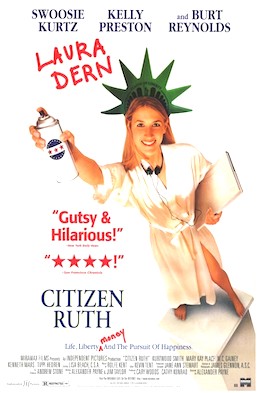
The document actually reminds me a lot of one of my favorite movies on the topic of abortion: Citizen Ruth (Payne, 1996). The movie satirizes both sides of the culture war, indicting both pro-life and pro-choice activists for their mutual failure to treat the women involved as actual human beings rather than pawns in a political battle. (There's a key scene toward the end where the two sides are so involved in screaming at each other about what is in Ruth's best interests that they don't notice her walking away from the whole mess.) In 1968 Evangelicals were the compassionate people writer-director Alexander Payne would one day challenge us to be with his film. But by the time he actually made his film in 1996, Evangelicals were just the butt of his jokes.

Sunday, October 5, 2008

"Abortion is murder!"

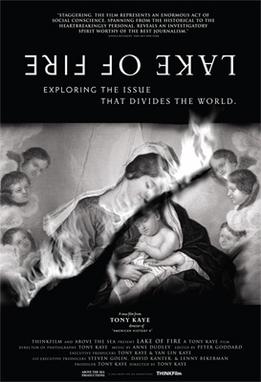
When I return to teaching, I plan to assign my students to watch the abortion documentary Lake of Fire (Kaye, 2006). Along with the Jewish homosexuality documentary Trembling Before G-d, it's one of the most stimulating movies I've seen about a contemporary ethical issue. And, like movies such as Waking Life and My Dinner With Andre, the film is made up almost entirely of philosophical discussion, priming the audience's intellectual pump for class discussion.

One caveat I have about the film, though, is that I don't think students will be able to digest the material without expert commentary. Much of the footage is presented without editorial comment -- there is no narrator and very few on-screen titles -- and hence lacks any sort of context and ends up being misleading.

Because of this lack of commentary, most reviews of the film claim that it is fair to both sides of the debate -- something unusual in the abortion contoversy. But I didn't find the film to be fair and openminded at all. Filmmaker Tony Kaye is not unbiased -- he's obviously pro-choice. I actually have a hard time understanding why anyone would miss this point. Why would reviewers think Kaye is anything but pro-choice? Surely professional film critics don't need the director to come right out and say he is pro-choice before they can detect his viewpoint. (Maybe they've seen too many Michael Moore movies!)

A more charitable interpretation of the critical blindspot is that since the film includes graphic footage of late-term fetuses, perhaps reviewers were led to think Kaye is sympathetic to the view that abortion is murder. After all, these fetuses look exactly like post-birth babies, and hence exactly the same sort of footage is used in many anti-abortion propaganda movies. (This, by the way, is one of the misleading scenes. The fetuses are clearly in their second-trimester of development. But without being told that almost 90% of abortions take place in the first-trimester when the fetus looks more like a sea monkey than a baby, viewers might think that all aborted fetuses look like this.)

Another reason people may mistakenly believe the film is ambivalent is that, in part because of the graphic footage but also because it presents such an array of voices from every side of the debate, the film is so unsettling that it creates a kind of ambivalence in the viewer. It's not that Kaye doesn't know what he thinks about abortion or that he keeps his own viewpoint hidden in the film -- it's that after watching the film, you no longer know exactly what you think about abortion. And that's the most significant aspect of the film. It's also one of the most pro-choice aspects of the film. The film wants to convince us that this is a hard issue that is not as black and white as it is usually presented in political debates. Therefore, the film suggests, we should leave the choice about abortions up to individuals.

Another caveat: I'm not sure the film is primarily a debate about abortion at all. It is a documentary about the people involved in the abortion debate. And it's mostly about fundamentalist Christians who believe that abortion doctors should be assassinated. In some ways, the film is presenting a philosophical challenge to pro-life advocates, asking them "if you agree that abortion is murder, then what makes you different than these extremists?" (Again, I don' t think the film is even trying to be unbiased.) It's a fascinating question: if abortion really is parallel to the holocaust, then why shouldn't pro-lifers declare open war on abortionists like the Allies declared on the Nazis?

Brett McCracken, an Evangelical reviewer, misses this challenge. He complains in his Christianity Today review that the film "purposefully avoids featuring any thoughtful, articulate, or moderate Christians". From the rest of the review, I have to assume that by "moderate", McCracken means a Christian who condemns abortion as murder but also condemns the murders of abortion doctors. While this may be true, the film nevertheless presents the positions of moderate Christians, while putting them in the mouths of extremists. And what this move does is make the extremists look like they have some good points and that they are not (entirely) crazy. So I actually take this to be a rhetorical virtue of the film.

Moreover I reject McCracken's definition of "moderate Christian". I think any view according to which abortion is obviously murder is a pretty conservative one. A truly moderate Christian is one who admits that this is a hard issue about which the Bible has little to say, and who is willing to allow diversity of opinions about abortion. A liberal Christian is one who simply accepts the pro-choice viewpoint as obviously true.

McCracken seems to think that what separates his own (supposedly "moderate" view) from other "fundamenatlist" or "expremist" views, is that he is not interested in forcibly converting nonbelievers. He complains that the film makes all pro-life advocates look like "mindless pawns in a larger and more malicious march toward theocracy". In other words, the film assimilates anyone who votes against abortion rights to the "reconstructionist" viewpoint that the laws of the United States should be revised to match the laws of the Old Testament so that, for example, anyone who uses the Lord's name in vain should be put to death. (Someone in the film actually gives this example!)

Again, McCracken's observation is true: the film does attempt to blur the line between extremist theocrats and more moderate run-of-the-mill pro-life Republicans. But again this is a virtue of the film. I think a strong case could be made (though the argument is left implicit in the film) that anyone whose position on aborion legislation comes from their Christianity and not from publically shared reasons is, indeed, a theocrat. (This point is even more clear when it comes to the issue of gay marriage.) The fact that McCracken is so defensive suggests that, on some level, he knows this critique to be on target.

It's this ability to challenge us to rethink the implications of our deeply held beliefs about abortion that I think is the film's biggest philosophical strength. Without the Socratic ability to recognize that we lack wisdom, we have no hope of escaping the unproductive torment of the "lake of fire" the abortion controversy has devolved into.
Tuesday, September 9, 2008

"Love is always small."

Christianity Today has a great interview (online here) with Andy Crouch about his new book Culture Making: Recovering Our Creative Calling. I've been a big fan of Andy since his days as creator/editor of re:generation quarterly. And his new book sounds especially exciting since it is the kind of thing I've been thinking about, too. See my review of WALL-E.

Thursday, August 28, 2008

"Is not all religion a contract between man and God?"

One of the recurring themes of this blog is the problem of evil. My first real post was titled "Theodicy at the Movies". But my interests are all of pop culture, not just movies. Today I want to discuss a graphic novel. Comic book auteur Will Eisner coined the term "graphic novel" as a fancy word for a literary comic book. And what's a comic book but a non animated cartoon?

The title piece in Eisner's seminal graphic novel (actually a collection of graphic short stories, but graphic literature in any case) A Contract With God (Eisner, 1978) is an interesting exploration of the problem of evil -- interesting because, like much great literature, it is open to multiple interpretations. Indeed, I would say that the story's ambiguity is its point. Like the problem of evil itself (at least in Eisner's view), the story is a mystery with no solution.

This is a very Jewish bit of theology. One of my favorite things about Contract is the way Eisner sometimes draws question marks in a font that resembles the Hebrew alphabet. Another example of this font is the word "God" on the cover, shown above left. To the right is one point where we see the Hebrew-esque question mark.

It is important that Eisner doesn't always draw question marks this way. He reserves this font for theological questions. Moreover, the only place he uses this Hewbrew font (other than the title) is in these theological question marks. It is as if Eisner sees the essence Hebraic thought as an unsolvable mystery, perhaps drawing on the tradition according to which the word Israel means "he who wrestles with God". And for the Jews, a nation persecuted for thousands of years, this wrestling revolves around the mystery of evil.

Friday, August 22, 2008

Jihad: "to strive in the path of God"

First there was Trembling Before G-d (Dubowski, 2001), then there was For the Bible Tells Me So (Karslake, 2007), and now comes A Jihad for Love (Sharma, 2008). These are documentary films about religious gay and lesbian people, focusing on Judaism, Christianity, and Islam, respectively. I loved Trembling Before G-d, but was disappointed by For the Bible Tells Me So's lack of rigorous engagement with the difficult Biblical texts (despite the film's title and the claims of its promotional materials.) But since Jihad was produced by the same people as Trembling, I have high hopes.

It's playing in San Francisco and Berkeley this week, though I haven't seen it, and to be honest, I'll probably wait for DVD. It's not getting great reviews, but for students of the problem of religion and homosexuality, it is surely worth a look. You can check out the official site here. And the trailer is below: