Showing posts with label self-deception. Show all posts

Thursday, February 12, 2009

“You’re working for me now.”


I currently live in Berkeley but Los Angeles is my home. So I never miss a chance to watch L.A.-themed movies. This week I watched for the first time To Live and Die in L.A. (Friedkin, 1985). It was a strange experience. For most of the movie I had the growing suspicion that the film was a piece of crap. It seemed like an utterly cliché cop buddy movie. All the characters speak in fake movie dialogue -- but dialogue that sounds silly, not cool like the fake movie dialogue in a Tarantino film. The alledged "hero" of the movie is an idiot who does all sorts of stupid and dangerous things that only movie cops do and would get real life police officers killed. More than that, the hero is a psychopath. He's beyond Dirty Harry. He's more like a Bad Lieutenant. But the film treats him in a typical heroic mode.... at least until the end.

The end of the movie caught me completely off guard. The hero just dies all of a sudden. And not in a big climactic shoot out or anything. The movie is going along like normal, and BANG, the guy dies. Then the movie goes along without him. It shouldn't be surprising that he dies since he's an idiot and a scumbag. If anything it should be suprising he lived as long as he did.

So the ending was like a Sixth Sense or Usual Suspects moment which sent me back to re-evaluate what I had seen earlier. A little Googling turned up a rather brillian essay that sheds light on the experience I had. It's a pretty long piece, so here are some quotes:

After nearly two decades of regarding To Live and Die in L.A. (1985) with a spectrum of emotions ranging from disdain-at-first-sight to qualified enthusiasm, it occurs to me that of all his works, this is the film I have watched and pondered most frequently. No longer do I see it as a shimmering piece of costume jewelry, but a forceful, semi-serious diagnosis of a prevalent human malady: the discrepancy between what we desire, or what we are pleased by, and what we claim to value, not only in life but in cinema. ...


[Director William] Friedkin redirects the modern cop thriller through the chartreuse time machine of noir, adorned with the MTV confections of Miami Vice, but his film emerges assomething far more nasty and authentic. ... To Live and Die in L.A. is also quite amusing, presumably intentionally, but possibly not. The humor is a conscious or unconscious byproduct of Friedkin’s love-hate relationship with the genre he plunders...


But once the superficialities are shunted aside, it becomes clearer that Friedkin’s film strives to deviate from the norm. Its hero is a corrupt man emblematized by a refusal to change, and his partner willingly swaps his morality for depravity. The villain, who murders only those who have betrayed orendangered his interests directly, is never as unlikable as the hero becomes. The protagonist, whose conduct leads to the death of innocent bystanders, is dispatched in the climax without a tear being shed. The hero’s obligatory “romantic interest” is at the very least a reluctant victim of coercion, and, conceivably, might qualify as a sex slave. And the voracious slickness that taunts Miami Vice (1984-1989) has, by film’s end, become the source of as much discomfort as pleasure. So this is not your ordinary cop thriller. ...


One of To Live and Die in L.A.’s persistent motifs is the creation and pursuit of phony things. As spectators grow to distrust the contradiction between what the film introduces itself to be and what it in fact is, they begin as well to question their own moral gullibility and aptitude in judging what is set before them. ...


I believe Friedkin is intrigued that we are so quick to take sides in a movie, and so easily manipulated to accept complexity as simplicity. This is likely why he adheres to the conventions of the buddy thriller—at times pressing them beyond credulity—before escalating what becomes a point-by-point repudiation of the devices used in such films to make spectators comfortable with dynamics that should not evoke comfort.

In the end, the essay's point is about self-deception, one of my favorite themes in cinema:

once we have agreed to stipulate that Chance is our hero, [Friedkin] wants, like a Judo master, to use the momentum of our own self-deception to flip us on our backs.
You can read the whole essay here at the website 24 Lies A Second.

Wednesday, May 21, 2008

"We all need mirrors to remind ourselves who we are."

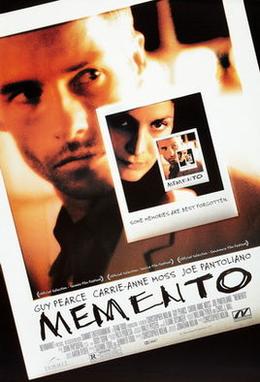
In recent posts, I've been exploring films that generate in their views a kind of self-deception. Today, I want to discuss a film that doesn't necessary trick us in this way, but rather explicitly addresses the issue of self-deception: Christopher Nolan's Memento (1999).

In Memento (as I'm sure you remember), Leonard Shelby has this "condition" called anterograde memory loss in which he can't make new memories. (It's the same problem Drew Barrymore has in 50 First dates, a "less depressing" movie as one of my students pointed out to me, but also a less philosophically interesting film as I pointed out to him.) I find it interesting, that whenever Leonard talks about his memory problems, he refers to it as a "condition". I'm sure its a sign of nothing so much as my own insanity, but when I hear the term "condition", I can't help but think of the philosophical concept of "the human condition".

Leonard has the words "Remember Sammy Jankis" tattooed on the back of his hand. Leonard says he tells people about Sammy "to help them understand. Sammy's story helps me understand my own situation." In the last lines of the film, Leonard claims, "We all need mirrors to remind ourselves who we are.” In his essay in Movies and the Meaning of Life, Michael Baur argues that Memento is one of the mirrors that can remind us who we are. Just as Sammy's condition is Leonard's condition, so Leonard's condition is our condition. Baur convincingly reads the film as an exploration of the problem of personal identity, in particular giving a Heideggerian critique of Locke's memory theory of identity. I highly recommend Baur's essay. Movies and the Meaning of Life is one of the best anthologies of film-philosophy out there, and Baur's essay is one of the best in the book. I don't wish to challenge his reading. But I do want to add an additional reading. I propose that Memento can also be read as an exploration of what Lyotard called "the postmodern condition". (Again, it's probably just my own insanity, but I can't help hearing a verbal connection between the names Leonard and Lyotard.)

Jamie Smith
has already explored some of Memento's connections to postmodern philosophy in his book Who's Afraid of Postmodernism? Taking Derrida, Lyotard, and Foucault to Church, but he focused specificaly on themes from Derrida. I'd like to take a more general approach to postmodernism, borrowing a familiar narrative about modernity as the quest for certainty and postmodernity as the acceptance of human finitude. On this narrative, see the work of Richard Rorty, Stephen Toulmin, Nancey Murphy, et al.

(By the way, Smith's Who's Afraid of Postmodernism? should be read by everyone interested in the future of the church. His discussions of postmodern philosophy are basic, but his application of postmodernism to the emerging church is brilliant. He shows why a truly postmodern church needs more than just candles, ambient music, and video screens -- it needs traditional liturgy, the lectionary, spiritual disciplines, etc. Too many of my friends in the Episcopal strand of the emerging church movement are giving up these things in favor of worship practices that are basically just Gen X versions of old-school modernist "seeker sensitive" churches. Smith is right that a truly postmodern church will need to recover its Catholicity. Anyway, back to Memento....)

Let's start at the beginning -- which, in Memento is actually the end. The first image in the film is a polaroid photograph. But the shot is played in reverse so that the image gradually fades away before being reinserted into the camera. I take this shot to be a summary of the entire film. One of Leonard's tattoos reads "Buy film. Camera doesn't lie. Notes can be lost." In one scene, Leonard tells Teddy: “Facts, not memories. That's how you investigate. … Memory can change the shape of a room; it can change the color of a car. And memories can be distorted. They're just an interpretation, they're not a record, and they're irrelevant if you have the facts.” So I take Leonard's polaroids as a symbol of objective evidence -- he thinks of them as pure, uninterpreted access to the Truth. But the film gradually undermines this view.

On this reading, the opening shot of the fading photograph symbolizes the loss of objective evidence: the postmodern condition as the awareness that all facts are mediated by the perspective one brings to them.

If Leonard's photographs suggest a modernist desire for objective evidence, perhaps we can read Leonard's memory problem as another symptom of modernity: the loss of tradition. Modernity, especially in its radical Enlightenment form, was the rejection of the authority of tradition in favor of, as Kant put it, "daring to know" for oneself. (Hence the Protestant Reformation.) Leonard's condition requires us to "learn to trust your handwriting. ... You have to be wary of other people writing stuff for you that is not going to make sense or is gonna lead you astray." Hence modernity involves radical individualism and autonomy.

Moreover, as Leonard says, in a world without memory, "You really need a system if you're going to make it work", recalling the desire of early modernists like Descartes and Francis Bacon to find the proper scientific and philosophical "method" by which to generate a perfect system of knowledge. Descartes's version of the method involved radical doubt, questioning anything that couldn't be proven with certainty. What he found using this method was that the only indubitable foundation of knowledge is one's own consciousness: "I think, therefore I am." (On this point, consider how much of the dialogue in Memento is Leonard's subjective thoughts in voiceover.)

The problem then becomes how to build a bridge from the subjective to the objective, to prove that as Leonard puts it at the end of the film, "a world outside my own mind." But Memento, following postmodern philosophy, argues that this is impossible. The problem is not just that it is impossible to overcome Cartesian skepticism about the external world, but that there is no such thing as "the" external world. Reality is not "given" to us, but must be interpreted by the knower.

The structure of the film reveals this fact to us. We are shown a scene and then are shown what happened just before that and then what happened just before that, etc. With each scene we are "thrown" (as Heidegger might put it) into the middle of an event and forced to interpret what's going on along with Leonard: "Ok, what am I doing? I'm chasing this guy. ... No, he's chasing me!" But with each new scene we are forced to reinterpret the previous scenes -- every interpretation is revisable, and certainty is impossible.

The most obvious example of this is the scene where Natalie manipulates Leonard. First we see Natalie crying and telling Leonard that a guy named Dodd has beaten her up and Leonard agrees to go "get rid of" Dodd for her. Then we see what took place just before this: Natalie provokes Leonard into beating her up. She takes all the pens with her and leaves the room so that Leonard can't write down what happens. Then when he forgets what he has done, she returns and pretends to cry, etc. What we took to be self-evident, unmediated observation of the scene has been shown to be just one interpretation.

The point is not that there is no such thing as truth (as some modernist philosophers claim postmodernists believe). Clearly, not all interpretations are equally good. But what we need if we are to make better interpretations is context. Leonard points out that, “If people scratch their nose a lot experts will tell you they’re lying. It really means they’re nervous. People get nervous for all kinds of reasons. It’s all about context.” The problem is that without memory, we have no context: “How am I supposed to heal if I can't feel time?”

The first line of the film is "So, where are you?" and the last line is "Now, where was I?" In order to understand who we are, we need to know where we are, how we got here, and where we're going. In other words, we need to be able to tie our present to a past and a future: we need to reconnect to traditional narratives (without necessarily turning them into what Lyotard calls "metanarratives").

As Teddy tells Leonard says, "You should start investigating yourself". In a world without memory, “You don’t know who you are" or "what you’ve become”. Without a narrative context in which to interpret our lives, we are left with no "meaning" of life. But in modernity we have rejected all traditional narratives. The only way to give our lives meaning is through self-deception, creating a narrative and then pretending it is simply a self-evident uninterpreted fact and not a narrative (a process Lyotard describes in The Postmodern Condition).

This is exactly what Leonard does. He gives himself "a reason to make [life in his condition] work" -- revenge. But at the end of the film, we realize that Leonard's revenge-narrative is based on a self-deception. Leonard spoke more than he realized when he said "Sammy's story helps me understand my own situation." It turns out that Sammy's story is Leonard's own situation. And hence as Leonard says of Sammy, "His condition was psychological not physical." In other words, Leonard is repressing his memory due to psychological trauma -- he doesn't actually have brain damage.

On one level, Leonard's psychological trauma is the rape of his wife. But on another level, his trauma is nothing less than the problem of evil. (Like Rashomon, discussed in an earlier post.) The injustice he has experienced makes it impossible for him to fit his world into a morally intelligible narrative. The universe just doesn't make sense to him. Life seems meaningless, and so he creates a false sense of justice to give his life purpose and meaning again: "I'm not a killer," Leonard says, "I'm just someone who wanted to make things right."

Note the multiple levels of self-deception here: Leonard is a killer; revenge is not justice; things are not right, but neither are they wrong in the way Leonard thinks they are (his wife wasn't murdered; she died of a semi-intentional insulin overdose); Leonard is now killing relatively innocent people, not trying to "make things right"; etc.

In order to give his life meaning, Leonard needs to find a life-defining project around which to construct his life-narrative. And in a postmodern world without objective evidence, the more resistant to contingency's project, the better. Teddy says Leonard wanted “to create a puzzle you could never solve.” Thus Leonard creates an unsolvable murder mystery for him to investigate and covers up this self-deception with the further self-deception of Sammy Jankis, a fiction in which he hides his own knowledge of the truth.

After telling Leonard that “You don't want the truth. You make up your own truth”, Teddy adds “So you lie to yourself to be happy. There's nothing wrong with that. We all do it.” But if we reject modernity's equation of truth with objectivity and its suspicion of narrative, then Teddy is wrong. We don't have to lie to ourselves to be happy. We can find happiness in life together, connecting our own life-stories to a communal narrative in which we serve as "mirrors" to remind one another who we are, guarding each other from self-absorption, self-deception, and self-destruction.

Monday, May 19, 2008

Deconstructing Fight Club

Updated: Be sure to read the comments to this post where I clarify the claims I am making.

I've already written about a couple of movies that seduce us into a kind of self-deception. Rashomon tempts us into reading its ending optimistically, thereby confirming its pessimistic thesis that we often lie to ourselves. (You can read my analysis here.) And The Matrix tempts us into ignoring its Marxist political implications, thereby confirming its thesis that our society is in the thrall of a capitalist ideology. (You can read that argument here.)

Now I want to give a brief argument that Fight Club (Fincher, 1999) does a similar thing: it tempts us into idolizing Tyler Durden as a pumped-up man's man, while simultaneously undercutting traditional masculinity with a pervasive homoerotic subtext. I won't bother to detail the gay imagery and symbolism in the film here. Just take my word for it. (One essay which gives a good catalog of the homoerotic references is Robert Alan Brookey and Robert Westerfelhaus, "Hiding Homoeroticism in Plain View" in Critical Studies in Media Communication, March 2002.)

For now I'm more interested in self-deception. The most interesting scene along these lines is the one where Tyler looks directly into the camera and says, “You're not your job. You're not how much money you have in the bank. You're not the car you drive. You're not the contents of your wallet. You're not your fucking khakis.” On the surface he is giving a kind of anti-advertisement meant to counter the consumerist messages of the media. But note that the film literally breaks down at this point – the sides of the image warp and we see the sprocket holes.

Here is the scene:


This cinematic device can be read as a simple homage to Bergman's Persona, a film, like Fight Club, about two people with an ambiguous relationship and which also includes a similar scene where the film breaks down. Here is that scene:


But the Bergman reference doesn't entirely make sense. Persona is about the nature of art and the human capacity for communication and other concepts which make sense of Bergman's self-reflexivity. But why is David Fincher revealing the cinematic basis of his film? Why does the film break down at exactly this point in Fight Club? I propose that our attention is being drawn to the fact that we are watching a movie -- a product of the mass media -- at exactly the moment when Tyler is attempting to undermine the influence of the media. Fincher is deconstructing himself. There is another example of this technique when Tyler is getting on a bus and sees a Gucci ad of a naked man and wonders "Is that what a man looks like?" The irony is that Tyler is played by Brad Pitt who has the exact same body as the model in the ad!

Fincher wants us to see that although Tyler is the unnamed narrator's image of an ideal man, that image is something socially constructed by the media. The things Tyler says sound a lot like people such as John Eldredge in his book Wild at Heart (e.g., "God designed men to be dangerous" but our culture teaches us instead "to be a nice guy"). And it is easy to get caught up in Tyler's speeches. But the film subverts itself, pointing out that the message that a "real man" is a macho brute like Mel Gibson (Eldredge argues that Jesus was more like Braveheart's William Wallace than Mother Theresa!) is just another one of the social constructions presented by the mass media.

But we don't notice these acts of self-deconstruction, because we don't want to. In order to realize that the film doesn't think Tyler's brand of machismo is the self-evidently true masculine ideal, you'd have to be able to admit that Fight Club is actually a gay film.

Friday, May 16, 2008

Rashomon and Other Misunderstood Clichés

Any time I tell people I am interested in philosophy and film, they inevitably say "Oh, like The Matrix?" This cliché even comes from professional philosophers -- The Matrix is at least mentioned in every textbook I know on using film to teach philosophy.

As for myself, I actually never found The Matrix to be very interesting. I thought it was a whole lot of fun as an action movie, but a bit confused as an exploration of modern epistemology and metaphysics. Ditto with one of professional philosophers' other favorite films Bladerunner: I thought it was a brilliant feat of cinematic style and production design but a rather shallow discussion of artificial intelligence and other problems in the philosophy of mind (such as the problem of other minds).

But then I read Stephen Mulhall's book On Film. (An earlier draft of the section on Bladerunner is available online here. By the way, if you follow the link on Mulhall's name you can see a picture of him in which he looks a little like David Lynch!) Mulhall convincingly argues that Bladerunner is really about Heideggerean anxiety in the face of death. Once pointed out, this reading seems obvious -- how could I have thought it was about the boring old problem of other minds? (Mulhall does discuss skepticism about other minds, but he approaches it not through the classical framework established by Bertrand Russell but through the much more helpful perspective of Stanley Cavell's work on "acknowledgment" of the Other in The Claim of Reason and Pursuits of Happiness, his seminal book about philosophy in classic Hollywood screwball comedies).

I found similar unknown depths in other philosophy class clichés like Rashomon and Crimes and Misdemeanors. And this sent me back to The Matrix to see what else might be found there.

One problem with most philosophical readings of films is that philosophers tend to read their own concerns into the films rather than taking seriously the film's own ideas. Part of the problem here is lack of education in how to "read" of film, but a deeper problem is an overly narrow idea about what counts as a "philosophical" discussion. I hope to discuss the latter issue at some point on this blog. And I'll probably come back to Bladerunner and Crimes and Misdemeanors at some point. But for now let me focus on The Matrix and Rashomon, both of which are usually misread in terms of the standard epistemological problem of skepticism, but are both actually interested in exploring the reasons professional philosophers tend to misread them.

Let's start with Rashomon (Kurosawa, 1950). Through a series of flashbacks, related by a woodcutter and a priest to an unnamed commoner, the film tells the story the murder trial of a bandit accused of killing a samurai in the forest. We see the court testimony of the woodcutter who found the samurai's dead body and reported it to the police, a priest who happened to be walking by the scene, the bandit himself, the samurai's wife, and even the dead samurai himself (whose ghost is channeled by a psychic medium). But each eye-witness gives incompatible versions of the events and we are left with the skeptical conclusion that we can never know what really happened.

In the opening scene the priest says he has “finally lose my faith in the human soul” because of the “horrible” story he has heard -- even more horrible than war, famine, plague, earthquakes, etc. What does he think is so disturbing? The problem seems to be, in part, because we can’t know what really happened in the forest. But why is that so disturbing? Each witness tells the story so as to make themselves look good. But note that the reason we can’t know what happened is not just that the witnesses lied. The problem is that each one experienced the situation differently.

For example, in the bandit's flashback, the sword fight between him and the samurai is typical action movie fare. But in the woodcutter's flashback, it is a more realistic farce with both fighters clearly scared out of their minds and falling all over each other etc. But I don’t think the bandit was lying about how the battle took place: in his own mind it was much more glorious than it was the way the woodcutter saw it. Likewise, despite the fact that the bandit, the samurai, and the wife give three very different versions of the woman’s request that the men fight, these differences could easily be read as different interpretations of the same event. In other words, the point is that we all see the world from our own biased perspective. The problem is that we don't know that we are biased. We think our own perspective is the uninterpreted self-evident truth.

Now the film is usually used in philosophy classes to introduce the problem of relativism: is truth just relative to each individual's perspective? And that is certainly one of the issues in the film. But that is not why the priest is so disturbed in the opening scene. I see the film as not so much an affirmation of epistemological relativism as psychologically-based rejection of Cartesian foundationalism. Remember that Descartes was responding to the post-reformation problem of finding a religiously and politically neutral basis for knowledge. He thought he could base the entire structure of knowledge on the “foundation” of human reason. Remember also that Descartes’s proposal was to prove everything using abstract mathematical and logical Reason since people can’t agree on philosophy, ethics, politics, or religion but but they can agree on math and science.

In my view, Rashomon challenges the possibility of basing knowledge on universal human Reason, not simply because each person reasons from his or her own perspective (though, again, I agree that that is part of the point of the film), but also for the more radical reason that humans are not rational. We repress what we know to be true in order to be happy. In particular we repress our awareness of human depravity. The "horror" that disturbs the priest is the same horror we Joseph Conrad called "the heart of darkness" -- "the horror, the horror" chillingly lamented by Marlon Brando in Apocalypse Now.

In the first line of the film, the woodcutter says, “I don’t understand.” In the last scene, he clarifies what he means: “I don’t understand my own soul.” The problem isn't that we lie to each other it's that we lie to ourselves. At one point the priest says, “It is because men are weak that they lie, even to themselves.” And when the priest says, “I refuse to believe anyone could be so sinful”, the commoner replies, “But is there anyone who's really good? Maybe goodness is just make-believe. … Man just wants to forget the bad stuff, and believe in the made-up good stuff. It's easier that way.”

Now, here is where things get really interesting -- and here is where professional philosophers focus on epistemology at the expense of psychology. I believe the film is set up to demonstrate the fact of self-deception with its own viewers. The film's ending seduces us into forgetting the dark lessons of the trial.

Most interpreters criticize the film for its apparently overly-optimistic ending: an abandoned baby is found in the ruins where the storytellers are, and when the woodcutter (seemingly) altruistically takes it in, the priest says he has regained his faith in humanity. This seems a suprisingly sentimental ending to a pessimistic film, and most critics see Kurosawa as losing his nerve at the last minute. But I think the point the film is making is the exact opposite of this optimistic reading.

It seems to me that the film includes deliberate hints to undermine this optimism, for it is possible that it was the woodcutter that abandoned the baby in the first place. Consider these usually overlooked details:
  • He already has six children, so it makes sense that he would think he couldn’t take care of another one.
  • He is very protective of the baby when the commoner takes the baby’s kimono.
  • He defends the baby’s parents for going through a lot of trouble to leave an amulet to protect the baby, recalling his original statement to the police in which he says he found an “empty” amulet case.
  • The baby stops crying as soon as the woodcutter takes him.
If I am right, then the woodcutter is not doing something heroic and selfless by taking the baby in. He is only doing his minimal duty to his own child and taking him in due to a guilty conscience. So the priest’s renewed faith in humanity is based on a lie. And if we as the audience share his optimism, we are mistaken, too. Moreover, this unjustified faith in humanity is due to self-deception. All the evidence is there for us to know that the woodcutter is lying, but we choose not to see it since we want to imagine human beings to be good. And when, on repeat viewings we realize that we have been seduced into easy optimism, we realize that the temptation to self-deception is a reality in our own hearts, not a general possibility "out there" in the world.

In this way Rashomon takes us to the core of the problem of evil. Is our belief that the world is meaningfully ordered -- that justice is possible and life is worth living -- simply a form of self-deception? Is faith in goodness, as Woody Allen will argue through the film Crimes and Misdemeanors, a form of blindness to reality?

Thus Rashomon contains within itself the seeds of deconstruction -- not a deconstruction of itself so much as a deconstruction of a standard but superficial reading of the film which demonstrates our unwillingness to face the darkness in our own hearts. It's a whole lot easier to turn the film into an exercise in abstract theoretical concerns. And I think analytic philosophers make a similar mistake with The Matrix which is not really about metaphysics and epistemology but is really about politics. More shockingly, I will argue that The Matrix does not have a Platonist or Gnostic metaphysics but is actually anti-Platonic. But since this post is getting long, I think I'll save that discussion for next time... [You can find my post about The Matrix here.]