Showing posts with label politics. Show all posts

Wednesday, June 17, 2009

"The medium is the message."

Here is an interesting audio interview with Todd Bouldin, founder of Pepperdine University's MFA in Screenwriting. I disagree with Bouldin's theory of the Church's relationship to the secular culture, but the interview did make me realize something. Bouldin started out wanting to make an "impact" for Christ in law and politics and then decided that the media is a more important influence on American culture. This connection between politics and the media helped me see what has been bothering me about the typical theory of how Christians should relate to Hollywood.

In the interview, Bouldin expresses a viewpoint similar to H. Richard Niebuhr. Niebuhr rejected what he called the “Christ-against-culture” position in favor of “Christ-transforming-culture” position. (The fun pictures to the left come from this blog post.) This move has become the party line for Evangelicals in Hollywood. The claim is that Christians in the middle part of the 20th Century rejected involvement with secular culture as sinful. But, having been abandoned by Christians and left to their own secular devices, the centers of culture like Hollywood, Washington DC, and Harvard, only got worse and worse and eventually dragged down all of America with them. According to this narrative, the only hope for redeeming American culture is for Evangelical Christians to move from cultural non-engagement to engagement – from Christ-against-culture to Christ-transforming-culture.

But while Evangelicals in Hollywood are still following this party line, many Evangelicals in Washington have changed their view. (I’m not sure about the Harvard folk.) The difference seems to be that Evangelicals haven’t yet tasted any real power in secular media, but they have in politics. The United States had an Evangelical president. There’s nowhere else to go from there. But despite having achieved genuine power (not just the presidency, but many other influential governmental positions), Evangelicals have failed to transform culture. America is just as godless as ever – maybe more so. Some of the founders of the Religious Right have now admitted that they were “blinded by might” and corrupted by the power they achieved. (Here is a nice summary of this theory.) Instead of the Church transforming culture, culture transformed the Church. Baby boomer Evangelicals still seem intent on the old model (witness Sarah Palin), but younger evangelicals seem to understand the failure of their parents’ ideas (they voted for Obama). Many young people are leaving politics behind for direct engagement with the world. They’re less interested in top down transformation of culture than bottom up revolution. Why bother with ineffective politicians when we can, for example, make a real economic difference by living and working in the inner city?

What we are seeing is that Niebuhr’s categories are misleading. Everyone – even those like Tertullian, Tolstoy, and the Quakers who Niebuhr cites as paradigmatic defenders of the Christ-against-culture position – want to transform culture. The question is not should we transform culture, but how can we transform it. The Christ-against-culture position rejects the idea – held by the Christ-tranforming-culture position – that Christians can use the tools of cultural power (e.g., politics, the arts, higher education, etc.) to transform culture. Rather the Christ-against-culture position holds that the Church has its own tools and its own very different understanding of power. On this view, whenever the Church attempts to use the world’s tools, the Church only succeeds in transforming itself into the world. For example, when the Church uses advertising techniques to market itself, it positions itself as just another product to be consumed and ceases to be an alternative to consumer culture. This is what Marshall McLuhan was talking about about when he said “The medium is the message.”

Unfortunately Evangelicals in Hollywood haven’t learned the lessons of Evangelical engagement in politics. Evangelicals still dream of “impacting” Hollywood by lifestyle evangelism (as Bouldin says, “simply being there”). The assumption of this strategy is that if individual filmmakers “get saved”, then culture will change. The problem is that it won’t work. If getting the President of the United States saved couldn’t transform American culture, then why think getting the president of Disney saved would work better? It is mystifying to me that Bouldin could understand that politics can’t transform culture but think the media can.

What if we give up pursuit of Hollywood power for the kind of direct engagement in the world that young people are discovering in the political realm? This would look like making independent films by, for, and about Christians. I’m not recommending cheesy evangelistic movies of the past, but serious (both dramatic and comic) artistic engagement with the issues that matter to us but which secular filmmakers simply can’t understand. What we need is a Christian version of Spike Lee who makes excellent art by, for, and about, African-Americans. This is a Christ-against-culture position. But it is not a call to hide in some self-imposed Christian ghetto. We shouldn’t create a parallel Christian movie studio. That would be like rejecting both the Democrats and the Republicans to create a third party for Christians. Instead we should -- if we want to transform American culture – reject politics/Hollywood altogether and do something entirely new.

There’s nothing wrong with working in Hollywood or Washington, DC as long as we don’t fool ourselves into thinking that we’re secret missionaries who will have some sort of “impact”. True transformation will have to come from a more radical strategy, the strategy of the Cross. Politics is all about power, but the Cross repudiates power in favor of weakness. That’s why Jesus says thinks like “My Kingdom is not of this world” and “Give to Caesar what is Caesar’s”. You might be able to be a Christian who is involved in politics, but you can’t be a Christian politician who uses the tools of Washington to further the cause of Christ. Similarly, the media is all about money, but the Cross reveals money to be an idol. That’s why Jesus says things like “You can’t serve God and money” and “Sell all you own, give to the poor, and follow me.” Again, you might be able to be a Christian who works in Hollywood, but you can’t be a Christian filmmaker who uses the tools of Hollywood to further the cause of Christ.

Am I wrong? Please let me know by posting a comment. I welcome any friendly criticism you can offer.

Wednesday, May 20, 2009

9

What's with the number 9? I just spent some time looking at movie trailers on the Apple website, and I noticed that this year (2009) we will have movies titled Nine, 9, $9.99, and District 9. What's more they're in my favorite genres: Nine is a musical, 9 and $9.99 are animated, and District 9 is sci-fi. Also Nine is a remake of an art film (Fellini's 8 1/2). And, judging from the trailers, at least two of the movies (9 and District 9) have political themes and the other two are about the meaning of life (Nine and $9.99). It looks like 2009 will be a great year for lovers of film as well as lovers of the number 9.

Saturday, March 7, 2009

"Historically, many of the greatest philosophers have argued that homosexual acts are morally objectionable."

I haven't posted for a while, because for the past month I've been deeply immersed in my dissertation. And it looks like I'll be at that for a couple more months still. But something happened that I thought I needed to share with you. I accidently signed a petition asking the American Philosophical Association not to penalize Christian colleges for discriminating against gays and lesbians in their hiring practices. Twice. I accidently signed the petition, and then I did it again.

Actually, I signed the petition on purpose, but I tried to attach a comment explaining that while I didn't agree with discrimination, I did agree that the schools had the right of religious freedom and if the schools had theological reasons for discrimination, then they should be allowed to hire whoever they wanted. But the comment function on the online petition didn't work. So now it looks like I support the cause without reservation. Oh well.

Here's a link to the petition. It's actually a counter-petition in response to a petition asking the APA to censure the Christian colleges. Here's a link to that original petition. As discriminatory schools, it specifically mentions "Azusa Pacific University, Belmont University, Bethal University, Biola University, Calvin College, Malone College, Pepperdine University, Westmont College, and Wheaton College", many of which I would love to work for, and two of which I have already worked for.

Anyway, here are my comments on the counter-petition -- the one I signed but don't entirely agree with:

This petition's distinction between act and disposition is compelling. It says "Institutions can require their faculty to agree to abide by ethical standards that forbid homosexual acts while not ipso facto discriminating on the basis of sexual orientation." In other words, they are not technically violating the letter of the APA anti-discrimination policy. This should be enough to allow these schools to avoid official censure.

At the same time this distinction is somewhat disingenious in that a job candidate at most of the schools in question who was open about having a "homosexual orientation" and did not "repent" of that orientation would be disqualified for the job -- even if he or she promised to remain celibate and to abstain from "homosexual acts". In other words, many of these schools really do discriminate on the basis of sexual orientation.

But for me this is an issue of religous freedom. As the petition points out, the discriminatory schools are simply "abiding by their long-standing and coherent ethical norms" -- despite the fact that, as I believe, their ethical norms have turned out to be false. Their position on homosexual acts is deeply grounded in their theological system such that they could not change their position without giving up their entire religious way of life. For that reason I believe these schools should have the right to discriminate based on sexual orientation.

This may or may not be a right we wish to reward with government funding (see my post on Prop 8), but a private organization such as the American Philosophical Association -- which was founded (according to the APA website) "to promote the exchange of ideas among philosophers, to encourage creative and scholarly activity in philosophy, to facilitate the professional work and teaching of philosophers, and to represent philosophy as a discipline" -- should allow for a diversity of moral viewpoints.

P.S. The petition's appeal to authority (quoted in the title of this post) is not exactly convincing. Most modern philosophers see appeal to authority as a logical fallacy. At the same time, it is fun to notice that many excellent philosophers have signed the petition. My favorite is Alasdair MacIntyre. Predictably all my Biola professors and collegues signed. Also: Peter Kreeft, Hugh J. McCann, Alvin Plantinga, Peter van Inwagen, Linda Zagzebski. Even my fellow Hume scholar Donald W. Livingston.

Tuesday, November 4, 2008

Thursday, October 30, 2008

"Barack Obama will win: It’s all in ‘The West Wing.’"

Here's a fun article comparing the current presidential election to the final season of the best TV shows in history: The West Wing (Sorkin et al, 1999-2006).

Wednesday, October 29, 2008

"Abortion confronts the Christian with the most perplexing questions of all."

This election season many Roman Catholic and Evangelical voters have found themselves attracted to Democratic candidate Barack Obama. At the same time, many of these religious voters feel conflicted because of Obama's pro-choice stand on abortion. That Evangelicals could support a Democrat at all is surprising, of course, because Evangelicalism has, for the past 30 or so years, wed itself tightly to the Republican party. But, for some Evangelicals and Roman Catholics, it is simply too much to ask to forsake the pro-life commitment that the Replublican party has used to gain the loyalty of the "Religious Right" for so long.

In light of this controversy, religious supporters of Obama have given some interesting arguments for Obama. For example, my wife posted about this issue on her blog and received some nice responses. Some pro-life advocates have explicitly argued in favor of Obama, too. But one of the most interesting arguments has come from Obama's running mate Joe Biden who has recently pointed out that Roman Catholic dogma on abortion has shifted throughout the centuries.

Catholic historian Frank Flinn has a nice article on the Church's changing attitudes toward abortion. He explains that it wasn't until 1869 that the pope declared abortion to be absolutely forbidden during all stages of pregancy. Before that, the fetus was not considered a person until the moment of "quickening" (i.e., the moment the mother first feels the baby move in her womb) which usually happens in the middle of the second trimester. Flinn even quotes Anselm as saying: "No human intellect accepts the view that an infant has the rational soul from the moment of conception"!

I suppose the argument here is that if even the supposedly infallible Roman Catholic Church has changed its mind over the centuries about when a fetus becomes a human person, then this is a question too hard for the American government and should be left up to individual people. It's the same point Obama was making when he told Evangelical leader Rick Warren that this question was above his "pay grade". One could reply (as did Biden's own Bishop) that when the Church changes its teaching, the later teaching is always better than the earlier teaching. But this reply would seem to undermine the whole point of conservatism which teaches that "traditional" (i.e., older) teachings are always better. This was the point I was making in my earlier post about same sex marriage. Conservatives can't argue that we should accept the "traditional" view of marriage, because on the traditional view wives are property of their husbands and the possibility of polygamy was assumed: men can own as many wives as they can afford. Here again the conservative argument from tradition doesn't support Evangelical and Catholic positions.

Now, I knew this stuff about the Catholic Church's evolving position, but when I read it again it got me wondering about Evangelicals. Has there been any shift in Evangelical understandings of abortion? A few minutes with Google reveals that there has been.

In 1968 Christianity Today sponsored a symposium on issues of birth control and abortion. And what happened? Evangelical leaders of the day got together and decided ... to be pro-choice. Follow this link for the published summary of the symposium along with some responses. Below are some of the most interesting passages, along with my comments in italics:
  • "Abortion confronts the Christian with the most perplexing questions of all: Is induced abortion permissible and if so, under what conditions? If it is permissible in some instances is the act of intervention still sinful? Can abortion then be justified by the principle of tragic moral choice in which a lesser evil is chosen to avoid a greater one? As to whether or not the performance of an induced abortion is always sinful we are not agreed, but about the necessity and permissibility for it under certain circumstances we are in accord." -- i.e., abortion is always tragic, but sometimes it is the best choice in a bad situation. Note also the assumption that we should approach the question of abortion with humility -- i.e., we should remember that the answer is above our pay grade.
  • "The Christian physician will advise induced abortion only to safeguard greater values sanctioned by Scripture. These values should include individual health, family welfare, and social responsibility." -- i.e., it is permissible to have an abortion if you think you won't be able to care for the child.
  • "The Christian maintains that in avoiding legalism on the one hand and license on the other, the prescriptions of legal codes should not be permitted to usurp the authority of the Christian conscience informed by Scripture." -- i.e., the choice of whether to have an abortion should be left to the individual, not mandated by the government.
  • "Physicians are called upon to maintain and restore the health of the whole [human being]." -- i.e., abortion may be necessary for the mental (not just the physical) health of the mother.
  • "We live in a world pervaded by evil. Human relationships become distorted; unwanted children are born into the world; genetic defects are not uncommon and harmful social conditions abound. Therefore, it is the duty of Christians to be compassionate to individuals and to seek responsibility to mitigate the effects of evil when possible, in accordance with the above principles. When principles conflict, the preservation of fetal life or the integrity of the human body may have to be abandoned in order to maintain full and secure family life." -- i.e., there are many kinds of cases in which abortion may be necessary: cases of "distorted" relationships such as rape or incest, cases of "genetic defects", cases of "harmful social conditions" such as poverty, cases in which the mother's bodily "integrity" is threatened such as when her life or health is in jeapardy, and even in cases of "unwanted" pregnancy. Note that many of these cases are spelled out in more explicit detail elsewhere in the report.
So this is a fairly standard pro-choice document. It is also a clearly pro-life document -- what? you can be pro-life and pro-choice at the same time? -- but while affirming the value and sanctity of all human life from the moment of conception, the document's drafters understand that in this fallen world hard choices must sometimes be made. And those choices can't be made for us by government officials who don't know the specifics of our case and try to create blanket rules that apply to everyone. Its a document I think Obama could agree with.

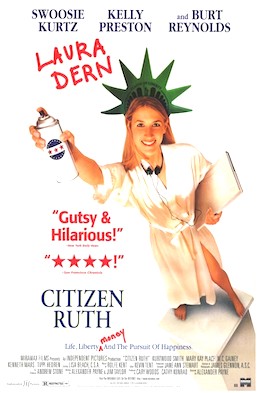
The document actually reminds me a lot of one of my favorite movies on the topic of abortion: Citizen Ruth (Payne, 1996). The movie satirizes both sides of the culture war, indicting both pro-life and pro-choice activists for their mutual failure to treat the women involved as actual human beings rather than pawns in a political battle. (There's a key scene toward the end where the two sides are so involved in screaming at each other about what is in Ruth's best interests that they don't notice her walking away from the whole mess.) In 1968 Evangelicals were the compassionate people writer-director Alexander Payne would one day challenge us to be with his film. But by the time he actually made his film in 1996, Evangelicals were just the butt of his jokes.

Tuesday, October 14, 2008

"Churches could lose their tax-exemption status."

It seems like every time I watch TV there's an anti-Prop 8 commercial on. (For those of you outside California, Proposition 8 is a voter initiative to amend the state constitution making same sex marriage illegal. This is in response to the recent state Supreme Court decision saying that the California constitution guarantees equal rights to same sex couples.)

Here is a link to the video. (I couldn't get it to embed in this post.) The ad is a point by point response to an earlier commercial for Yes on Prop 8 (embedded below):


Now, one claim from this ad sticks out to me: "Churches could lose their tax-exemption status." The "No On Prop 8" people ridicule this claim because the Supreme Court decision explicitly states that religions will not be affected. But I actually think that, while they are usually paranoid, the religious right is correct in their fears about this proposition. Why wouldn't the same sort of reasoning apply in the same sex marriage case that applied in the interracial marriage case when Bob Jones University lost their tax exempt status for their racial discriminatory policies?

I actually don't know what I think about this issue. I totally agree that Bob Jones's policies were evil. And I agree that the same-sex marriage issue is parallel. But I also think it was part of Bob Jones's religious freedom to keep the races segregated according to their (evil) fundamentalist doctrines. Maybe no churches should be tax exempt. But it seems wrong to dole out tax exemption in such a way that it pressures churches to violate their own religious teachings.

This issue reminds me of the issue of polygamy. Sometimes opponents of gay marriage argue that if we allow same sex couples to marry, there will be no stopping the slide down the slippery slope to allowing group marriage. Again, I think this is a place where the religious right is absolutely correct. But again, I'm not sure that it would be such bad thing to allow polygamous marriage. It was evil of the U.S. government to persecute the Mormon church for their marriage practices -- and it was even more ridiculous for the Mormons to change their doctrines in order to gain public acceptability. If the Mormon religion teaches polygamy, then it is their First Amendment right to practice polygamy.

For more reflection on polygamy, check out HBO's series Big Love, starring Bill Paxton as a man married to three wives. The show is a fascinating look at a variety of viewpoints on polygamy. It does not shy away from the dark side of polygamy as it is practiced in the fundamentalist Mormon "compounds" (forced marriage, pedophilia, incest, etc., not to mention repressive patriarchy), but the central characters' suburban polygamous family is surprisingly healthy. The show seems to be arguing that polygamy is not necessarily evil: if we brought polygamy out of the shadows of criminalization it could be made to work.

And the show's fundamentalist Mormon patriarch gives the best argument against Prop 8 I've heard: If we define marriage as the union between one man and one woman, then we criminalize many of our Biblical forefathers such as Abraham, Jacob, David, etc. In other words, the "traditional" definition of marriage does not seem to be limited to heterosexual monogamy.