Tuesday, March 10, 2009

"Eeny, meeny, miny, moe..."

Here's a parable of nihilism. There is a group of blind men trying to describe something they've been told is an "elephant". One says it is like a snake, another says it is like a spear, another a wall, a tree, a fan, and so on. But each of them, unbeknownst to the others, is actually empty-handed and is completely bluffing. None of them are holding anything, but all of them are pretending to describe something anyway so as not to look ignorant. The "elephant in the room" is that there is nothing there. There is no "elephant".

This is, essentially, the point of Gus Van Sant's film Elephant (Van Sant, 2003). Inspired by the Columbine massacre and other high school shootings, Elephant considers the question of why a teenager would one day murder a dozen of his classmates. The violence comes "out of the blue" (the opening and closing images are a blue sky) without warning or provocation. And Van Sant's suggestion is that the "elephant in the room" is that there is no explanation for the violence. This is just the kind of thing that happens in our world. Things are random and meaningless, hence the film's final lines: "Eeny, meeny, miny, moe..." The killers have no reason for what they do any more than anyone else does.

After the Columbine shooting, there was much speculation in the media about the causes of the killers' rampage. Was it the music they listened to or the video games they played? Was it their parents' fault? Were they bullied by their classmates? Elephant rejects those explanations. Each of the main characters has more reason to shoot up the school than the actual killers do. The other students have alcoholic parents, get punished unjustly by the principal, are made fun of by other students, are accidentally pregnant, etc. But only two of the students turn out to be homicidal. The fact that these students do murder their classmates is just as (and no more) inexplicable than the fact that the other students do not murder their classmates.

This inexplicability is mirrored in the film's camera work. Almost all of the film is shot in long tracking shots which follow students as they walk through the hallways of the school. This gives the film a restless, searching tone. But when the camera stops moving, something interesting happens. The camera stands still and lets the action happen around it without focusing on anything in particular. The best example is a scene on the football field early in the film.

The shot starts with the shy and nerdy girl Michelle staring unexplicably into the sky. She then walks off screen, but the camera doesn't follow her. The shot continues to show the field. In the background some students are playing football. They move on and off the screen, but the camera doesn't follow them. This continues for several minutes, an excruciating amount of time for nothing to happen in a movie. Since there is nothing to look at except the football game, we watch that, but the players keep disappearing. We feel that there must be something happening just off screen, but we can't see it. There must be more going on here that we don't know about. Finally a student in a lifeguard shirt walks by and we follow him into the school.

This feeling that there is more going on continues throughout the film. On screen, there is no plot, no story, nothing really happens. But we feel like there must be more going on than we can see, maybe off camera. The elephant in the room, however, is that there is nothing else. This is life as it is. This is life in its meaningless randomness. This is the nihilism of Elephant.

Saturday, March 7, 2009

"Historically, many of the greatest philosophers have argued that homosexual acts are morally objectionable."

I haven't posted for a while, because for the past month I've been deeply immersed in my dissertation. And it looks like I'll be at that for a couple more months still. But something happened that I thought I needed to share with you. I accidently signed a petition asking the American Philosophical Association not to penalize Christian colleges for discriminating against gays and lesbians in their hiring practices. Twice. I accidently signed the petition, and then I did it again.

Actually, I signed the petition on purpose, but I tried to attach a comment explaining that while I didn't agree with discrimination, I did agree that the schools had the right of religious freedom and if the schools had theological reasons for discrimination, then they should be allowed to hire whoever they wanted. But the comment function on the online petition didn't work. So now it looks like I support the cause without reservation. Oh well.

Here's a link to the petition. It's actually a counter-petition in response to a petition asking the APA to censure the Christian colleges. Here's a link to that original petition. As discriminatory schools, it specifically mentions "Azusa Pacific University, Belmont University, Bethal University, Biola University, Calvin College, Malone College, Pepperdine University, Westmont College, and Wheaton College", many of which I would love to work for, and two of which I have already worked for.

Anyway, here are my comments on the counter-petition -- the one I signed but don't entirely agree with:

This petition's distinction between act and disposition is compelling. It says "Institutions can require their faculty to agree to abide by ethical standards that forbid homosexual acts while not ipso facto discriminating on the basis of sexual orientation." In other words, they are not technically violating the letter of the APA anti-discrimination policy. This should be enough to allow these schools to avoid official censure.

At the same time this distinction is somewhat disingenious in that a job candidate at most of the schools in question who was open about having a "homosexual orientation" and did not "repent" of that orientation would be disqualified for the job -- even if he or she promised to remain celibate and to abstain from "homosexual acts". In other words, many of these schools really do discriminate on the basis of sexual orientation.

But for me this is an issue of religous freedom. As the petition points out, the discriminatory schools are simply "abiding by their long-standing and coherent ethical norms" -- despite the fact that, as I believe, their ethical norms have turned out to be false. Their position on homosexual acts is deeply grounded in their theological system such that they could not change their position without giving up their entire religious way of life. For that reason I believe these schools should have the right to discriminate based on sexual orientation.

This may or may not be a right we wish to reward with government funding (see my post on Prop 8), but a private organization such as the American Philosophical Association -- which was founded (according to the APA website) "to promote the exchange of ideas among philosophers, to encourage creative and scholarly activity in philosophy, to facilitate the professional work and teaching of philosophers, and to represent philosophy as a discipline" -- should allow for a diversity of moral viewpoints.

P.S. The petition's appeal to authority (quoted in the title of this post) is not exactly convincing. Most modern philosophers see appeal to authority as a logical fallacy. At the same time, it is fun to notice that many excellent philosophers have signed the petition. My favorite is Alasdair MacIntyre. Predictably all my Biola professors and collegues signed. Also: Peter Kreeft, Hugh J. McCann, Alvin Plantinga, Peter van Inwagen, Linda Zagzebski. Even my fellow Hume scholar Donald W. Livingston.

Thursday, February 12, 2009

“You’re working for me now.”


I currently live in Berkeley but Los Angeles is my home. So I never miss a chance to watch L.A.-themed movies. This week I watched for the first time To Live and Die in L.A. (Friedkin, 1985). It was a strange experience. For most of the movie I had the growing suspicion that the film was a piece of crap. It seemed like an utterly cliché cop buddy movie. All the characters speak in fake movie dialogue -- but dialogue that sounds silly, not cool like the fake movie dialogue in a Tarantino film. The alledged "hero" of the movie is an idiot who does all sorts of stupid and dangerous things that only movie cops do and would get real life police officers killed. More than that, the hero is a psychopath. He's beyond Dirty Harry. He's more like a Bad Lieutenant. But the film treats him in a typical heroic mode.... at least until the end.

The end of the movie caught me completely off guard. The hero just dies all of a sudden. And not in a big climactic shoot out or anything. The movie is going along like normal, and BANG, the guy dies. Then the movie goes along without him. It shouldn't be surprising that he dies since he's an idiot and a scumbag. If anything it should be suprising he lived as long as he did.

So the ending was like a Sixth Sense or Usual Suspects moment which sent me back to re-evaluate what I had seen earlier. A little Googling turned up a rather brillian essay that sheds light on the experience I had. It's a pretty long piece, so here are some quotes:

After nearly two decades of regarding To Live and Die in L.A. (1985) with a spectrum of emotions ranging from disdain-at-first-sight to qualified enthusiasm, it occurs to me that of all his works, this is the film I have watched and pondered most frequently. No longer do I see it as a shimmering piece of costume jewelry, but a forceful, semi-serious diagnosis of a prevalent human malady: the discrepancy between what we desire, or what we are pleased by, and what we claim to value, not only in life but in cinema. ...


[Director William] Friedkin redirects the modern cop thriller through the chartreuse time machine of noir, adorned with the MTV confections of Miami Vice, but his film emerges assomething far more nasty and authentic. ... To Live and Die in L.A. is also quite amusing, presumably intentionally, but possibly not. The humor is a conscious or unconscious byproduct of Friedkin’s love-hate relationship with the genre he plunders...


But once the superficialities are shunted aside, it becomes clearer that Friedkin’s film strives to deviate from the norm. Its hero is a corrupt man emblematized by a refusal to change, and his partner willingly swaps his morality for depravity. The villain, who murders only those who have betrayed orendangered his interests directly, is never as unlikable as the hero becomes. The protagonist, whose conduct leads to the death of innocent bystanders, is dispatched in the climax without a tear being shed. The hero’s obligatory “romantic interest” is at the very least a reluctant victim of coercion, and, conceivably, might qualify as a sex slave. And the voracious slickness that taunts Miami Vice (1984-1989) has, by film’s end, become the source of as much discomfort as pleasure. So this is not your ordinary cop thriller. ...


One of To Live and Die in L.A.’s persistent motifs is the creation and pursuit of phony things. As spectators grow to distrust the contradiction between what the film introduces itself to be and what it in fact is, they begin as well to question their own moral gullibility and aptitude in judging what is set before them. ...


I believe Friedkin is intrigued that we are so quick to take sides in a movie, and so easily manipulated to accept complexity as simplicity. This is likely why he adheres to the conventions of the buddy thriller—at times pressing them beyond credulity—before escalating what becomes a point-by-point repudiation of the devices used in such films to make spectators comfortable with dynamics that should not evoke comfort.

In the end, the essay's point is about self-deception, one of my favorite themes in cinema:

once we have agreed to stipulate that Chance is our hero, [Friedkin] wants, like a Judo master, to use the momentum of our own self-deception to flip us on our backs.
You can read the whole essay here at the website 24 Lies A Second.

Saturday, January 31, 2009

"I just try and refresh folks memory by way of illustration."

One of my favorite movies about filmmaking is The Five Obstructions (von Trier and Leth, 2003). It is a non-fiction film in which director Lars von Trier challenges his friend, fellow Danish filmmaker Jørgen Leth, to remake his 1967 short film "The Perfect Human" five times, each time under different constraints. For example, once Leth must remake the film with no shot longer than 12 frames (half a second), another time he must make the film as an animated cartoon. Each time Leth remakes the film, he approaches the same material from a slightly different angle thereby revealing a different aspect of the infinitely complex truth of the human condition.

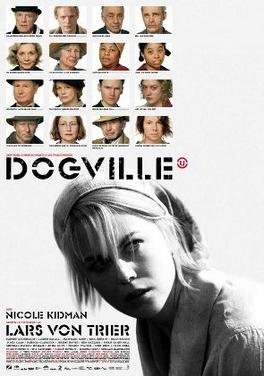
Today I was watching von Trier's own film from the same time period Dogville (von Trier, 2003), and it struck me that von Trier's entire English language career (his Danish language films are another story) has been a Five Obstructions-style series of remakes. Von Trier keeps remaking the same movie a female Christ-figure -- a pure-hearted woman who suffers unjust torments in order to save someone she selflessly loves. In Breaking the Waves, von Trier challenged himself to shoot the film in a hyper-realistic hand-held camera style; in Dancer in the Dark he remade the story as a musical; and in Dogville he remade the film on a single sound stage without any sets in the manner of Thornton Wilder's Our Town or a Bertolt Brecht play.

The strange thing is that Dogville ends quite differently than the previous films it is remaking. In the earlier films, the suffering woman is eventually killed but brings a kind of redemption through her death. These are clearly New Testament sort of stories. At first Dogville seems to be following the same narrative, but in its last ten minutes the story suddenly turns Old Testament: a God-like gangster shows up and convinces the film's Christ-figure to choose judgment over forgiveness. I'm not sure what to make of this. Is von Trier repudiating the earlier films? Or is he merely showing us another aspect of the infinitely complex truth?

At one point, the philosopher-novelist character says he is writing a story based on the events of the film. When he adds that he hasn't come up with a good name for the town yet, the heroine asks him why he doesn't just call it Dogville. He replies: "It wouldn't work. It's got to be universal." Well, if the movie we're watching is called Dogville, does that mean it isn't (and isn't intended to be) universal? So perhaps the point of the film is not to reject forgiveness and mercy entirely but to remind us that grace is not the whole story: there is judgment and justice, too. Rather than read Dogville as a critique of the Gospel narratives, perhaps we should read it as a retelling of the Sodom and Gomorah narrative: God sends an angel to the town but the people rape her and so God destroys the town. This isn't the prettiest story in the Bible, but it is still in there and must be reckoned with.

Starting from this reading it is tempting to see the film as von Trier's reaction to the terrorist attacks of September 11, 2001. (This was von Trier's first film made after 9/11.) Perhaps, like Jeremiah Wright and Jerry Fallwell, von Trier is interpreting the terrorist attacks as God's judgment on the United States. Especially in light of the closing credits which plays David Bowie's "Young Americans" over images of American crime and poverty, combined with the film's Prologue about the philosopher's attempt to teach the town a lesson about their inability to receive good gifts, von Trier seems to be saying that God has given the U.S. grace upon grace but we have not provided God's gifts with a hospitable place in which to live and bear fruit. And if we persist in our inhospitality we will face God's wrath.

Fortunately this is only one aspect of the infinitely complex truth. Instead of following the townspeople of Dogville, we might instead follow the selfless heroines of Breaking the Waves and Dancer in the Dark. We might choose to take the world's suffering on ourselves and to transform it into an opportunity for love.

Thursday, January 29, 2009

"Hand of God, that bible stopped a bullet."

This week I watched a couple of heist genre movies: Mission Impossible III (Abrams, 2006), and Heist (Mamet, 2001). It occured to me that heist movies suggest various positions on divine Providence.

In many recent heist movies, there is an elaborate, twist-filled plot which makes it seem that the robbers are facing various set-backs until in the final scene the criminals seeming complications are revealed to have been part of their plan all along. Perhaps the best classic example of this plot is The Sting (Hill, 1973). Recent examples include the Ocean's Eleven (Soderbergh, 2001) and Inside Man (Lee, 2006).

What is interesting about the two movies I saw this week is the way they deviate from the conventional plot. In The Sting et al, seemingly unforseen events occur throught the film, but the heroes turn out to have been in control of these events all along. These movies could be read as a symbol of Providence -- God is in control even if we can't initially see how. But in Mission Impossible III (actually in all three of the Mission Impossible movies), it turns out in the end that the villain -- not the hero -- was actually in control of the seemingly random events all along. This a pessimistic vision of a kind of dark Providence. More interestingly, in Heist there are real set-backs, though the heroes manage to be successful in spite of them. Here we have a world of real contingency where there seems to be no providence at all: genuinely random things happen of which no one is in control.

That writer-director David Mamet knows his film is dealing with (the lack of) Providence is seen in these lines, thrown away in a quiet moment in the middle of the film: "We knew this firefighter, this trooper, who always caried a bible next to his heart. We used to mock him, but that bible stopped a bullet. ... Hand of God, that bible stopped a bullet, would of ruined that fucker's heart. And had he had another bible in front of his face, that man would be alive today." In Mamet's world, shit just happens, and even miracles are random and meaningless.

Tuesday, January 27, 2009

"These are the fittest, well-fed, best-kept horses I've ever seen."

Recently actor Liam Neeson was a guest on The Daily Show With Jon Stewart. He was supposed to be there to discuss his new movie, but the interview ended up focusing on a local New York City political debate about the horses used to pull carriages around Central Park. Stewart maintains that animals "would rather run" freely than pull carriages and deserve "a better life" in a "pastoral existence". But Neeson argues that domestic animals like cows and horses have "been trained for thousands of years" to do this work and actually enjoy it. Neeson's suggestion is that domestic animals can actually be fulfilled by their work (when given humane working conditions) in the same way that humans can be fulfilled by their jobs.

I couldn't get the embed function to work, but you can watch the video here. (The relevant discussion starts at 1:40 and ends at 5:04.)

Neeson's view reminds me of C.S. Lewis's argument in The Problem of Pain that it is the human vocation to domesticate all animals. In contrast to what he calls “atheistical thought” which sees wild animals as natural and domestication as artificial, Lewis argues (based on God's command in Genesis 1:28 to "subdue" the earth and "have dominion" over the animals") that the tame animal is “in the deepest sense, the only ‘natural’ animal – the only one we see occupying the place it was made to occupy".

For a reconstruction of Lewis's view see my essay "Animal Pain and the Community of All Creatures" (esp. p. 10ff) available on my website.

Monday, January 5, 2009

"If you want more meaningful art, build a more meaningful world."

I found myself with some time to kill in a bookstore recently. Mostly I read philosophy and theology books, but brick-and-mortar bookstores rarely carry a very good selection of such books. I have to go to Amazon to find most of the stuff I'm looking for. So I often turn to the periodical section to kill my browsing time.

This time I ended up reading the Nov/Dec 2008 issue of Adbusters magazine. I've been a fan of the Adbusters anti-capitalist artwork (such as the image above), but I've never read the actual magazine. There were several really interesting articles in this issue.

The first one that caught my eye was about pop art (foreshadowed by Ducham's dadaism) as a critique of American capitalism's implicit nihilism. Author Sarah Nardi quotes Warhol as saying he "wanted to paint nothing" and Murakami as saying he tries to "express hopelessness." You can read the article here.

But a more thought-provoking article was "Virtual Morality" by Andrew Tuplin. Tuplin explores the phenomenon of violent video games such as Gand Theft Auto and amoral virtual worlds such as Second Life. These and other computer programs allow users to act out violent and sexually deviant fantasies.

Tuplin points out that the Enlightenment conception of morality (which most Americans have) is more or less libertarian: the purpose of morality is only supposed to allow us to pursue our own freely chosen goals while preventing us from hurting others in the process. In short, something is morally wrong only if it harms someone. And "harm" is defined as doing something against someone's will. Note that on this view it is conceptually impossible to "harm" oneself (as long as you are not acting out of some sort of confusion or insanity such as addiction). So for those with this conception of morality, there could be nothing wrong with acting out fatasies of rape, torture, pedophilia, etc. if these fantasies are simulated and do not harm any actual person.

Then Tuplin argues that religious ethics can provide an alternative to this view. According to Tuplin, religious ethics teaches that something is wrong if it offends God and that God is offended by our thoughts and desires as well as our actions. On this view, it is morally wrong even to want to rape or torture whether you act on those actions or not. So for those who have this conception of morality, there is no significant difference between virtual and actual behavior.

Now, I see what Tuplin is going for. The subtitle of his essay asks the question "Are we free to do anything we want in a virtual world, or are some things inherently wrong?" So he is attempting to reject the ethical view called "consequentialism" according to which something is wrong only if it harms someone. Instead he want to affirm a form of "deontology" according to which actions are inherently right or wrong regardless of their consequences. But he doesn't seem to understand that one need not be religious to affirm deontological ethics.
And he doesn't seem to understand that one need not hold to a divine command ethics in order to be religious. Historically, the majority of Christian theologians have rejected the sort of ethics Tuplin calls "religious". Indeed, I would argue that, it is logically incoherent to think that morality is based on what offends God.

But Tuplin is on to something when he says "The humanist or secular view of morality is concerned only with what we do. True religious morality is concerned not only with what we do, but with who we are, with what we desire to do." If we disregard his characterization of the two views as religious vs. secular, Tuplin has indeed given us a good alternative to Enlightenment ethics. The point is that for pre-Enlightenment views morality is as concerned with character as with behavior. (Note that this was the view of the Greek philosophers and is not essentially tied to religion.)

The important difference between this view and the Enlightenment view is that morality is not simply about preventing harm to others, but involves preventing harm to oneself. "Harm" on this view is doing something against an ideal, not simply doing something against one's will. This is a health model of morality. If you act in a way that is not healthy (i.e., it is not living up to the ideal of human nature), then you harming yourself and are acting immorally even if you don't harm anyone else.

This view gives us a way to criticize violent and sexually deviant fantasies: it is an abuse of one's own character to have immoral desires even if one never acts on those desires.