Wednesday, May 28, 2008

Nonviolent Heroes and the Failure of the Christian Imagination

Last year I went to a conference on “Faith, Film, and Philosophy” at Gonzaga University. I gave a paper on what Batman Begins can tell us about the nature of fear and the relationship between justice and revenge. (One of these days, I will post my thoughts about that film.)

One of the keynote speakers was my good friend Ralph Winter, producer of (among other things) the X-Men movies. He gave his standard lecture about advice on being a Christian in Hollywood. His two main points were: (1) Focus on quality filmmaking, not propaganda, (2) Don’t be afraid of dark subject matter since real life isn’t always G-rated.

Now, I don't deny that this is good advice. And I'm not criticizing my friend Ralph. But I do think Christians should be beyond this advice now. People have been saying this same stuff since the 1980s. The problem for Christian filmmakers today is no longer quality. Many of the student films I see at Biola University, Azusa Pacific University, and other Christian film programs are of a very high technical quality. The problem now is what kind of film do you make after you master the craft of filmmaking? Likewise with Ralph's second point. The problem is not being willing to show the darkness. Christian kids these days are really into that. (The class I taught on horror film at Biola was very popular.) The problem is how do you show the darkness truthfully and not just make the world look like a sick place beyond redemption?

The other keynote speaker at the Gonzaga conference was Thomas Hibbs, a philosopher from Baylor University. I highly recommend to you Hibbs’s book Shows about Nothing: Nihilism in Popular Culture from the Exorcist to Seinfeld. (A really nice interview with Hibbs can be found here. I am currently reading his follow-up Arts of Darkness: American Noir and the Quest for Redemption. I'll let you know how it is.) Hibbs argues that recent films have tended to “aestheticize evil”, making it look interesting if not necessarily attractive. He gives examples like The Exorcist, and The Silence of the Lambs. But, drawing on Hannah Arendt's idea of “the banality of evil”, Hibbs argues that these films misrepresent evil. Moreover, he argues that one reason this has happened is that our culture has lost the ability to make goodness interesting and attractive. Think about how much more interesting Batman is than Superman or Han Solo than Luke Skywalker.

I think this phenomenon is partly because, as Ralph Winter points out, real life heroes are not always perfect. But it is also because, as Thomas Hibbs points out, Christians have demonstrated a failure of imagination. We don’t know how to make goodness seem attractive.

This is related to a question Christian media scholar Bill Romanowski poses regarding The Passion of the Christ: “Why did the director have Jesus stand up to invite more scourging by the Roman soldiers? Is this historically accurate, a reflection of Gibson’s theology, or does it disclose a contemporary attitude?” (Eyes Wide Open: Looking for God in Pop Culture, rev. ed. p. 100). Romanowksi never comes right out and says it, but I think he is suggesting that this is a manifestation of Mel Gibson’s image of masculinity and heroism (compare Braveheart), an image formed more by macho American action movies than by scripture.

This line of thinking led me to ask my students at Biola, what would a truly Christian hero look like? How could you represent a hero with specifically Christian virtues of love, joy, peace, patience, kindness, goodness, faithfulness, gentleness, and self-control? In the context of Amerian cinema, would such a person be a hero or a wuss? Attractive or boring?

Hibbs is right: there has been a failure of Christian imagination. We have failed to imagine truly Christian heroes. The most Christlike movie heroes I can think of are actually Hindus and Buddhists: Think the title character in Gandhi, Li Mu Bai in Crouching Tiger, Hidden Dragon, and Ashitaka in Princess Mononoke. I might also mention Xander from the finale to Buffy the Vampire Slayer Season Six, and the title character from MacGyver. All of these heroes use intellect and compassion to disarm their enemies nonviolently and then either reconcile with them or at least bring them to (nonlethal) justice.

Can you think of any other examples? The Biola students hated this question and refused to participate in my discussion. Part of the problem was that I assumed that a Christian hero would be a pacifist. Having been indoctrinated into right-wing politics at their Orange County evangelical churches, the Biola students rebelled at my suggestion that Jesus wouldn't support war or killing, even in self-defense. (Somewhat shockingly, when I confronted them with Scriptural evidence of times when Jesus refused to use violence to protect himself from attackers, the students actually argued that we are not supposed to imitate Christ!) But surely we can all agree that peaceful resolution to conflict is better than violent resolution. So even if one wants to defend the just war theory point that Jesus could condone violence under certain circumstances, the fact remains that we need to do serious thought about how to make a movie about peace seem "cool".

And it is not just the question of heroes. The challenge of the Christian imagination arises in any number of cinematic genres: What would it look like to make a comedy that is not dehumanizing (i.e., that never asks us to laugh at someone's misfortune)? What would a romance look like that doesn't trivialize sex or reinforce repressive gender roles? What would an action movie look like that doesn't aestheticize or otherwise glorify violence? What would a "message movie" look like that respects its audience's intelligence and ethical autonomy (i.e., is not manipulative propaganda)? If there are no answers to these questions, I think we should conclude that Hollywood filmmaking and Christianity are incompatible. But I don't believe that. I trust that great Christian artists can solve these problems, if only they would bother to take theses issues seriously.

So let's engage our Christian imaginations, starting with the concept of a hero. How could we portray a hero who is both genuinely Christian and cinematically attractive? Any ideas?

Tuesday, May 27, 2008

“What does it matter? All is grace.”

The opening image of Diary of a Country Priest (Bresson, 1951) is of the eponymous diary. The book opens and we see a black ink blot that resembles a Jackson Pollock painting. This sheet is moved to reveal the words of the diary. The abstract “painting” turns out to be a blot sheet inserted between wet pages to keep the ink from bleeding onto other pages. But the accumulated image created by the words of the diary is an image of chaos and disorder. We see and hear the Priest writing the film’s first lines: “I don’t think I’m doing anything wrong in writing down daily, with absolute frankness, the simplest and most insightful secrets of a life actually lacking any trace of mystery.” The Priest sees his life as insignificant, just another accumulation of events that, when seen over time, only amount to a disordered ink blot. This theme of disorder returns when the priest’s friend Torcy says the job of a priest is to create order: “Keep order all day long, knowing full well disorder will win out tomorrow, because in this sorry world, the night undoes the work of the day.”

The theme of struggling for Justice and order recurs throughout the film. One of the Priest’s first duties is the funeral of a townswoman. Her husband says it is “only just” that he be allowed to bury his wife for free even though everyone is required to pay the same funeral fee. The Doctor says “I’m not one to go around babbling about justice. I don’t expect it for myself. From whom should I ask it? I don’t believe in God.” After the Doctor commits suicide, the Priest wonders about the state of his soul, and Torcy replies “God is the only judge. Dr. Delbende was a just man, and God is the judge of the just.” Chantal comes to him in anger about her father’s adulterous affair with her Governess and says “You know quite well all I ask is justice.” The Countess thinks God’s allowing her son to die was “unjust”.

But the Priest sees himself as a bad priest, unable to create the meaningful order he is called to. In the next scene after Torcy tells the Priest to create order, the Priest says “the simplest tasks are by no means the easiest”. The Priest is constantly criticizing himself for not praying enough, but Torcy tells him “you have the spirit of prayer”. What could this mean?

The Priest’s defining characteristic seems to be the stomach illness that will develop into terminal cancer by the end of the film. The illness prevents him from eating anything but bread and wine, leaving him weak and making the townspeople think he is a drunk. The doctor tells him his stomach problem is the result of his alcoholic mother drinking too much while she was pregnant. Clearly the illness is a metaphor for original sin, passed down from parent to child. And the only solution to the suffering caused by sin is the bread and wine of the Eucharist. But this is something the world will not understand: they will only see the Church as a bunch of hypocritical sinners, rather than a group of sin-sick pilgrims in search of the only medicine that can help them.

Indeed, the film seems to see the priest’s suffering as a sign of his closeness to God. After he receives the anonymous letter telling him to resign from the parish, the Priest stays up all night trying unsuccessfully to pray. He finally concludes “God has left me. Of this I am sure.” And the next scene reports “an incredible improvement in my health”. But the very next scene is the Doctor’s suicide. In response the Priest says “I have never suffered so much and likely never will again, even when I die.” The Priest’s emotional distress is presumably because he himself had considered suicide and the Doctor had told him “You and Torcy and I are of the same race, an odd race. … The race that holds on.” If the Doctor could not hold on, how could he? At the Doctor’s funeral, Torcy told him that the Doctor had “lost his faith, and couldn’t get over not believing”. It is this connection between himself and the Doctor that leads the Priest to suffer. But it is at this point the Priest says he realized he “had not lost my faith”. Apparently, the evidence of his faith and God’s presence is his suffering.

Later he has an epiphany when Torcy again discusses with him what it means to be a priest (or to have a “vocation”): “If you can’t pray, just repeat the words! Listen, I don’t think I’ve been wrong about you. Try to answer this. I’ve thought a lot about vocation. We’ve all received the calling, only not in the same way. And to simplify things, I try to put each of us in his place – in the Gospels. In short, I think – or I imagine – if our soul could drag this wretched body of ours back up that slope of 2,000 years, it would lead it straight to the very place where – ” He breaks off because the Priest is crying. The Priest tells us “The truth is that I always return to the olive grove [i.e., to the Garden of Gethsemane where Christ suffered his most emotional anguish while waiting to be crucified.] It was a very familiar and natural movement for my soul. I’d never realized it until that moment. Suddenly Our Lord had shown me grace and reveled through my old master’s lips that nothing would tear me from my chosen place in eternity. I was a prisoner of the Holy Agony”.

Note that the film’s first shot of the Priest is of his wiping his face (a sign of his physical frailty) and film shot immediately cuts to a shot of the Priest looking through the bars of a metal fence as if he were in prison, thereby establishing the metaphor of his suffering as prison. But note also that the Priest sees “prisoner” here is a good thing, something which keeps him from leaving God. His suffering is the evidence of God’s presence, not God’s absence. His suffering is a symbol of Christ’s suffering: by living, whether he prays or not, he is “repeating the words” of the Gospel. His life of suffering is itself his prayer.

He comes close to this insight earlier in the film when he counsels the Countess to “resign” herself to life’s suffering. The Countess is the first to bring up resignation. She says she is “resigned” to her husband’s infidelities. The Priest tells her it is wrong to send Chantal away, but the Countess doesn’t care about right and wrong: “God took my son from me. What more can he do to me? I no longer fear him.” The Priest replies that God only took her son “for a time” but that her “the coldness of your heart may keep him from you forever.” The Priest implies that the Countess loved her son too much and is allowing his death to come between her and God and hence will ultimately come between her and her son in the afterlife. She wonders how love can be bad, how it could ever separate anyone. Love “has it order, its law” that God himself is subject to since it is God’s nature to love.

Next the Priest points out sin’s ability to bring disorder into the world: “No one knows what can become of an evil thought in the long run. Our hidden faults poison the air others breathe. … I believe if God gave us a clear idea of how closely we are bound to each other in good and evil, we truly could not live.” She asks what is “this hidden sin?” and he replies “You must resign yourself. Open your heart”, implying that her sin is the desire to create order and justice. Rather than getting angry about the evil and disorder in the world, she must resign herself to it. She says, recalling the Doctor’s suicide, she is already resigned; otherwise she would have killed herself. He replies, “That’s not the resignation I meant.” What he wants is her to admit that she hates God for not bringing about what she sees as justice. As soon as she does this, he says “Now at last you are face-to-face. He and you. … You must yield to him unconditionally. … Say: Thy kingdom come, thy will be done.” She says can’t say this, because it would be allowing her son to be dead. But he replies, “The kingdom whose coming you have just wished for is yours and his”, recalling his earlier claim that “there isn’t one kingdom for the living and one for the dead. There is only the kingdom of God, and we are within it”.

Note that the Priest ends up doing exactly the opposite of what Torcy had originally said a priest’s job is: rather than bringing order into the Countess’s life, he gets her to give up the illusory desire for order. She says “an hour ago, my life seemed to me in order, each thing in its place. You have left nothing standing.” He replies “Give it to God just as it is.” When she objects that she is too proud, he says “Give him your pride along with everything else”, recalling his earlier claim that “to die is difficult, especially for the proud”. Eventually she is able to give up her hatred over he son, symbolized by throwing his picture into the fire. As she writes in her letter to the Priest, “I didn’t believe resignation was possible, and in fact it’s not resignation that has come over me. I’m not resigned – I’m happy. I desire nothing.” By giving up her desire for order in the world, she is able to find happiness, a kind of spiritual order within the external disorder. And this leads immediately to her death due to a heart problem, a metaphorical death to this world in order to achieve life in the next.

Later we find out that Chantal had spied on this conversation. But, while she had experienced the very same scene as the Priest, she had interpreted it very differently than the Priest did. When Torcy repeats Chantal’s claim that the Priest had “blackmailed” the Countess with eternal damnation, the Priest says “that’s your version of what happened. I could tell a different one.” Note that had earlier told the Canon (the Count’s Uncle, also a priest) “I don’t see how there could be any report of such a conversation”, suggesting that the truth is ineffable and any account would only be an interpretation.

It is this idea of alternate narratives that is the key to the opening shot of the ink blot sheet. The Priest does indeed share the same motto as the doctor: “face up to it”. But where the Doctor faced up to the disorder of life and interpreted it as a reason to commit suicide, the Priest faced up to the disorder of life and interpreted it as “grace”, the chance to live in “the Holy Agony”. So the Priest does have “the spirit of prayer” but that is because by resigning himself to a life of suffering, he turns his life into a prayer: the re-incarnation Christ’s passion. This is what it truly means to be a priest: to mediate the suffering of Christ to the world and vice versa. The Priest is right that “our hidden faults poison the air others breathe”, but he is also right that “we are bound to each other” in both “good and evil”. Hence the hidden virtue of our suffering purifies the air others breathe.

But this “war” (as Torcy calls it at the Doctor’s funeral), is a mystical and hidden war that requires proper interpretation to be revealed. The last shot of the film is a shadow of a cross that is meant to recall the opening shot of the ink blot. When looking at the diary and its account of the events of the Priest’s life, we might see the very same events as the image of disorder or we might see them as a reflection of Christ’s Holy Agony. The difference is whether we can achieve resignation and the desire for God’s kingdom to come. The film’s last line ought to be our response to the evil, disorder, and suffering in the world: “What does it matter? All is grace”.

Monday, May 26, 2008

"I Can Save You!"


The Feminarian's comments on my post about I Am Legend made me realize that I glossed over an ambiguity in the end of the movie. Just before writing my post, I had read the review from The Journal of Religion and Film. According to that review, it was the 1971 film version The Omega Man which first transformed the novel's protagonist Robert Neville into a Christ-figure by locating the cure in his blood and then having him sacrifice himself. I was thinking of that point when I emphasized the new film's treatment of Neville as a kind of messiah. As The Feminarian pointed out, this led me to forget the fact that it is the female zombie's blood which contains the life-giving cure in the recent version. Nevertheless, it remains true that Neville originally developed the cure by mixing his own blood with lab rats and only later injecting it into the female zombie.

The Religion and Film review argues that turning Neville into a Christ-figure is odd since the point of the original novel is that Neville is in fact unknowingly evil and is destroying innocent lives in search of an unnecessary "cure". I noted clues to this theme in the new movie -- clues made explicit in the DVD's alternate ending. Here I want to argue that the fact that the cure is ultimately found in the zombie's blood, complicates the Religion and Film analysis. It seems that the new movie is not necessarily, as the review argues, moving further in the direction of making Neville into a Christ-figure; rather, the new movie (even in the theatrical version reviewed by Religion and Film) may in fact be moving back toward the ambiguity of the original novel.

There are, then, a number of ways of reading the film: (1) As in the Religion and Film review, Neville may be read as a Christ-figure who sacrifices himself in the fight against evil and in whose blood the source of life is found; (2) Alternatively, Neville may be read as an anti-Christ who is himself evil and the zombie woman is the Christ-figure who suffers unjust torture, "dies" and is "resurrected" (after the first, failed cure treatment), and in whose blood the cure is found; (3) Or perhaps the point is that the cure for evil is ultimately found when Neville's blood is mixed with the zombie blood, suggesting, as in my original analysis, that God is found in our relationship with others.

My preferred reading is (3). What is interesting is that, in the theatrical version, Neville doesn't realize the importance of learning to live in peace with the zombies -- he simply blows himself up, taking as many of them with him as possible. If, as I suggested in my original post, we are to take the film as some sort of statement about the war on terror, the implication becomes that America's insistence on seeing the entire Arab world as "evil" and in need of a western imposed "cure" is the moral equivalent of a suicide bombing. Neville is a self-proclaimed Messiah, shouting at his enemies, "I can save you!" and wondering why they continue to try to kill him. Perhaps the movie wants us to see George W. Bush in Neville's role.

Or am I completely off? Any additional ideas on how to read this movie?

Sunday, May 25, 2008

"Go, Speed, Go!"

Last night I saw a misunderstood cinematic masterpiece: Speed Racer (The Wachowski Brothers, 2008). It's gotten really bad reviews, but I had more fun at Speed Racer than I have had in years.

In the opening sequence, the filmmakers teach us how to watch this movie. We see the young Speed Racer daydreaming in school about race car driving, but his imagination is represented as an image of himself among his own childlike drawings of cars: Speed is inside a cartoon. And that sums up the movie. It's a cartoon with live action people inside it. (There is a similar sequence later with Speed's little brother Spritle imagining himself inside the cartoon he is watching on TV.)

As a cartoon, then, many of the criticisms of Speed Racer miss the mark. I don't even bother to take seriously the complaints of old people who got a headache from the movie or thought it was edited too fast. People said the same things about Star Wars 30 years ago, and now that movie actually seems pretty slow! It seems like a better criticism that the movie's philosophy (the same kind of anti-corporate neo-Marxism as discussed in my post on The Matrix) is simplistic and obvious. But once you realize that Speed Racer is a cartoon, this criticism evaporates. You don't watch a 30s screwball comedy and complain that there is not enough kung-fu in it; and you don't watch a cartoon and complain that its characters and message are too black-and-white (or in primary colors, as it were). I actually found the moral clarity of the movie refreshing. Exposing us to moral ambiguity is an important function of art, but we do need heroic role-models, too.

So Speed Racer is doing the same sort of thing The Matrix was doing. But whereas The Matrix was a live action version of anime movies directed at an older teen audience (most notably Ghost in the Shell), Speed Racer is the kind of cartoon we watched in elementary school (a point that's hard to miss with all of Spritle's talk of "cooties"). I've heard Speed Racer compared to movies like Dick Tracy and Sin City, (neither of which, by the way, are nearly as cinematically creative and interesting as Ang Lee's Hulk -- another misunderstood masterpiece -- which recreates not only the look of a comic book but also the experience of reading one), but those comparisons seem wrong. Both of those movies were based on print comics while The Matrix and Speed Racer are based on animation. (It is significant that the opening sequence of Speed Racer has the young Speed drawing his own flip book animation. It is in that cartoon that he imagines himself. Later, the walls of the Grand Prix race track are decorated with zebra images which seem to be animated when seen from the drivers' perspective. This is an homage to a 19th Century animation device called a zoetrope.)

In some respects, Speed Racer is doing the same sort of thing attempted by the recent Disney musical Enchanted (Lima, 2007) -- but without the irony. I actually found Enchanted unwatchable. Playful intertextuality is one thing, but Enchanted was just too cynical for my taste. The film assumed that we wouldn't be able to enjoy an old-school fairy tale cartoon without a heaping helping of cinematic deconstruction. I realize that the movie was ultimately trying to help us get back the childlike innocence that allowed us to love the original Disney princess cartoons, but its mode of referencing earlier movies was too ironic and made it impossible to take the movie seriously. Indeed, that's exactly the problem: it didn't take itself seriously enough. The problem is not that it was a comedy; the problem is that, in Disney terms, Enchanted didn't "believe in itself" -- so how could I believe in it? I don't need to be winked at in order to enjoy fairy-tale romance.

Contrast Enchanted with postmodern satires like Scream and Starship Troopers which manage to work both as a spoof of a particular genre as well as an actual example of that genre. (Shrek might fit in this category, too.) In other words, Scream is a spoof of a horror movie while at the same time, still being a horror movie -- as opposed to Scary Movie which is just a spoof. This is a fine line to walk, and how exactly these movies pulled off this cinematic miracle is unclear to me. What is clear is that Enchanted didn't know the same trick.

There are, however, other recent movies which do manage to succeed in the way Speed Racer does. Consider Baz Luhrmann's Moulin Rouge! and Quentin Tarantino's Kill Bill movies. These movies speak in a different voice than the postmodern satires like Scream and Starship Troopers. Instead of spoofs, here we have hyper-real "movie movies" as Tarantino calls them -- taking stuff that "only happens in the movies" and then turning it up to 11. These movies reference earlier movie clichés and (especially in Tarantino's hands) even deconstruct them, but they manage to do this lovingly and without "winking" and so without the irony of a spoof -- irony which in the case of Enchanted ends up draining the magic from a genre we loved as kids (and, indeed, still love). An older movie that also succeeds along these lines is The Coen Brothers' The Hudsucker Proxy, but, of course, the godfather of this style is George Lucas whose Star Wars and Raiders of the Lost Ark first showed us how it is done. Not every movie should be like this. But, boy, are these movies fun when done right.

Saturday, May 24, 2008

"Light up the darkness."

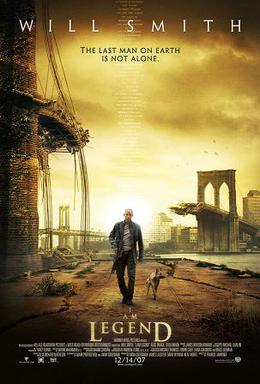
I am Legend (Lawrence, 2007) finally made its way to the top of my Netflix queue this week. I didn't really care if I ever saw it, but my wife thought it sounded good. Ironically (or maybe due to our various levels of expectation), she ended up thinking it was really boring and too slow, and I ended up thinking it wasn't too bad.

I liked the slow, quiet parts of the film that explored the psychology of Will Smith's character Robert Neville. I haven't read the original novel, and I haven't seen the Charleton Heston version The Omega Man (Sagal, 1971), so I couldn't be disappointed in how unfaithful the film was to the earlier versions. And, sure, the special effects are bad and the zombies look like computer generated cartoon characters, but that kind of thing doesn't bother me. I'm more interested in story, character, and theme. So I was pleasantly surprised to find out that the film was about one of my philosophical interests: the problem of evil. Unfortunately, I'm not sure the movie has much to say of philosophical interest.

The movie sets up the problem in its starkest form. When he finally meets another human survivor, Anna, who claims to have been led to him by God, Neville responds by rehearsing the havoc wreaked by the zombie-creating Krippen Virus: "Let me tell you about your 'God's plan'. Six billion people on Earth when the infection hit. KV had a ninety-percent kill rate, that's five point four billion people dead. Crashed and bled out. Dead. Less than one-percent immunity. That left twelve million healthy people, like you, me, and Ethan. The other five hundred and eighty-eight million turned into your dark seekers, and then they got hungry and they killed and fed on everybody. Everybody! Every single person that you or I has ever known is dead! Dead! There is no God!"

Anna wants to take Neville to a colony of survivors, but Neville doesn't believe there is any such colony. Not only is there no God, there are no other humans: we are utterly alone in the universe. But at the climax of the film, Neville does indeed hear the voice of God telling him to sacrifice himself to save the world. He becomes so obvious a Christ-figure that it is literally his blood which will provide the cure to the virus. Then Anna takes the cure to the colony of survivors, giving them hope for the future.

So what's the point? Is it simply that we should not give up hope? That we should have a kind of blind faith that there is a God, that God has a plan, and that we are not alone? Whatever the message of the movie is, it seems to be summed up by Neville's speech about reggae musician Bob Marley: "He had this idea. It was kind of a virologist idea. He believed that you could cure racism and hate — literally cure it, by injecting music and love into people's lives. One day he was scheduled to perform at a peace rally, gunmen came to his house and shot him down. Two days later, he walked out on that stage and sang. Somebody asked him 'why' he said: 'The people that are trying to make this world worse are not taking a day off — how can I? — Light up the darkness." Again, the point seems to be that we should keep the faith and continue to fight the good fight in spite of the fact that, to all appearances, we are making no difference. It's a rather traditional theodicy.

Note the line about "the people that are tyring to make this world worse". Combined with the fact that this movie takes place in New York City which Neville refers to as "ground zero", this seems to be a reference to the war on terror. Interestingly, there may be a critique here of the Bush administration's characterization of the terrorists as people who "hate freedom" and want to destroy civilization. When Neville kidnaps a female zombie to use as a guinea pig for his anti-virus research, a male zombie risks his life to save the female. Neville rather obtusely interprets the event this way: "Behavioral note - an infected male exposed himself to sunlight today. Now it's possible decreased brain function or growing scarcity of food is causing them to ignore their basic survival instincts. Social de-evolution appears complete. Typical human behavior is now entirely absent." Of course, what's really going on is that the zombies are not entirely inhuman monsters but have genuine love for one another. (This theme is made explicit in the alternate ending to the film, available on the DVD's bonus disc.)

At another point, Neville refers to the fact that the zombie virus was a product of human technological experimentation gone wrong: "God didn't do this, we did." This line serves both to reinforce the traditional theodicy (by presenting evil is a result entirely of human sin and free will) as well as to suggest again a liberal viewpoint on terrorism (by implying that terrorism was in fact cultivated by America unjust foreign policies and cultural imperialism).

Whichever interpretation we emphasize (whether the reading of Neville as a Christ-figure battling absolutely evil zombies or the reading according to which both sides are morally ambiguous), the point seems to be the same: God is found in our relationships with others. It is when Neville is absolutely alone that he falls into despair about the death of God. But when he meets Anna, he learns again to hear God's voice (significantly, through a memory of his daughter's voice). And what is God's voice telling us? In the words of Neville's daily radio broadcast, "You are not alone. There is hope." In the words of Bob Marley, we can "light up the darkness" by spreading human love like a virus.

As an answer to the problem of evil, it's not terribly deep or original. But it's not entirely wrong, either.

Friday, May 23, 2008

Just For Fun: Derrickson's Remakes

Mentioning Scott Derrickson's The Exorcism of Emily Rose in yesterday's post reminded me of a humorous idea I had the first time I saw the movie. It occurred to me that Scott Derrickson is remaking the great theological movies as horror movies.

Scott's USC master's thesis Love in the Ruins (1995) was fairly obviously a remake a Wings of Desire (1987) except with demons whispering despair into people's ears instead of angels whispering hope. Less obviously, his first feature film, the direct-to-video Hellraiser: Inferno (2000) was a remake of Bad Lieutenant (1992). Both films are about corrupt, drug-addicted, women-abusing, cops whose investigation of a disturbingly evil crime forces them to face their own evil -- except that in Scott's film, the cop ends up haunted by demons and damned to Hell rather than receiving the moment of redemptive grace which the original film's protagonist experiences. Finally, Scott's first major studio release The Exorcism of Emily Rose (2005) was a remake of Breaking the Waves (1996). Both films are Kierkegaardian fables about a devout and innocent young woman who may or may not have heard God's voice telling her to sacrifice her own life in order to participate in humanity's redemption through suffering -- except Scott's version has (what else?) demons.

I can't wait to see what he'll do with his upcoming remake of The Day the Earth Stood Still (due Christmas 2008). Maybe, since this movie is already a remake, it will break the pattern. Or maybe Scott will find a way to secretly make it a remake of The Seventh Seal (1957). Or, since the theological films he borrows from are usually only about 8-9 years old at the time of his remake, and since The Day the Earth Stood Still will star Keanu Reeves, maybe Scott's subtext this time will be . . . The Matrix (1999)???

Thursday, May 22, 2008

The Symbolism of Evil

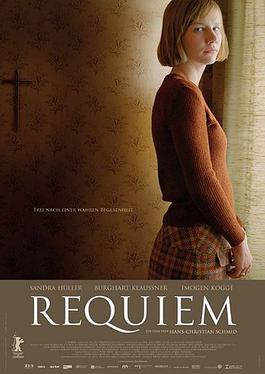
Recently there were two movies made based on the life of Anneliese Michel, a German college student from the 1970s who claimed to be possessed by a demon. My fellow Biola University alum Scott Derrickson updated the story to 2000s era America in his horror genre film The Exorcism of Emily Rose (Derrickson, 2005). German filmmaker Hans-Christian Schmid made a more straightforward dramatic biography of Anneliese in Requiem (Schmid, 2006). The result was a far more subtle and interesting film. (Sorry, Scott!)

Derrickson’s movie is set up as a courtroom investigation which asks us to decide whether we think Emily is really possessed or not. Requiem is not interested in that question. In fact the film seems to assume that the girl (in this version called Michaela) is not really possessed. Indeed, it seems to assume that she knows she’s not really possessed. Instead, the film asks us why, if she knows she is simply sick and not really possessed, she would go along with her mother and priest’s exorcism scheme? The answer the film suggests is that she wants to recontextualize the meaning of her suffering. If she is simply sick, then her suffering is random and meaningless; but if she is possessed, then she is a martyr.

Once Michaela interprets her own life through the lens of St. Catherine, her own favorite saint, she is able to accept her suffering with peace. Prior to this, she is “ashamed” of her illness, and wants to be a normal kid. The “voices” she hears are her mother’s voices telling her she is a “slut” and that she is not capable of going to college. But when she first attempts to interpret these feelings as demonic possession, her liberal priest tells her that the Devil is only a symbol and recommends she seek medical attention. Then, when, the stress of school almost prevents Michaela from completing the first semester, and her boyfriend wonders if maybe college is not the best place for her, she realizes her mother will be proven right. She begins to give herself over to her symptoms in order to press the possession interpretation, and to show that it is not her weakness that is preventing her success but the Devil. Hence the movie suggests one use of the symbolism of evil is to allow us to create a meaningful narrative out of our suffering.

Note that on this interpretation the film is not necessarily arguing the liberal point that the Devil is just a symbol. The film’s view that Michaela is using the Devil as a symbol is compatible with the conservative Christian view that the Devil is also literally real and can possess other people. More likely, however, the film is making a post-liberal point: it is the Devil oppressing Michaela – in the form of her mother’s criticism (and to a lesser degree in the form of her physical handicap). In other words the Devil is a symbol, but the Devil is not just a symbol, because symbols have their own kind of reality and so no symbol is just a symbol.

Question: I haven't read Paul Ricoeur's The Symbolism of Evil, but from what I understand my reading of Requiem is similar to the kind of thing Ricoeur is doing in that book. Does anybody out there have any insight on this?